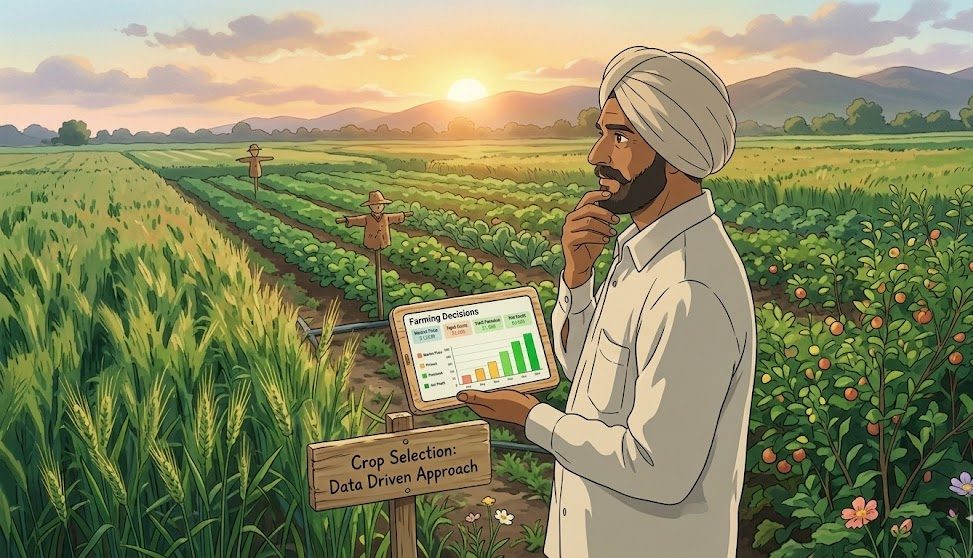
Did you know that according to agricultural market data, the price of a single hectare of specialty saffron can yield up to ten times the revenue of a hectare of traditional wheat? It is a staggering statistic that highlights a harsh reality: many farmers work tirelessly only to break even because they are planting for tradition rather than for the market. The “Challenge” is that agriculture is no longer just about growing food; it is a high-stakes game of supply and demand where a single wrong choice in the spring can lead to financial ruin by autumn.
The “Pain Point” for most growers is the “Commodity Trap”—growing low-value crops that require massive acreage to turn a profit. The ultimate solution lies in Strategic Crop Selection, a methodology that balances biological suitability with market intelligence. This article serves as your professional roadmap to financial freedom in farming. You will learn the core fundamentals of crop-market alignment, the measurable benefits of high-value niche farming, and a practical guide to choosing the right crops for your specific land and lifestyle.
Understanding Strategic Crop Selection: Key Concepts and Importance
Strategic crop selection is the practice of matching your land’s biological capabilities with the current and future demands of the marketplace. Historically, farming was localized; you grew what your neighbors grew. Today, however, importance is placed on Agro-Economic Zoning—the science of identifying which high-value crops will thrive in your specific climate while filling a gap in the supply chain.
Think of choosing your crops like Building a Stock Portfolio. If you put all your money into one stable but low-growth “blue-chip” stock (like corn), you will have safety but very little growth. If you diversify with “High-Growth Tech Stocks” (like medicinal herbs or gourmet mushrooms), your potential for high profit sky-dives.
Technical parts like Growing Degree Days (GDD) and Soil Cation Exchange Capacity (CEC) act as the “financial metrics” of your farm. GDD tells you if you have enough heat to finish a crop, while CEC tells you if your soil can “hold” the nutrients those high-value plants need. By understanding these fundamentals, you move away from “Hope-Based Farming” toward “Evidence-Based Investing.” This ensures that every seed you buy is a calculated move toward a higher profit margin.
Why It Matters: The Top Benefits of Choosing the Right Crops
Choosing the right crops transforms your farm from a place of labor into a high-performance business engine. Here is why strategic selection is the most important decision you will make:
- Drastic Increase in Net Profit: By targeting niche markets—such as organic microgreens or heirloom tomatoes—beginners can see profit margins of 200% to 500% higher than commodity grains.
- Reduced Dependency on Subsidies: High-value crops often bypass the volatility of government-regulated markets, allowing you to set your own prices based on quality and brand story.
- Risk Mitigation through Diversification: Planting a mix of “Cash Crops” (quick turnover) and “Legacy Crops” (long-term value like fruit trees) ensures that a single pest or weather event doesn’t wipe out your entire income.
- Resource Optimization: Some high-profit crops, like lavender or garlic, require significantly less water and fertilizer than thirsty crops like alfalfa, lowering your overhead costs.
Pro Fact: In the current global market, niche organic produce is growing at a rate of nearly 12% annually, far outpacing the 2-3% growth seen in conventional commodity agriculture.
How to Get Started: A Practical Guide for Beginners
Transitioning to high-profit farming requires a disciplined approach. Follow this 5-step actionable plan to choose your winning crops:
Step 1: Conduct a Market Gap Analysis
Visit your local farmers’ markets and high-end restaurants. What is expensive? What is always sold out? Identify 3-5 crops that people want but can’t easily find. Market demand should always dictate your planting list.
Step 2: Perform a “Biological Audit”
Test your soil and check your “Plant Hardiness Zone.” Don’t try to grow vanilla beans in a temperate climate just because they are expensive. Your crops must be Biologically Compatible with your land to ensure high yields.
Step 3: Calculate the “Time-to-Market”
Choose a mix of crops. Short-Cycle Crops (like radishes or lettuce) provide quick cash flow, while Medium-Cycle Crops (like peppers or tomatoes) provide bulk revenue in the summer.
Step 4: Analyze the Supply Chain
How will you sell it? If you are far from a city, choose crops that are easy to transport or store (like dried herbs or onions). If you are near a city, focus on highly perishable, high-value items (like berries or microgreens).
Step 5: Start with a “Trial Plot”
Before committing your whole farm, plant a 5% “Test Patch” of your chosen specialty crop. This allows you to learn the specific pests and quirks of the plant without risking your entire financial stability.
Beginner’s Tip: Avoid “Trend Chasing.” Just because everyone is talking about hemp or goji berries doesn’t mean you should plant them. Look for Consistently Expensive crops rather than “Viral” ones.
Overcoming Challenges and Looking into the Future
The biggest hurdles in choosing high-profit crops are Market Access and Initial Learning Curves. High-value crops often require more specialized knowledge than corn or soy. To solve this, many successful farmers are using Digital Marketing to sell directly to consumers, bypassing the middleman and keeping 100% of the profit.
Looking into the future, we are moving toward Predictive Market Analytics. We are seeing the rise of AI tools that can tell a farmer what the price of a specific vegetable will be six months from now based on global planting data. We are also seeing the rise of Vertical Farming and Hydroponics, which allow you to choose crops based entirely on price, as the “weather” is controlled inside a building. The trend is moving toward “Hyper-Specialization”—farmers becoming “Gourmet Mushroom Experts” or “Heirloom Seed Specialists.”
Conclusion
Choosing the right crops is a journey from being a “price-taker” to a “price-maker.” By balancing the biology of your soil with the demands of your local economy, you can build a farm that provides not just food, but true wealth. The core message is simple: Don’t plant what is easy; plant what is Valuable.
Call to Action: This weekend, visit three local grocery stores and write down the five most expensive items in the produce section.
Research if those crops can grow in your soil. Your journey toward maximum profit starts with the data you gather today. Embrace the strategy, and watch your farm—and your bank account—flourish.
Frequently Asked Questions (FAQs)
1. What is the most profitable crop per acre? Currently, specialty mushrooms, saffron, and microgreens are among the highest-earning crops per square foot due to their high market price and quick turnover rates.
2. Can I make a profit on just one acre of land? Yes. By focusing on High-Intensity, High-Value crops like flowers or medicinal herbs, a single acre can produce more revenue than fifty acres of commodity corn.
3. Is it better to grow organic? In many cases, yes. Organic certification allows you to access a premium market where customers are willing to pay 30-50% more for the same crop.
4. How do I know if a new crop will grow in my soil? The only way to be certain is to perform a Professional Soil Test and cross-reference your results with the specific pH and nutrient requirements of that crop.