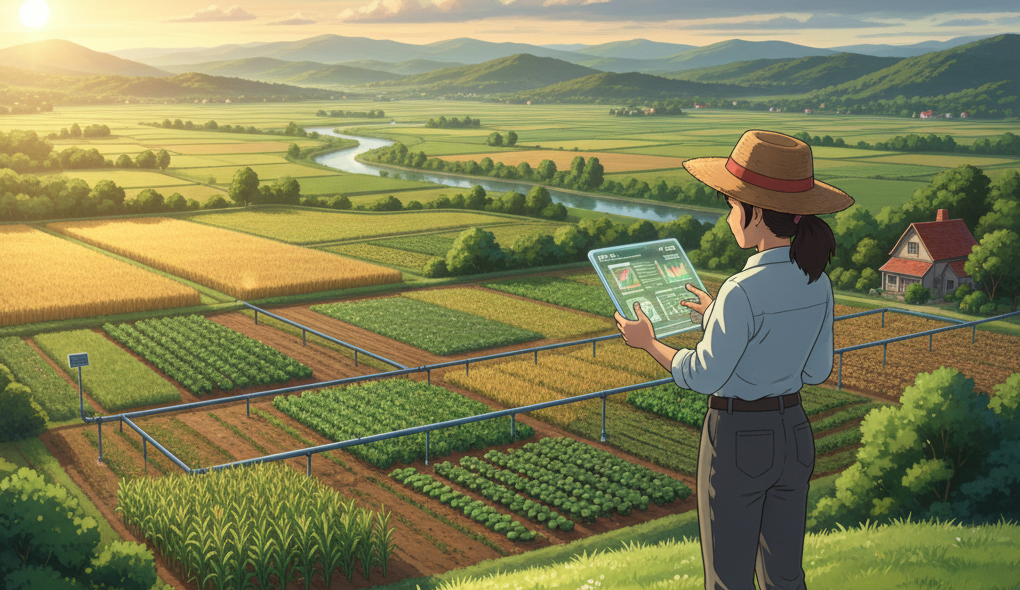
What if I told you that nearly 50% of new agricultural ventures fail within their first five years? It is a staggering statistic that highlights a harsh reality: growing crops is a biological feat, but growing a farm is a business challenge. Many passionate growers find themselves trapped in a cycle of “survival farming,” where they work harder every year only to break even, battling rising input costs and the unpredictable whims of a changing climate.
The primary “Pain Point” for modern farmers isn’t a lack of effort; it is the absence of a scalable, strategic framework. The “Challenge” is moving from manual daily labor to a system-driven operation that thrives even when the owner isn’t in the field. The ultimate solution lies in Smart Growth Strategies—the integration of financial literacy, ecological intelligence, and technological leverage. This article provides a comprehensive roadmap for scaling your farm. You will learn how to optimize your operations, diversify your revenue streams, and build a resilient brand that ensures long-term success.
Understanding Farm Growth: Key Concepts and Importance
Farm growth is often misunderstood as simply “buying more land.” In the modern context, growth is about Vertical Optimization and System Resilience. Historically, farming was a game of horizontal expansion—more acres meant more money. However, in an era of land scarcity, smart growth focuses on increasing the “margin per square foot” rather than just the “number of acres.”
Think of your farm as a Biological Factory. In a poorly managed factory, the machines (the soil and plants) are frequently breaking down, the workers are exhausted, and the inventory is wasted. Smart growth is like installing an Advanced Operating System into that factory. It’s about creating “Standard Operating Procedures” (SOPs) for everything from seed starting to post-harvest packaging.
This modern relevance is driven by the “Value-Added” economy. Farmers are no longer just price-takers in a commodity market; they are CEOs of a complex supply chain. Understanding the difference between Gross Income (what you sell) and Net Profit (what you keep) is the fundamental concept that separates a struggling farm from a thriving enterprise.
Why It Matters: The Top Benefits of Smart Farm Scaling
Scaling your farm using smart strategies offers far more than just financial gains. It transforms your lifestyle and your environmental footprint:
- Financial Stability through Diversification: By growing multiple crop varieties and offering services (like farm tours or workshops), you ensure that if one crop fails, your entire income doesn’t disappear.
- Operational Freedom: Implementing systems allows you to delegate tasks. This reduces burnout and gives you the time to focus on “high-level” business growth rather than just weeding.
- Environmental Stewardship: Smart growth often utilizes Regenerative Agriculture. This builds organic matter in the soil, which acts as a natural insurance policy against drought and erosion.
- Brand Equity: A farm that grows strategically builds a recognizable brand. This allows you to charge a premium price because customers trust your quality and your story.
Pro Fact: Farms that utilize data-driven management software see an average increase in operational efficiency of 20% within the first two years of implementation.
How to Get Started: A Practical Guide for Scaling
Scaling a farm requires a transition from being a “doer” to being a “director.” Here is your 5-step actionable plan for long-term success:
Step 1: Audit Your Current Efficiency
Before you grow, you must fix the “leaks.” Track your labor hours and input costs for every crop. Identify which crops are actually profitable and which ones are “vanity crops” that look good but lose money.
Step 2: Invest in Scalable Infrastructure
Focus on tools that multiply your time. A Modular Irrigation System that can be expanded easily or a Walk-Behind Tractor with interchangeable implements are better investments than specialized, one-off machinery.
Step 3: Formalize Your Sales Channels
Move away from “hope-based marketing.” Secure your income by establishing a CSA (Community Supported Agriculture) program or signing seasonal contracts with local boutique grocery stores and restaurants.
Step 4: Master the Art of Value-Adding
Don’t just sell tomatoes; sell roasted tomato sauce. Don’t just sell lavender; sell essential oils. Value-Added Products have a longer shelf life and significantly higher profit margins than raw produce.
Step 5: Build a Lean Team
As you grow, you cannot do it all. Hire for your weaknesses. If you love growing but hate accounting, hire a part-time bookkeeper. Building a small, dedicated team is the only way to achieve true scale.
Beginner’s Tip: Start with “Soft Scaling.” Instead of buying more land, try to increase the yield and efficiency of your existing plots by 15% through better soil management and tighter planting schedules.
Overcoming Challenges and Looking into the Future
The journey to growth faces two major hurdles: Capital Access and Climate Uncertainty. Accessing loans for small-scale farms can be difficult; however, many successful farmers solve this through “Bootstrapping”—reinvesting 100% of their early profits back into the farm—and utilizing government grants for sustainable practices.
To combat climate uncertainty, the future trend is Climate-Adaptive Farming. This includes the use of Biochar to improve soil water retention and the installation of Agrivoltaics (placing solar panels over crops). In the next decade, we will see the rise of “Hyper-Local Distribution Hubs,” where small farms use AI to coordinate their harvests and supply entire cities, competing directly with industrial agriculture.
Conclusion
Farm growth is not an accident; it is the result of deliberate, smart choices. By focusing on operational efficiency, diversifying your income, and treating your soil as your most valuable capital, you move from the stress of survival to the security of success. The core message is clear: The most successful farmers are those who grow their business skills as much as they grow their crops.
Call to Action: This month, choose one manual task on your farm—like watering or record-keeping—and find a way to automate or systematize it.
Step out of the field and into the office for one hour a day; that hour will be the most profitable part of your journey. Your legacy as a successful grower starts with the strategy you build today.
Frequently Asked Questions (FAQs)
1. When is the “right time” to expand my farm’s acreage? Only expand when your current land is at 80% or more of its maximum efficiency. If you are still losing money or struggling with weed management on one acre, buying a second acre will only double your problems.
2. Is technology necessary for a “small” farm? Yes, but it doesn’t have to be expensive. Technology can be as simple as a free spreadsheeting app to track planting dates or a solar-powered irrigation timer. It’s about using tools to save time.
3. How do I choose which “Value-Added” product to create? Look at your “waste.” If you have a surplus of slightly bruised fruit that can’t be sold fresh, that is your perfect candidate for jams, dried fruit snacks, or fermented products.
4. What is the most important skill for a farm owner? Adaptability. The market, the weather, and consumer tastes change constantly. The ability to pivot your strategy based on data and observation is what ensures long-term survival.