Did you know that nearly 40% of global crop production is lost annually to pests, diseases, and post-harvest mismanagement? It is a staggering statistic that keeps many farmers awake at night. The “Challenge” is that agriculture is a 365-day commitment where the stakes change with every shift in the wind and every drop in temperature. For the modern grower, the “Pain Point” is no longer just about hard work; it is about the paralyzing uncertainty of what to do when the seasons don’t follow the old rules.
The ultimate solution lies in Seasonal Strategic Planning. This is the art of aligning biological cycles with data-driven management. Instead of reacting to problems as they arise, a seasonal guide allows you to anticipate them. This article serves as your comprehensive roadmap to year-round agricultural success. You will learn the core fundamentals of seasonal crop cycles, the tangible benefits of a structured farming calendar, and a practical guide to implementing high-yield practices from the first thaw of spring to the deep sleep of winter.
Understanding Seasonal Crop Farming: Key Concepts and Importance
Seasonal crop farming is the strategic management of a farm’s activities based on the Phenological Stages of plants and the shifting climatic conditions of the year. Historically, farming was a rhythmic tradition passed down through oral history. Today, however, importance is placed on Agrometeorology—the science of how weather affects soil and crops.
Think of seasonal farming like a Grand Symphony. In a symphony, the violin doesn’t play the whole time, and the drums only enter at specific moments. If the drums come in too early, the music is ruined. Similarly, if you apply nitrogen too late in the season, you don’t get bigger fruit; you just get excessive leaves that attract pests.
Technical parts like Growing Degree Days (GDD) serve as the “metronome” for this symphony. GDD is a measure of heat accumulation used to predict when a crop will reach maturity. By understanding these fundamentals, you move away from “calendar-based” farming and toward “Climate-Responsive” farming. This ensures that every action—whether it’s tilling, planting, or harvesting—is performed at the exact moment the biological window is open, maximizing the efficiency of your land and labor.
Why It Matters: The Top Benefits of Seasonal Guides
Following a disciplined seasonal guide transforms a chaotic farm into a predictable, profitable enterprise. Here is why structured planning is essential:
- Optimal Resource Allocation: When you know exactly what each season requires, you can buy seeds and fertilizers in bulk during the “off-season,” saving up to 20% in capital costs.
- Minimized Pest and Disease Pressure: Many pests follow strict seasonal cycles. By adjusting your planting dates (Season Escaping), you can bypass the peak hatching periods of devastating insects.
- Enhanced Soil Health: A seasonal approach emphasizes Cover Cropping and Crop Rotation, which prevents soil erosion in the winter and replenishes nitrogen in the spring.
- Labor Efficiency: By spreading tasks logically across the year, you avoid the “Burnout Peaks” where there is too much work to do and not enough hands to do it.
Pro Fact: Farmers who use Seasonal Climate Forecasts to adjust their planting windows report an average yield increase of 15-25% compared to those who follow a fixed date every year.
How to Get Started: A Practical Guide for Every Season
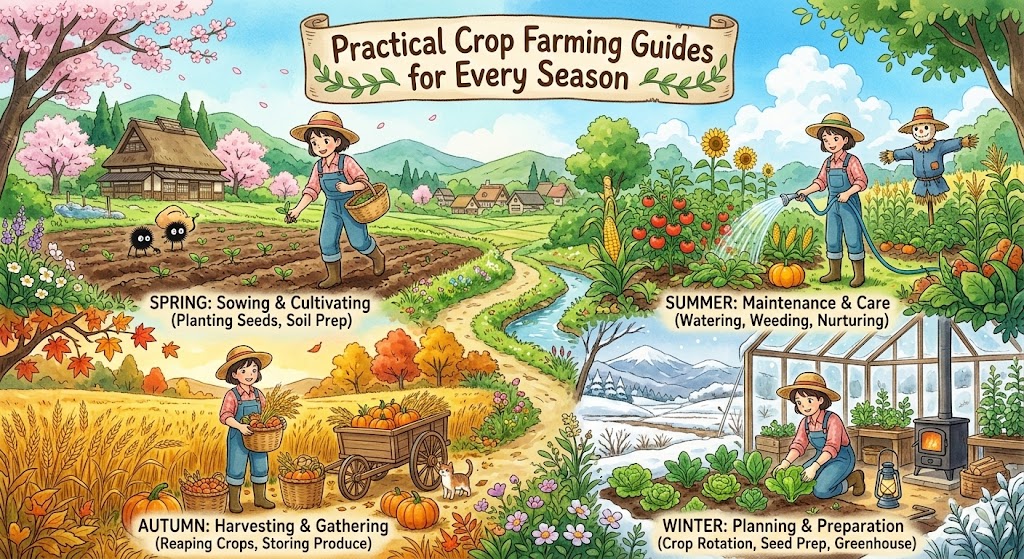
Mastering the seasons requires a shift from manual labor to executive management. Follow this 4-season actionable plan to stabilize your production:
Step 1: Spring – The Foundation (Preparation & Planting)
Test your soil the moment the ground thaws. Don’t guess—measure your pH and nutrient levels. Focus on Seedbed Preparation; ensure the soil is aerated but not over-tilled. Use “Succession Planting” to ensure you don’t have everything ripening at the exact same time.
Step 2: Summer – The Growth (Maintenance & Protection)
This is the season of Precision Irrigation. Use mulch to keep soil temperatures stable. Implement Integrated Pest Management (IPM) by scouting your fields twice a week. Look for “beneficials” like ladybugs before reaching for a chemical spray.
Step 3: Autumn – The Reward (Harvest & Storage)
Timing is everything. Use a Brix Refractometer to measure the sugar content of your crops to find the peak harvest window. Focus on Post-Harvest Handling; cooling your produce immediately after picking can double its shelf life.
Step 4: Winter – The Recovery (Soil Building & Planning)
The “Quiet Season” is for the soil. Plant Winter Cover Crops like cereal rye or hairy vetch to protect the topsoil from wind and snow. This is also your time for Financial Auditing—review which crops made money and which ones only took time.
Beginner’s Tip: Don’t try to plant everything in one season. Start with Two Reliable Crops that are suited for your specific “Hardiness Zone.” It is better to have a perfect harvest of one crop than a failing harvest of ten.
Overcoming Challenges and Looking into the Future
The biggest hurdle for seasonal farming is Climate Volatility. “False Springs” or late-summer droughts can ruin a year’s work in days. To solve this, modern farmers are investing in Season Extension Tools like high tunnels, row covers, and frost-protection sensors. These innovations allow you to “cheat” the seasons and gain an extra 4-6 weeks of production.
Looking into the future, we are moving toward AI-Driven Predictive Phenology. We are seeing the rise of apps that use satellite data to tell a farmer exactly when to harvest based on the spectral signature of the plant. We are also seeing the development of “Climate-Smart” seeds that are bred to trigger growth only when specific soil moisture and temperature thresholds are met simultaneously, effectively “self-managing” the seasonal transition.
Conclusion
Practical crop farming is not a race; it is a cycle. By respecting the rhythm of the seasons and applying data-driven strategies, you ensure that your farm remains a thriving, sustainable source of life and profit. The core message is simple: The most successful farmers are those who prepare in the winter, plant with precision in the spring, protect in the summer, and profit in the autumn.
Call to Action: This week, find your local “First and Last Frost Dates” for the upcoming year and mark them in a dedicated Farm Calendar.
Start your seasonal planning today. The earth is ready to reward your foresight; all you have to do is align your work with the rhythm of the world.
Frequently Asked Questions (FAQs)
1. What is the most important task to do in the “Off-Season”? The most important task is Soil Testing and Equipment Maintenance. Repairing your tools and knowing exactly what your soil needs before the rush of spring starts will save you hundreds of hours of frustration.
2. Can I grow crops in the winter? Yes, depending on your region. Using Cold Frames, High Tunnels, or Greenhouse systems, you can grow hardy greens (like kale and spinach) and root vegetables even in freezing temperatures.
3. How do I know when the “perfect” time to plant is? Instead of a date, use Soil Temperature. Most seeds have a specific temperature range for germination (e.g., 15°C for corn). Buying a simple soil thermometer is more accurate than any calendar.
4. What are cover crops, and why do I need them in the winter? Cover crops are plants like clover or rye that you grow not to sell, but to protect the soil. They prevent your best topsoil from washing away in the rain and add organic matter back into the earth when you till them in spring.