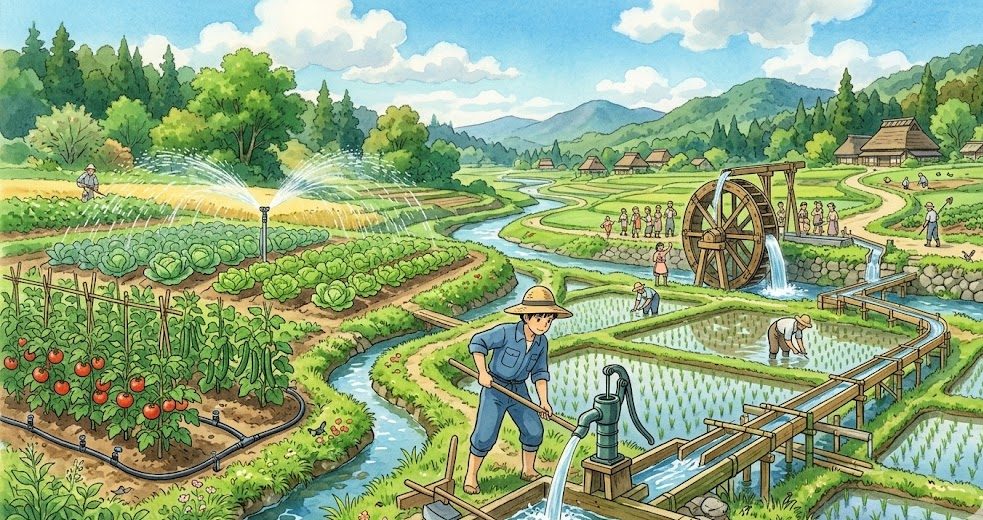
Did you know that agriculture accounts for approximately 70% of all freshwater withdrawals globally? As water scarcity becomes an urgent reality, the traditional method of “flooding the field” is no longer just inefficient—it is economically dangerous. For the modern grower, the “Pain Point” is clear: rising water costs, shrinking groundwater reserves, and unpredictable drought cycles are eating away at profit margins. The “Challenge” is to produce more food with significantly less water while maintaining soil health.
The ultimate solution lies in Essential Modern Irrigation Methods. This is the strategic shift from “Volume-Based” watering to “Precision-Targeted” hydration. By moving away from wasteful surface irrigation and embracing technologies that deliver water directly where the plant needs it, we can achieve a “Double Win”—higher yields and lower utility bills. This article serves as your professional roadmap to water management. You will learn the core fundamentals of efficient water delivery, the measurable benefits of smart irrigation systems, and a practical step-by-step guide to upgrading your farm’s “circulatory system” for a more sustainable and profitable future.
Understanding Irrigation: Key Concepts and Importance
Irrigation is more than just “watering plants”; it is the artificial application of water to the soil to assist in the growing of agricultural crops. Historically, civilizations rose and fell based on their ability to manage river floods. Today, modern relevance is defined by Water-Use Efficiency (WUE)—a metric that measures how much of the water applied actually reaches the plant roots versus how much is lost to evaporation or runoff.
Think of irrigation like a Targeted Nutrient Delivery System in a hospital. In the old days, we might have sprayed a whole room with medicine (Surface Irrigation) hoping the patient would breathe it in. Modern irrigation is like an IV Drip (Drip Irrigation) or a Precise Mist (Sprinkler Systems). It delivers the exact “dose” of water directly into the “veins” (roots) of the crop.
A technical concept to master is Evapotranspiration (ET). This is the sum of evaporation from the land surface plus transpiration from plants. By understanding the ET rate of your specific region, you move from “Guesswork” to “Demand-Based Irrigation.” This ensures that your irrigation schedule is synced with the biological needs of the plant and the atmospheric conditions of the day, effectively turning your water pump into a precision tool.
Why It Matters: The Top Benefits of Smart Irrigation
Investing in the right irrigation method is the single most effective way to stabilize your farm’s production in an era of climate volatility. Here is why it matters:
- Significant Water Savings: Methods like Drip Irrigation can reduce water usage by 30% to 70% compared to traditional flood methods by eliminating surface runoff and deep percolation.
- Drastic Yield Improvement: Precision irrigation prevents “Water Stress.” By keeping soil moisture at a consistent level, plants grow faster, larger, and produce higher-quality fruit or grain.
- Reduced Disease and Weed Pressure: Since water is delivered only to the base of the crop, the surrounding soil remains dry. This “starves” weeds of water and prevents fungal diseases caused by wet foliage.
- Fertigation Capabilities: Modern systems allow for Fertigation—the process of injecting fertilizers directly into the water line. This ensures nutrients reach the roots with 95% efficiency, reducing fertilizer waste.
Pro Fact: Drip irrigation systems operate at an efficiency of over 90%, whereas traditional flood irrigation can be as low as 40% efficient due to evaporation and poor distribution.
How to Get Started: A Practical Guide for Beginners
Upgrading your irrigation system is a journey of precision. Follow this 5-step implementation plan to optimize your water usage:
Step 1: Conduct a Topography and Soil Audit
Before buying pipes, understand your land’s slope and soil type. Sandy soils require frequent, short bursts of water, while clay soils benefit from slower, deeper applications.
Step 2: Choose the Right Method for Your Crop
Not all systems fit all plants. Use Sprinklers for broad-acre crops like grains, but prioritize Drip Lines or Micro-Sprayers for high-value orchards, vineyards, and vegetables.
Step 3: Install Soil Moisture Sensors
This is the “Brain” of your system. Place sensors at two depths: one in the active root zone and one below it. If the bottom sensor is wet, you are over-watering and wasting money.
Step 4: Automate with Smart Controllers
Replace manual valves with Smart Irrigation Controllers. These devices connect to local weather stations and automatically skip a watering cycle if rain is forecasted, saving you thousands of gallons per year.
Step 5: Regular System Maintenance
Check for leaks and clogged emitters weekly. A single leak in a pressurized system can waste hundreds of liters of water in a single night.
Beginner’s Tip: Always install a High-Quality Filter at the start of your system. Even clean-looking well water contains small particles that can clog expensive drip emitters over time.
Overcoming Challenges and Looking into the Future
The biggest hurdles in modern irrigation are the Initial Capital Cost and the Complexity of Installation. To solve the cost issue, many farmers are utilizing Solar-Powered Pumps, which eliminate ongoing electricity costs and pay for themselves within 3–4 years. For the complexity, “Plug-and-Play” kits are becoming more common for small-scale operations.
Looking into the future, we are moving toward AI-Driven Autonomous Irrigation. We are seeing the rise of Thermal Satellite Imaging that detects “hot spots” in a field—areas where plants are thirsty—and automatically triggers a drone or a robotic sprayer to address only that specific zone. Another trend is Sub-Surface Drip Irrigation (SDI), where pipes are buried permanently underground, allowing for zero evaporation and the ability to farm the surface without disturbing the irrigation lines.
Conclusion
Essential irrigation methods are the “Life Support System” of the modern farm. By moving from a “Volume” mindset to a “Precision” mindset, you protect your most valuable resource while ensuring a more bountiful harvest. The core message is clear: In the future of agriculture, the most successful farmers won’t be those with the most water, but those who use every drop with the most intelligence.
Call to Action: This week, calculate your current water costs and compare them to your crop yields.
If you aren’t using Soil Moisture Sensors, start your journey today by researching a simple sensor kit. The future of your farm’s resilience starts with the data you gather at the root level today.
Frequently Asked Questions (FAQs)
1. Is Drip Irrigation too expensive for a small farmer? While the initial setup has a cost, the savings in Water, Fertilizer, and Labor usually result in the system paying for itself within two growing seasons. For very small plots, DIY gravity-fed drip kits are extremely affordable.
2. Can I use irrigation with “No-Till” farming? Yes! In fact, Mulching (a staple of no-till) makes irrigation even more effective by preventing the sun from evaporating the water you just applied, keeping the soil moist for longer.
3. What is the best time of day to irrigate? The best time is Early Morning (4:00 AM to 8:00 AM). This reduces evaporation loss and ensures the plants are fully hydrated before the heat of the day hits. Avoid evening watering as it can lead to fungal growth.
4. How do I know if I am over-watering my crops? Signs of over-watering include Yellowing Leaves, stunted growth, and visible “pooling” of water. The most accurate way to tell is by using a soil probe or sensor to check the moisture level 6–10 inches below the surface.