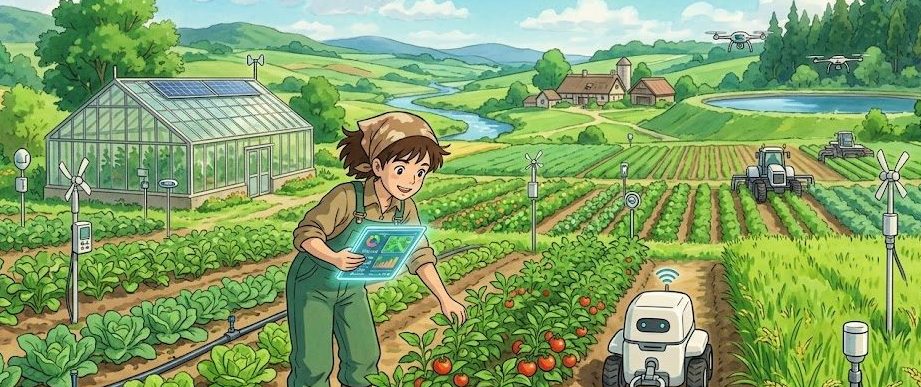
The agricultural landscape is undergoing a seismic shift. As the global population hurtles toward 10 billion by 2050, the traditional “spray and pray” methods of farming are no longer sustainable or sufficient. Enter Smart Farming—the integration of advanced technologies like IoT, AI, and Big Data into traditional agricultural practices.
This guide explores the innovative solutions driving the fourth agricultural revolution and the essential categories every modern farmer needs to master for long-term success.
1. The Core Pillars of Smart Farming
Smart farming isn’t just about buying a drone; it’s about a holistic approach to land management. It relies on three primary pillars:
- Precision: Applying the right treatment, at the right time, in the right place.
- Automation: Using robotics to handle repetitive, labor-intensive tasks.
- Data-Driven Insight: Moving from “gut feelings” to decisions backed by real-time sensor data.
By focusing on these pillars, farmers can maximize yields while significantly reducing the waste of water, fertilizer, and fuel.
2. Essential Agriculture Categories for Modern Success
To build a successful smart farm, one must understand how technology fits into the different sectors of the industry.
A. Precision Crop Management
This is the heart of smart farming. Using Variable Rate Technology (VRT), farmers can adjust the amount of seed or fertilizer applied to specific sections of a field based on soil health.
- Soil Sensors: Measure moisture, pH levels, and nutrient content.
- Satellite Imagery: Provides “normalized difference vegetation index” (NDVI) maps to identify stressed plants before they die.
B. Smart Livestock Monitoring
Livestock management has moved beyond simple ear tags. Modern “Connected Cows” use wearable sensors to track:
- Health & Fertility: Monitoring body temperature and activity levels to detect illness or heat cycles.
- Geofencing: Using GPS collars to keep cattle within specific boundaries without physical fences.
C. Controlled Environment Agriculture (CEA)
For urban areas or harsh climates, CEA (including Hydroponics and Aeroponics) is the future. Smart greenhouses use automated climate control systems to maintain the perfect temperature, humidity, and CO2 levels 24/7.
3. Innovative Solutions Transforming the Field
What does “innovation” actually look like on the ground? Here are the technologies moving the needle:
The Rise of Agricultural Drones (UAVs)
Drones are the “eyes in the sky.” Beyond simple photography, they are now used for:
- Multispectral Imaging: Seeing things the human eye can’t, like early-stage fungal infections.
- Automated Spraying: Drones can spray hard-to-reach areas with surgical precision, reducing chemical exposure for human workers.
AI and Machine Learning
Artificial Intelligence acts as the brain of the smart farm. AI algorithms can analyze decades of weather patterns, soil data, and market prices to tell a farmer exactly when to plant and harvest for maximum profit.
Autonomous Machinery
Self-driving tractors and robotic weeders are solving the chronic labor shortages facing the industry. These machines can operate overnight, guided by GPS with centimeter-level accuracy, ensuring no inch of soil is wasted.
4. The Benefits: Why Make the Switch?
Transitioning to smart farming requires an initial investment, but the ROI is compelling:
| Feature | Traditional Farming | Smart Farming |
|---|---|---|
| Resource Use | High waste (Blanket application) | Optimized (Targeted application) |
| Labor | High dependency on manual work | Reduced through automation |
| Environmental Impact | Potential for runoff/degradation | Sustainable and regenerative |
| Predictability | Weather-dependent and risky | Data-backed and mitigated |
Export to Sheets
5. Overcoming the Challenges of Adoption
While the future is bright, the road to smart farming isn’t without hurdles.
- High Initial Costs: High-tech equipment and software subscriptions can be expensive for small-scale farmers.
- Connectivity Issues: Many rural areas still lack the high-speed internet required for real-time IoT data transmission.
- Data Security: As farms become digital, protecting proprietary farm data from cyber threats becomes a new priority.
The Solution: Many governments are now offering “AgTech” subsidies, and many companies are moving toward “Farm-as-a-Service” (FaaS) models, allowing farmers to rent technology rather than buying it outright.
6. The Future: Towards “Agriculture 5.0”
We are already seeing the glimpses of the next phase. Agriculture 5.0 will involve even deeper integration of biotechnology and the “Internet of Everything.” Imagine seeds that are genetically programmed to communicate their needs directly to a robotic harvester, or blockchain-enabled supply chains that allow a consumer to scan a QR code on an apple and see the exact day it was picked and the soil stats of the tree it grew on.
7. Conclusion: Getting Started
Smart farming is no longer a luxury for “big ag”—it is a necessity for anyone looking to remain competitive in a changing climate. Success in modern agriculture requires a shift in mindset: seeing yourself not just as a grower, but as a data manager and a steward of technology.
Steps to Begin:
- Start Small: Begin with soil moisture sensors or a simple farm management software.
- Focus on Data: Collect data for one full season before making major equipment purchases.
- Stay Educated: The tech evolves fast; join local AgTech hubs or online forums to stay ahead of the curve.
By embracing these innovative solutions, we can ensure a future that is not only food-secure but environmentally resilient. The farm of tomorrow is being built today—one data point at a time.