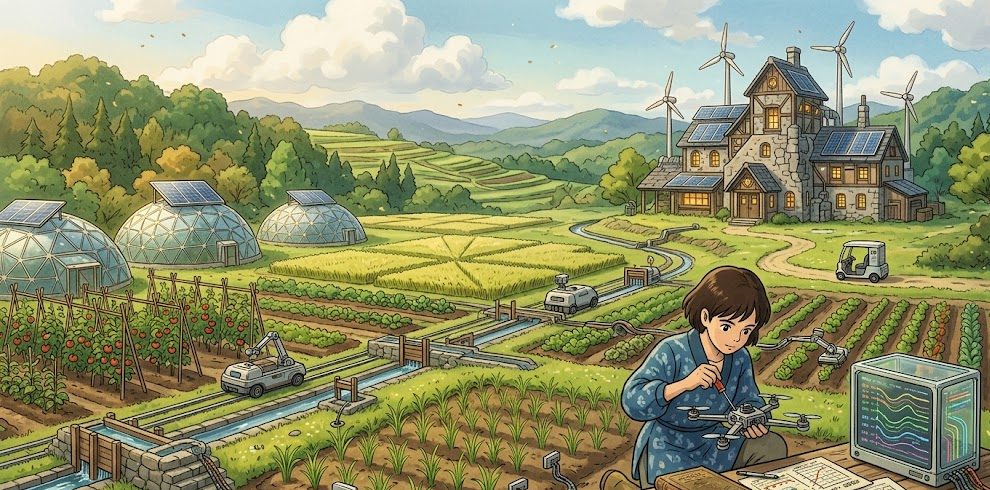
The global agricultural landscape is standing at the edge of a new frontier. With the world’s population projected to reach nearly 10 billion by 2050, the traditional “one-size-fits-all” approach to farming is no longer sustainable. To meet rising demands while protecting the environment, the industry is turning to Precision Agriculture, Automation, and Data-Driven Management.
This transition represents a shift from labor-intensive practices to intelligence-intensive systems. For the modern agropreneur, integrating these technologies isn’t just about being “high-tech”—it’s about maximizing every square inch of soil and every drop of water for peak profitability.
1. What is Precision Agriculture?
Precision agriculture is often defined as “doing the right thing, in the right place, at the right time, and in the right way.” Instead of treating a 100-acre field as a single unit, precision technology allows farmers to manage it as 100 individual one-acre plots.
- Variable Rate Technology (VRT): Rather than applying the same amount of fertilizer across the entire field, VRT systems use GPS and sensors to adjust the flow of inputs in real-time. Areas with high nutrient density receive less, while “hungry” patches get exactly what they need.
- GPS Guidance Systems: Auto-steer technology on tractors ensures that rows are perfectly straight and overlaps are minimized. This reduces “double-spraying” and fuel consumption, often saving farms between 10% and 15% in operating costs annually.
2. The Role of Automation in Modern Yield
Automation is the solution to one of farming’s greatest challenges: the labor shortage. By automating repetitive, high-precision tasks, farmers can focus on high-level strategy and business growth.
- Autonomous Machinery: We are moving toward a world of “driverless” tractors and robotic weeders. These machines can operate 24/7, even in low-visibility conditions, ensuring that planting and harvesting happen at the perfect biological window.
- Robotic Weeding and Thinning: Instead of blanket herbicide application, robots equipped with computer vision can identify weeds and eliminate them with lasers or targeted micro-doses of chemicals. This can reduce herbicide usage by up to 90%, significantly lowering costs and environmental impact.
- Automated Irrigation: Smart valves integrated with soil moisture sensors ensure that water is only delivered when the plant actually needs it. This prevents over-watering, which can lead to root rot and nutrient leaching.
3. Data-Driven Decision Making: The “Brain” of the Farm
In the past, farming decisions were based on intuition and historical “gut feelings.” Today, data is the most valuable crop a farmer can harvest.
- IoT (Internet of Things) Sensors: Low-cost sensors placed throughout the field provide a 24/7 stream of data on soil temperature, moisture, pH, and nutrient levels. This data is sent directly to a smartphone or dashboard, allowing for “remote monitoring.”
- Satellite and Drone Imagery: Using NDVI (Normalized Difference Vegetation Index), drones can “see” plant stress before it becomes visible to the human eye. Early detection of nitrogen deficiency or pest infestation allows for surgical intervention rather than whole-field treatment.
- Farm Management Software (FMS): Platforms that aggregate data from tractors, sensors, and weather stations help farmers track their ROI (Return on Investment) down to the penny. By analyzing multi-year data, farmers can identify which seed varieties perform best in specific soil types.
4. Protecting Yield Through Predictive Analytics
One of the most exciting aspects of data-driven farming is Predictive Modeling. By combining historical data with real-time weather forecasts, AI algorithms can predict disease outbreaks or pest migrations before they happen.
- Disease Forecasting: Fungal pathogens often require specific humidity and temperature windows to spread. Data systems can alert a farmer three days in advance of a high-risk window, allowing for a preventative (and cheaper) spray.
- Market Intelligence: Data isn’t just for the field; it’s for the market. Predictive tools analyze global crop yields and demand to help farmers decide the best time to sell their harvest, ensuring they capture the highest possible price.
5. Implementing the “Smart Farm” Transition
Moving toward a data-driven model doesn’t have to happen overnight. It is a journey of incremental upgrades.
- Phase 1: Record Keeping. Start by digitizing all farm inputs, yields, and costs.
- Phase 2: Soil Mapping. Create a digital map of your soil health to understand your baseline.
- Phase 3: Targeted Upgrades. Invest in GPS guidance or smart irrigation controllers first, as these often provide the fastest ROI.
- Phase 4: Full Integration. Link all machinery and sensors into a single cloud-based management platform.
6. The Benefits: Why Accuracy Matters
The shift toward precision and automation isn’t just a trend; it is a mechanical necessity for the future of food security.
| Benefit | Technology Used | Impact on Profitability |
|---|---|---|
| Input Savings | Variable Rate Technology | 15-20% reduction in fertilizer costs |
| Labor Efficiency | Autonomous Tractors/Robotics | Lower overhead and 24/7 operation |
| Yield Optimization | Drone/Satellite Monitoring | 10-15% increase in total harvest volume |
| Sustainability | Smart Irrigation/Spot Spraying | Reduced water waste and chemical runoff |
Export to Sheets
7. Conclusion: The Agropreneur’s Edge
The era of “guessing” in agriculture is over. Precision, automation, and data are the tools that allow a farmer to transform from a manual laborer into a high-level manager of a complex biological factory.
By embracing these technologies, you aren’t just growing crops; you are growing a resilient, scalable, and highly profitable business. The future of farming is digital, and those who master the data will be the ones who feed the world.
Summary Checklist for Data-Driven Success:
- [ ] Install soil moisture sensors in high-value zones.
- [ ] Use drone imagery to identify “underperforming” patches in the field.
- [ ] Transition to an automated farm management app for daily logs.
- [ ] Explore Variable Rate Application (VRA) for your next fertilization cycle.