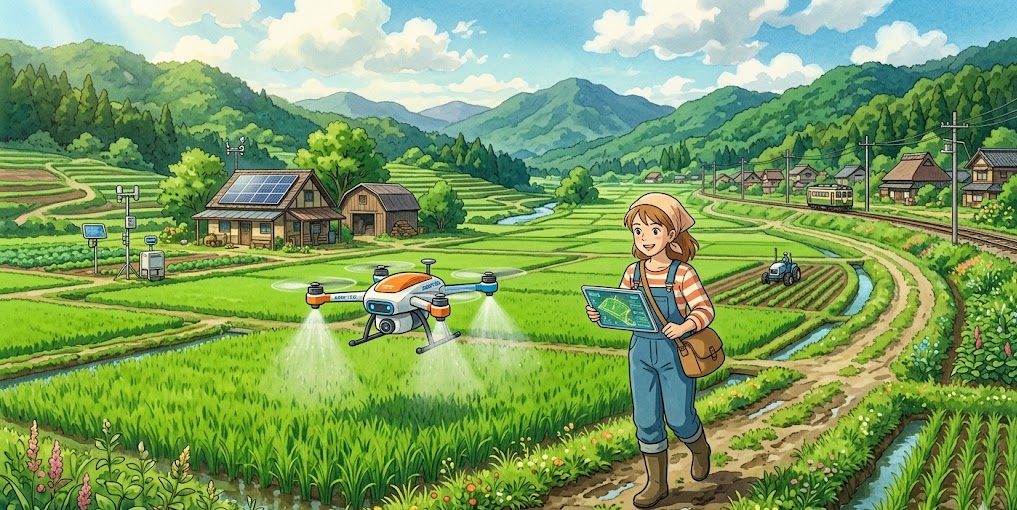
For centuries, farming was a game of averages. Farmers treated entire fields as a single unit, applying the same amount of water, fertilizer, and seeds across every acre, hoping for the best. Today, the agricultural landscape has been entirely rewritten by data. Welcome to the era of Precision Agriculture and Smart Crop Farming.
As the global population surges and environmental conditions become increasingly unpredictable, maximizing crop yields while minimizing resource waste is no longer just a goal—it is a necessity. By merging traditional agronomy with cutting-edge digital technology, smart farming is transforming agriculture into a highly precise, tech-driven industry.
Whether you are an agritech enthusiast, a commercial farm operator, or an investor looking at the future of food production, understanding these technologies is critical. Here is a deep dive into the techniques powering the next agricultural revolution.
What is Precision Agriculture?
At its core, Precision Agriculture (PA) is a farm management strategy based on observing, measuring, and responding to temporal and spatial variability to improve agricultural production sustainability.
Instead of treating a 1,000-acre farm as one uniform plot, precision agriculture uses technology to treat it as thousands of individual micro-plots. It ensures that every single plant receives exactly what it needs—no more, no less—precisely when it needs it.
The Core Technologies of Smart Farming
Smart crop farming relies on an ecosystem of interconnected technologies. These tools gather data, analyze it, and execute automated actions in the field.
1. The Internet of Things (IoT) and Field Sensors
IoT devices are the nervous system of a smart farm. Small, durable sensors are placed throughout the fields to continuously monitor localized conditions.
- Soil Moisture Sensors: Measure exact hydration levels at the root zone, preventing over-watering or drought stress.
- Nutrient Sensors: Detect real-time levels of nitrogen, phosphorus, and potassium (NPK) in the soil.
- Micro-Climate Weather Stations: Track localized temperature, humidity, and wind speed, offering far more accuracy than regional weather forecasts.
2. Drones and Satellite Imagery
The “eye in the sky” has revolutionized crop monitoring.
- Multispectral Imaging: Drones equipped with specialized cameras capture data beyond human vision. By measuring Normalized Difference Vegetation Index (NDVI), farmers can detect early signs of plant stress, disease, or pest infestations weeks before they become visible to the naked eye.
- Topographical Mapping: 3D mapping helps in designing optimal drainage systems and planning efficient tractor routes.
3. GPS and Automated Machinery
Modern tractors look more like airplane cockpits. Equipped with Real-Time Kinematic (RTK) GPS, these machines can navigate fields with sub-inch accuracy.
- Auto-Steering: Reduces driver fatigue and ensures perfectly straight crop rows, maximizing land usage.
- Autonomous Tractors and Rovers: Fully driverless machines that can plow, seed, and even weed fields autonomously, operating 24/7.
4. Artificial Intelligence (AI) and Predictive Analytics
Gathering data is useless without analysis. AI platforms ingest the massive amounts of data collected by sensors and drones, cross-referencing it with historical crop data and weather models. The AI then provides actionable insights, such as predicting the optimal harvest window to the exact day to maximize market value.
Key Smart Farming Techniques in Action
How do these technologies translate into actual farming practices? Here are the most impactful techniques used in precision agriculture today:
Variable Rate Technology (VRT)
This is perhaps the most powerful tool in the precision agriculture arsenal. VRT allows farm machinery to alter the application rate of seeds, fertilizers, and pesticides as it moves across the field.
- How it works: If a drone maps a field and finds a specific 50-square-foot patch deficient in nitrogen, the VRT-equipped tractor will automatically spray more fertilizer only on that specific patch, conserving chemicals and saving money everywhere else.
Precision Irrigation (Smart Water Management)
Water scarcity is a critical global issue. Smart irrigation systems use soil moisture sensors and weather forecast data to automate watering schedules. Systems like targeted drip irrigation deliver precise amounts of water directly to the plant’s root zone, virtually eliminating evaporation and runoff waste.
Automated Weed and Pest Targeting
Instead of blanketing an entire field with herbicides, smart sprayers utilize AI-powered cameras to distinguish between a crop and a weed in milliseconds. The machine then triggers a micro-burst of herbicide directly onto the weed. This technique can reduce chemical usage by up to 80%, drastically lowering costs and protecting the local ecosystem.
The ROI: Why Precision Agriculture Makes Financial Sense
Implementing smart farming technology requires significant upfront capital. However, the return on investment (ROI) is undeniable, which is why commercial agriculture is adopting it at breakneck speed.
- Massive Input Cost Reduction: By applying water, seeds, and chemicals only where absolutely necessary, farms drastically reduce their highest operational expenses.
- Increased Yield and Quality: Perfectly timed harvesting and optimized nutrient delivery push crops to their maximum genetic potential, resulting in heavier yields and higher-quality produce that commands premium market prices.
- Environmental Sustainability: Precision agriculture prevents chemical runoff into local rivers, conserves millions of gallons of fresh water, and protects soil health, ensuring the land remains viable for future generations.
Conclusion
Precision Agriculture and Smart Crop Farming are not just futuristic concepts; they are the active reality of modern agribusiness. By replacing guesswork with precise, real-time data, technology is empowering the agricultural sector to do more with less.
As AI becomes smarter and IoT sensors become more affordable, the barrier to entry for smart farming will continue to drop. For the modern digital-first economy, the integration of data and agriculture represents one of the most exciting, profitable, and essential technological frontiers of our time.