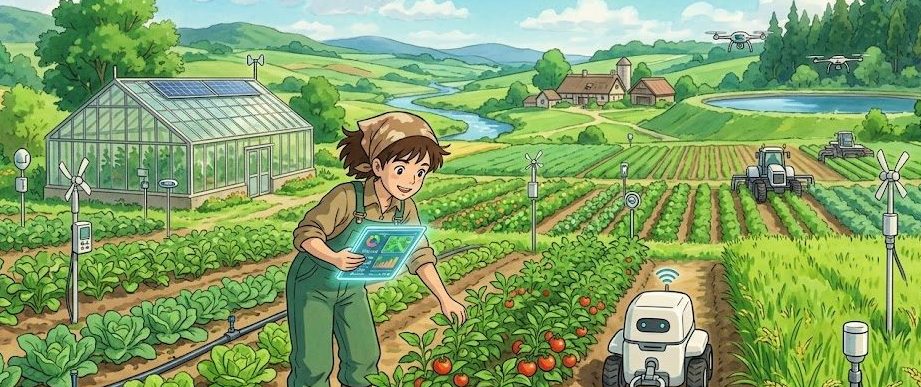
The agricultural landscape is undergoing a digital revolution. Traditional farming methods, while foundational, are often no longer enough to meet the demands of a growing global population and a changing climate. Enter Smart Crop Farming—the integration of advanced technologies like AI, IoT, and automation into daily agricultural practices. By leveraging these modern innovations, farmers can not only boost their yields but also optimize resource usage and maximize profitability.
1. The Power of Precision Agriculture
Precision agriculture is the “brain” behind smart farming. It involves using technology to ensure that crops and soil receive exactly what they need for optimum health and productivity.
GPS and Auto-Steer Systems
Gone are the days of manual tractor steering that leads to overlapping or skipped patches. Modern tractors equipped with GPS and auto-steer technology allow for:
- Reduced Fuel Consumption: By following precise paths, tractors cover the field in the most efficient way possible.
- Minimized Soil Compaction: Staying on designated tracks prevents unnecessary pressure on the soil, preserving its structure for root growth.
Variable Rate Technology (VRT)
Not every part of a field is the same. VRT allows farmers to apply water, fertilizers, and seeds at different rates across a single field. Using soil maps and real-time data, the machinery automatically adjusts the output, ensuring that high-potential areas get more nutrients while preventing wastage in lower-potential zones.
2. IoT and Real-Time Soil Monitoring
The Internet of Things (IoT) has brought the “Voice of the Soil” to the farmer’s smartphone. Smart sensors are now the eyes and ears of a modern farm.
- Soil Moisture Sensors: These devices measure the volumetric water content in the soil. Instead of watering on a schedule, farmers can water exactly when the sensors indicate a dip in moisture levels, saving up to 40% more water.
- NPK Sensors: Real-time monitoring of Nitrogen, Phosphorus, and Potassium levels allows for precise “fertigation” (fertilization through irrigation), preventing the chemical runoff that often damages local water bodies.
- Weather Stations: On-site hyper-local weather stations provide data on humidity, wind speed, and solar radiation, allowing farmers to predict pest outbreaks or frost events before they happen.
3. Drones and Satellite Imagery: The Eye in the Sky
Remote sensing is perhaps the most visual innovation in smart farming. It allows for a “birds-eye view” of crop health that is impossible to see from the ground.
NDVI Imaging
Normalized Difference Vegetation Index (NDVI) is a graphical indicator used to analyze remote sensing measurements. It tells a farmer how much “green” or chlorophyll-rich a plant is.
- Early Stress Detection: Drones can identify patches of a field that are under stress (due to pests or lack of water) weeks before the human eye can see the yellowing of leaves.
- Targeted Spraying: Instead of spraying an entire 100-acre farm, drones can be programmed to spot-spray only the affected areas, reducing pesticide costs by over 60%.
4. AI and Machine Learning in Yield Prediction
Artificial Intelligence (AI) is turning raw data into actionable insights. By analyzing years of historical weather data, soil reports, and market trends, AI algorithms can provide:
- Optimal Planting Dates: Determining the exact window to plant seeds to avoid early-season frost or late-season droughts.
- Yield Estimation: Accurate forecasting of harvest volumes helps farmers negotiate better prices with buyers and plan their logistics (trucks, storage, labor) well in advance.
- Pest Identification Apps: Simple mobile applications where a farmer can take a photo of a leaf, and the AI identifies the disease and suggests the exact biological or chemical cure instantly.
5. Controlled Environment Agriculture (CEA)
For regions with harsh climates, modern innovations have moved the farm indoors.
- Vertical Farming: Using stacked layers to grow crops, primarily in urban areas. This method uses 95% less water and zero pesticides.
- Hydroponics and Aeroponics: Growing plants in nutrient-rich water or mist instead of soil. This allows for 365-day production cycles, independent of outside weather conditions.
- Automated Greenhouses: Smart glass that adjusts its opacity based on sunlight intensity and automated ventilation systems maintain the perfect “Spring-like” environment all year round.
6. The Economic Impact: ROI of Smart Innovations
While the initial investment in smart technology can be significant, the Return on Investment (ROI) is usually realized within 2-3 harvest cycles.
| Innovation | Primary Saving | Yield Increase (Avg.) |
| Drip Irrigation + Sensors | 40-50% Water Saving | 15-20% |
| Drone Monitoring | 60% Pesticide Reduction | 10% |
| VRT Fertilization | 30% Fertilizer Saving | 12-15% |
| AI Logistics Planning | 20% Waste Reduction | N/A (Profit boost) |
7. Conclusion: The Future is Automated
Smart Crop Farming is not about replacing the farmer; it is about empowering them with better data. Innovations like autonomous tractors, AI-driven crop scouts, and blockchain-based supply chains are making farming more predictable and less of a gamble.
For the modern entrepreneur, the “Agri-Tech” space offers a unique opportunity to build applications and systems that solve real-world food security problems while maintaining a highly profitable digital and physical asset.