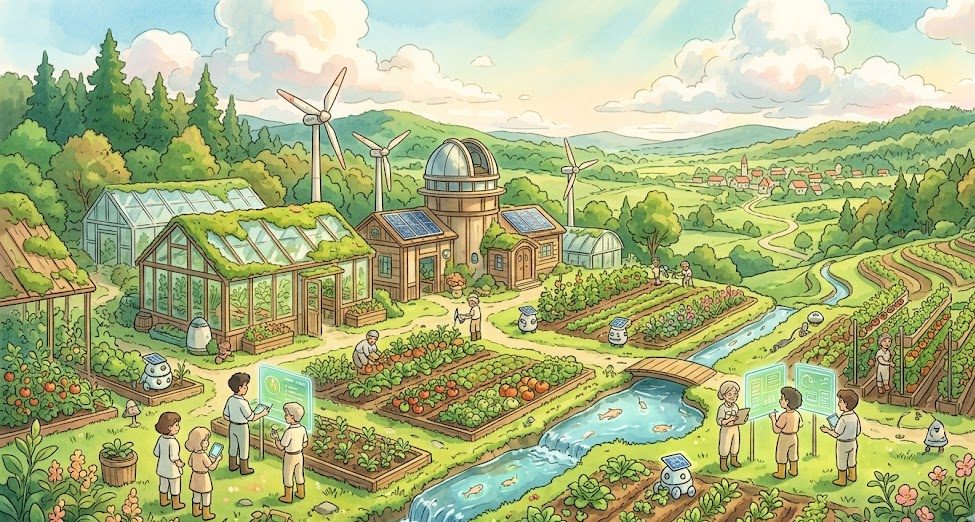
Agriculture is no longer just about seeds and soil; it is becoming a frontier for Data Science, Artificial Intelligence (AI), and Robotics. As we move through 2026, the global food system faces a double-edged sword: a rapidly growing population and the unpredictable wrath of climate change. To survive and thrive, the industry is shifting toward a high-tech model centered around Farming Innovation Hubs and Smart Crop Techniques.
1. The Farming Innovation Hub: The “Silicon Valley” of Fields
A Farming Innovation Hub is a centralized ecosystem where agronomists, tech startups, and traditional farmers collaborate. These hubs serve as testing grounds for “Ag-Tech” before it scales to the global market.
Core Functions of Innovation Hubs:
- Resource Democratization: High-end technology like multispectral drones and AI soil-analyzers are expensive. Hubs operate on a “sharing economy” model, allowing small-scale farmers to access tools they couldn’t afford alone.
- Local Adaptation: A solution that works in the Netherlands might fail in India. Hubs focus on Localized R&D, ensuring that smart techniques are tailored to specific soil types and climates.
- Real-Time Data Streams: These centers provide farmers with hyper-local weather forecasts, pest alerts, and market price predictions using Big Data.
2. Smart Crop Techniques: Precision and Efficiency
The goal of “Smart Crops” is to maximize yield while minimizing the “footprint”—using less water, less fertilizer, and less land.
A. Precision Agriculture
Instead of treating an entire 100-acre field as a single unit, Precision Agriculture treats every square inch individually.
- IoT Sensors: Placed in the soil, these sensors measure moisture and nutrient levels in real-time, sending data directly to the farmer’s smartphone.
- Variable Rate Application (VRA): Automated machinery applies water or fertilizer only where the sensors indicate a deficiency, reducing waste by up to 40%.
B. Controlled Environment Agriculture (CEA)
With urban sprawl eating up arable land, we are moving upward.
- Vertical Farming: Crops are grown in stacked layers, often in urban warehouses.
- Hydroponics & Aeroponics: These techniques grow plants in nutrient-rich water or mist, bypassing soil entirely. This method uses 95% less water than traditional farming and eliminates the need for chemical pesticides.
3. The AI and Robotics Revolution
Autonomous systems are solving the labor shortage crisis in the agricultural sector.
- Ag-Bots: Robots are now capable of “Laser Weeding”—identifying weeds via computer vision and killing them with thermal energy, removing the need for toxic herbicides.
- Drone Scouting: Drones equipped with thermal cameras can spot a disease outbreak in a single plant before it spreads to the rest of the crop.
- Autonomous Tractors: Self-driving machinery can operate 24/7 with centimeter-level accuracy, ensuring perfectly straight rows and optimal seed depth.
4. Climate-Resilient Bio-Engineering
Smart crops aren’t just about how we grow; they are about what we grow. Through CRISPR gene-editing, scientists are developing crops that can withstand the extremes of 2026:
- Drought-Tolerant Varieties: Crops that can survive extended periods without rainfall.
- Salt-Tolerant Grains: Allowing agriculture to flourish in coastal areas where seawater intrusion is a problem.
- Nutrient Fortification: Enhancing the zinc, iron, and vitamin content of staple crops like rice and wheat to combat global malnutrition.
5. Sustainability and the “Carbon Farm”
Modern innovation hubs are turning farms into “Carbon Sinks.” By using Regenerative Agriculture—such as no-till farming and cover cropping—farmers can trap atmospheric carbon in the soil.
- Carbon Credits: Farmers can now earn extra income by selling carbon credits to corporations, making environmental “good” a financial “gain.”
6. Challenges to Overcome
Despite the brilliance of these innovations, significant hurdles remain:
- The Digital Divide: Reliable high-speed internet is still missing in many rural heartlands.
- High Entry Costs: The initial investment for “Smart” hardware remains a barrier for the average farmer.
- Data Sovereignty: There are rising concerns about who owns the data generated by a farmer’s field—the farmer or the tech giant?
7. Conclusion: The Dawn of Agriculture 4.0
The future of agriculture is a hybrid of ancient wisdom and futuristic technology. The Farming Innovation Hub acts as the brain, while Smart Crop Techniques act as the hands of this new era.
By 2030, the “traditional farmer” will likely be part data analyst and part biologist. Through these innovations, we aren’t just feeding the world; we are doing it in a way that allows the planet to breathe again. The transition from “Green Revolution” to “Digital Revolution” is officially here.
Summary Table: Traditional vs. Smart Farming
| Feature | Traditional Farming | Smart Farming (2026) |
| Water Usage | High (Flood Irrigation) | Low (Drip/Precision) |
| Pest Control | Mass Chemical Spraying | Targeted AI/Laser Weeding |
| Decision Making | Experience/Intuition | Data-Driven/AI Models |
| Labor | Manual/Heavy Machinery | Autonomous Robots/Drones |
| Yield | Seasonal/Variable | Consistent/Optimized |