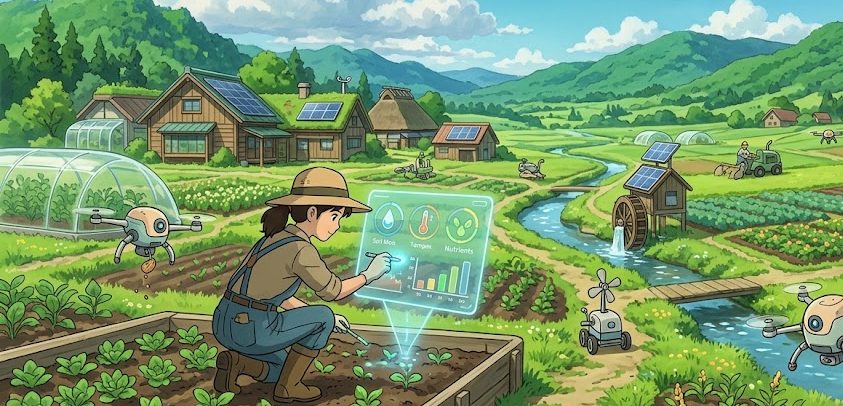
For centuries, agriculture was a game of “wait and see.” Farmers planted seeds, prayed for rain, and hoped that pests wouldn’t find their fields. It was a profession built on intuition, grit, and a heavy dose of luck.
However, as we move through 2026, the stakes have changed. With a global population climbing toward 10 billion and a climate that is increasingly unpredictable, “intuition” is no longer enough. We are witnessing a monumental shift—a transition from traditional, labor-intensive farming to Smart Crop Farming.
This deep dive explores the innovations that are moving us beyond the plow and into a future where every seed is a data point and every harvest is a masterpiece of engineering.
1. What is Smart Crop Farming?
At its core, Smart Crop Farming (also known as Precision Agriculture) is the application of modern Information and Communication Technologies (ICT) to agriculture. It is the practice of ensuring that the crops and soil receive exactly what they need for optimum health and productivity, while ensuring the sustainability of the environment.
Instead of treating a 100-acre field as a single unit, smart farming treats it as 100,000 individual plants. This micro-management at scale is the defining characteristic of the agricultural revolution.
2. The Pillars of Agricultural Innovation
A. The Internet of Things (IoT) and Real-Time Sensing
The “eyes and ears” of the modern farm are IoT sensors. These small, durable devices are scattered throughout fields to monitor variables that the human eye simply cannot detect:
- Soil Moisture Sensors: These prevent over-irrigation by signaling exactly when the root zone is dry.
- NDVI (Normalized Difference Vegetation Index) Sensors: These use light frequency to measure the photosynthetic activity of plants, identifying “stress” before the plant even turns yellow.
- Automated Weather Stations: Localized stations provide hyper-accurate data, allowing farmers to protect crops from frost or heatwaves with minutes of notice.
B. Satellite Imagery and “The View from Above”
While sensors work on the ground, satellites provide the macro-perspective. High-resolution satellite data now allows farmers to see nitrogen deficiencies or pest outbreaks from space. By layering satellite maps over tractor GPS systems, farmers can create Variable Rate Application (VRA) maps. This means a tractor can automatically increase fertilizer in a “weak” spot and decrease it in a “strong” spot as it drives.
C. Robotics and Autonomous Systems
The image of the farmer on a tractor is being replaced by the image of a technician monitoring a fleet.
- Autonomous Tractors: These machines can run 24/7 without fatigue, using LiDAR and GPS to navigate within centimeters of accuracy.
- Drones (UAVs): Drones are the “special forces” of smart farming. They can be deployed to spot-spray weeds, map terrain, or even plant seeds in hard-to-reach areas.
3. Indoor and Vertical Farming: Defying Geography
One of the most radical departures from “traditional” methods is the decoupling of farming from the land itself.
Vertical Farming utilizes controlled-environment agriculture (CEA) technology. By stacking crops in layers and using LED “light recipes” that mimic the sun, these farms can produce 300 times more food per square foot than a traditional farm.
- Hydroponics & Aeroponics: These systems grow plants in nutrient-rich water or mist, using 90% less water than soil-based farming.
- Urban Integration: Because these farms don’t need “good soil,” they are being built in abandoned warehouses in the hearts of cities, reducing “food miles” to “food meters.”
4. Genetic Innovation: The New Seed
Innovation isn’t just happening around the plant; it’s happening inside it. Beyond the controversial GMOs of the past, new techniques like CRISPR gene editing are being used to create crops that are:
- Drought-Resistant: Plants that can thrive with minimal water.
- Bio-Fortified: Crops with higher levels of Vitamin A, Iron, or Zinc to fight global malnutrition.
- Perennial Versions of Annuals: Imagine wheat that doesn’t need to be replanted every year, but grows back like grass, saving soil structure and labor.
5. The Role of Big Data and AI
The “Brain” behind smart farming is Big Data. A single smart farm generates millions of data points every day. AI algorithms process this data to provide Predictive Analytics. Instead of reacting to a problem, the AI says: “Based on current humidity and historical patterns, there is an 80% chance of a fungal outbreak in Section B in three days. Apply organic fungicide now.”
6. Sustainability: The Ultimate Goal
Innovation isn’t just about “more”; it’s about “better.” Traditional methods often led to soil erosion and chemical runoff. Smart farming fixes this:
- Reduced Chemical Load: By targeting only the weeds, herbicide use can be cut by up to 90%.
- Carbon Sequestration: Smart tools help farmers implement “No-Till” practices, keeping carbon locked in the soil.
- Water Conservation: In a world facing water scarcity, the precision of smart irrigation is a literal life-saver.
7. Strategic Comparison Table
| Feature | Traditional Farming | Smart Crop Farming |
|---|---|---|
| Decision Making | Based on experience/tradition | Based on real-time data/AI |
| Resource Use | Blanket application (Wasteful) | Variable Rate (Precise) |
| Labor | Human-intensive, physical | Tech-focused, analytical |
| Environmental Impact | High runoff & soil degradation | Low footprint & regenerative |
| Scalability | Limited by physical labor | Highly scalable via automation |
Export to Sheets
8. Monetizing the Innovation (Adsense Friendly Insights)
For digital creators and agricultural entrepreneurs, the “Smart Farming” niche is a goldmine. Advertisers in the IoT, SaaS, and heavy machinery sectors are looking for high-quality content.
High-Value Topics to Cover:
- “How to Transition your Family Farm to Smart Tech”
- “The Best Low-Cost IoT Sensors for Smallholders”
- “Understanding Ag-Data Security and Privacy”
9. Challenges to Overcome
While the future looks bright, the “Deep Dive” wouldn’t be complete without acknowledging the hurdles:
- Initial Cost: The “CapEx” (Capital Expenditure) for smart tech is high.
- Connectivity: Many rural areas still lack the high-speed 5G or Starlink access needed for real-time data.
- The Learning Curve: Farmers need to become “Digital Literates.”
Conclusion
Going “Beyond Traditional Methods” isn’t a luxury; it’s a necessity. Smart Crop Farming is the synthesis of human ingenuity and the natural world. It allows us to produce more with less, protecting our planet while feeding its people.
The agricultural revolution is no longer about the size of your tractor; it’s about the depth of your data. As we embrace these innovations, we ensure that the oldest profession in human history remains the most vital one for our future.
Expert Insight: If you’re a small-scale farmer, don’t be intimidated by the “Big Tech” of smart farming. Start with a single soil moisture sensor and a weather app. The journey to a smart farm begins with the first data point.