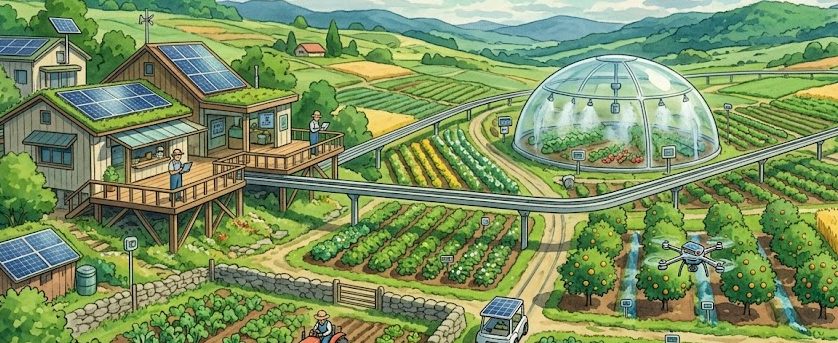
The global agricultural landscape is currently undergoing a “digital twin” evolution. As we move further into the 2020s, the challenge is no longer just about growing more food; it is about growing food more intelligently. The answer lies in the creation of Smart Farming Hubs—centralized, data-driven ecosystems that act as the “brain” of the operation—and their integration with Specialized Crop Management (SCM).
This integration represents the pinnacle of modern agrotechnology, moving away from generalized farming and toward a surgical, data-backed approach that maximizes every square inch of soil.
1. Defining the Smart Farming Hub
A Smart Farming Hub is not just a collection of gadgets; it is a unified digital infrastructure that aggregates data from various sources to provide a “single source of truth” for the farm. Think of it as an Air Traffic Control center for agriculture.
The Components of the Hub:
- Edge Computing & IoT: Sensors placed across the fields measure soil moisture, leaf wetness, and nutrient levels, sending data to the hub in real-time.
- Satellite & Drone Telemetry: Multi-spectral imaging provides a bird’s-eye view of crop health, identifying “stress zones” before they are visible to the naked eye.
- AI Analytics Engine: The core of the hub that processes raw data into “Actionable Intelligence,” such as precisely when to irrigate or the exact day a pest outbreak is likely to occur.
2. Specialized Crop Management (SCM): Beyond the “Average”
Traditional farming often treats an entire 100-acre field as a single unit. If one corner is dry, the whole field is watered. This leads to massive waste and suboptimal growth. Specialized Crop Management breaks the field down into “Management Zones.”
By integrating SCM with the Smart Hub, farmers can apply different strategies to different micro-sections of the same field.
The SCM Framework:
- Genotype-Specific Care: Different crop varieties have different metabolic needs. SCM allows a farmer to adjust nutrient delivery based on the specific DNA profile of the crop in a particular zone.
- Variable Rate Technology (VRT): Through the hub, machinery is programmed to adjust the flow of seeds or fertilizer as it moves across the field, ensuring that “high-potential” areas get more resources and “low-potential” areas aren’t wasted.
- Phenotyping in Real-Time: Monitoring the physical traits (phenotypes) of crops to adjust management strategies during the growing season.
3. The Synergy: Hub-Driven Decision Making
When the Smart Hub meets SCM, the result is a massive leap in Resource Use Efficiency (RUE).
| Operational Area | Conventional Approach | Smart Hub + SCM Approach |
| Irrigation | Scheduled (e.g., every Tuesday) | Triggered by real-time soil tension data. |
| Fertilization | Blanket application (Pre-season) | Pulse-feeding based on plant uptake rates. |
| Labor | Manual scouting and intuition | Directed “precision scouting” via GPS alerts. |
| Harvesting | Based on calendar date | Based on peak Brix (sugar) or moisture levels. |
4. Strategic Implementation: Building the Ecosystem
To maximize agricultural potential, the integration must follow a logical progression. You cannot run a high-tech SCM strategy on a low-tech hub.
Phase 1: The Sensor Overlay
Before you can manage, you must measure. This involves deploying a mesh network of sensors. The goal here is to map the Inherent Variability of the land—understanding which parts of the farm are naturally more fertile or prone to flooding.
Phase 2: The Data Synthesis
The Hub begins to ingest historical weather patterns, soil maps, and previous yield data. Using machine learning, the Hub creates a Predictive Model. It stops telling you what is happening and starts telling you what will happen.
Phase 3: The Automated Response
This is the “closed-loop” stage. The Smart Hub communicates directly with autonomous tractors, smart valves, and robotic weeders. If the Hub detects a nitrogen deficiency in Zone B-4, it automatically dispatches a drone or a variable-rate spreader to address that specific spot.
5. High-Profit Specialization: The Economic Engine
The “Hidden Logic” of this integration is the dramatic improvement in the Margin per Acre.
- Waste Elimination: By using SCM, farms typically see a 20-30% reduction in chemical and water costs.
- Quality Optimization: Specialized management allows for higher “Grade A” yields. In crops like grapes, berries, or specialty grains, a slight increase in quality can lead to a 50% increase in market price.
- Traceability & Compliance: Smart Hubs automatically generate a “Digital Passport” for every crop. In a world where consumers demand to know the carbon footprint and chemical history of their food, this data is a high-value asset.
6. Overcoming the “Complexity Barrier”
The transition to Smart Hubs and SCM can be daunting. The key to successful integration is Interoperability.
Farmers must ensure that their sensors, software, and machinery all speak the same language (standardized protocols like ISOBUS). The Smart Hub acts as the translator, ensuring that a sensor from Company A can tell a tractor from Company B exactly what to do.
7. The Environmental Imperative
Beyond profit, this integration is a primary tool for Climate-Smart Agriculture.
- Carbon Sequestration: By managing crops specifically to increase root depth and soil organic matter, farms become carbon sinks.
- Pollution Prevention: Precision application means that fertilizers stay in the plant and the soil, rather than leaching into local groundwater or evaporating as greenhouse gases.
Conclusion: The Future of the Intelligent Farm
Maximizing agricultural potential is no longer a game of “brute force.” We cannot solve the food security crisis by simply working harder or using more chemicals. We must work faster than the speed of change.
The integration of Smart Farming Hubs with Specialized Crop Management turns the farm into a learning machine. Every season becomes a data set that makes the next season more efficient, more profitable, and more resilient.
The revolution isn’t just about the technology; it’s about the Shift in Logic. We are moving from being “Masters of the Land” to “Partners with the Data.” Those who embrace this integration will lead the next era of global prosperity.
Key Takeaway: The Smart Hub is your brain; Specialized Management is your hands. Together, they create a farm that is capable of achieving its true biological and economic potential.