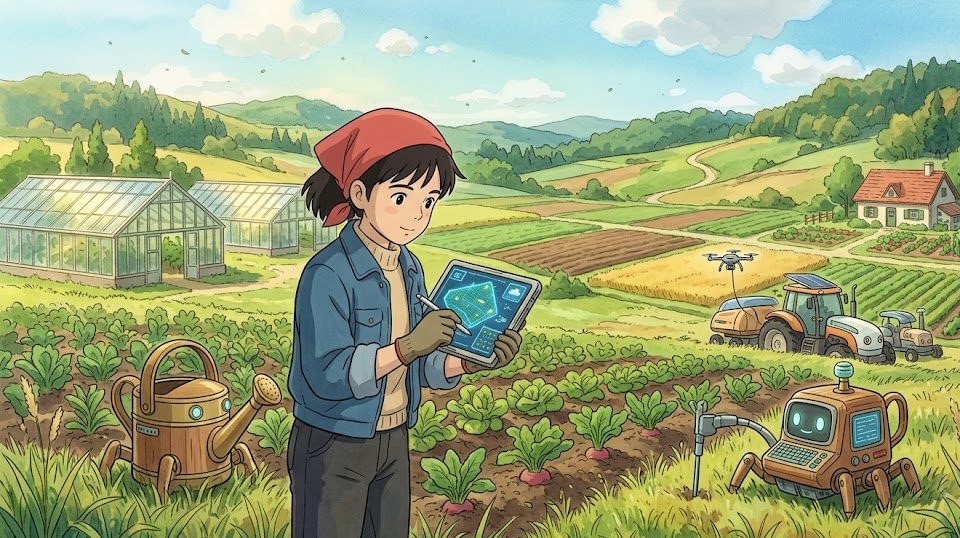
In the agricultural landscape of 2026, the difference between a struggling farm and a “digital goldmine” lies in how a grower manages information. Traditional farming often relies on guesswork, but “Smart Crop Farming” uses data to ensure “Precision Yields.” This guide serves as a comprehensive blueprint for achieving “Financial Freedom” by integrating high-tech tools with “Practical Farming” wisdom to grow more with less effort and zero chemical costs.
1. The Core of Smart Crop Farming: Data as the New Seed
Just as you select high-quality seeds, you must now collect high-quality data. In 2026, data is the foundation of “Smart Farming” innovations.
- IoT Soil Sensors: These devices are the “eyes” of your farm, providing real-time data on moisture and nutrient levels directly to your dashboard.
- Precision Management: By monitoring the “biological engine” of your fields, you can identify specific nutrient deficiencies or pest threats before they are visible to the human eye.
- Predictive AI: Artificial Intelligence analyzes years of weather patterns and real-time feeds to provide an accurate blueprint for every planting season.
2. Precision Irrigation: Every Drop Counts
Data-driven harvests require “water-saving techniques” that treat water as a precious digital asset.
- Automated Drip Systems: Triggered by real-time sensor data, these systems deliver hydration directly to the root zone, reducing waste and evaporation.
- Mulching as a Shield: A cornerstone of “Practical Farming,” mulching acts as a protective blanket that suppresses weeds and significantly reduces evaporation, keeping the root zone moist and cool.
3. Healing the Soil Naturally: The Biological Engine
Innovation in 2026 is deeply rooted in “Natural Farming” principles, where “healing the soil naturally” ensures long-term resilience.
- The No-Till Advantage: Avoid heavy plowing to preserve delicate fungal networks (mycorrhizae) that act as a natural nutrient delivery system.
- Zero Chemical Costs: The secret lies in fermented organic matter and bio-inputs that “recharge” the soil’s microbial life without the “burning” effect of synthetic NPK.
- Integrated Livestock: Combining dairy, poultry, or goat farming creates a “Closed-Loop” system where animals provide manure for bio-inputs, and crop residues serve as feed.
4. Maximizing Profits with High-Value Cash Crops
Precision yields allow you to focus on “High-Value Cash Crops” that offer a much higher return on investment per square foot.
- Exotic Selections: Focus on niche markets for crops like broccoli, zucchini, or cherry tomatoes, which command premium prices.
- Micro Farming: Use vertical gardening and space optimization to turn even small plots into high-profit ventures, a key strategy for “Micro Farming” success.
5. Smart Pest and Weed Control
In a data-driven system, “Natural Pest Management” (NPM) replaces toxic chemicals.
- Biodiversity: Planting a variety of crops together confuses pests and provides homes for natural predators like birds and frogs.
- Biological Barriers: Use cover crops to smother weeds naturally, a “low-maintenance” technique that improves soil structure while keeping fields clean.
Conclusion: Securing Your Digital Goldmine
Smart Crop Farming is a strategic path to “Financial Freedom.” By combining the precision of “Smart Technology” with the wisdom of “Natural Farming,” you create a resilient, high-yield environment that requires less effort and zero chemical costs. Whether you are practicing “Survival Farming” for self-reliance or scaling a commercial “Farming Innovation Hub,” the goal remains: grow more, waste less, and restore the earth.