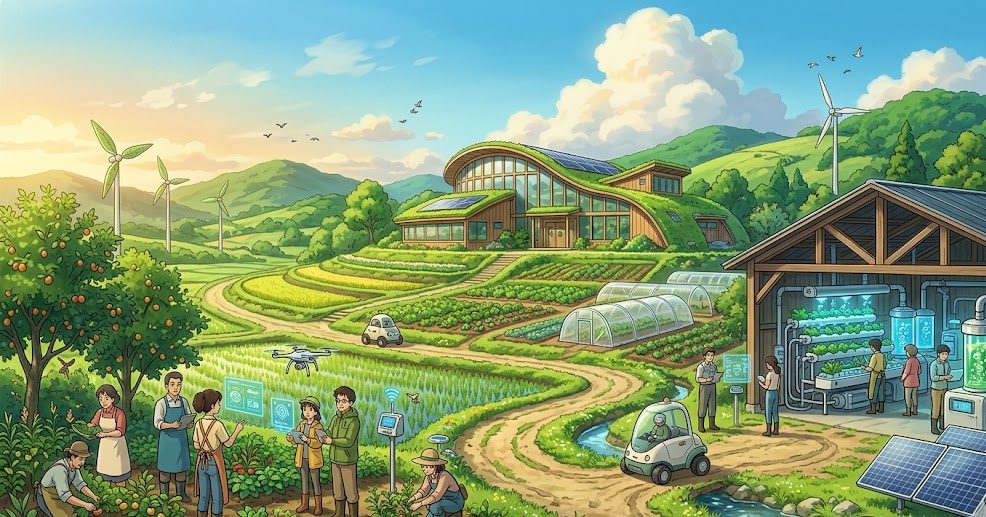
The global agricultural landscape is undergoing a massive paradigm shift. With the global population projected to reach nearly 10 billion by 2050, traditional farming methods alone cannot meet the skyrocketing demand for food, fiber, and fuel. Enter Digital Agriculture and AgriTech Trends—the technological revolutions transforming dusty fields into data-driven ecosystems.
Today, a farm is no longer just land and a tractor; it is a Modern Farming Innovation Hub. By merging biotechnology, Internet of Things (IoT), Artificial Intelligence (AI), and automation, modern growers are maximizing crop yields, minimizing resource waste, and redefining sustainability.
In this comprehensive deep-dive, we will explore the breakthrough innovations shaping the agriculture sector, the tech trends driving maximum ROI, and how digital transformation is securing the future of global food security.
1. What is a Modern Farming Innovation Hub?
A Modern Farming Innovation Hub is a conceptual and practical ecosystem where cutting-edge technology intersects with traditional agronomy. It represents a shift from intuitive farming (making decisions based on guesswork or historical habits) to precision agriculture (making decisions based on real-time data).
These innovation hubs integrate multiple digital layers to monitor farm health, predict weather anomalies, and automate labor-intensive processes. The primary objective is simple: Produce more with less. Less water, less chemical fertilizer, less human labor, but significantly higher quality and yield.
2. Key AgriTech Trends Disrupting the Industry
The rapid commercialization of tech has brought enterprise-grade tools directly into the hands of everyday farmers. Here are the defining AgriTech trends of this decade:
A. Artificial Intelligence and Machine Learning in Agronomy
AI acts as the brain of the modern digital farm. Machine learning algorithms analyze decades of weather patterns, soil data, and crop performance to give farmers prescriptive insights.
- Predictive Yield Mapping: AI can accurately forecast harvest volumes months in advance, helping farmers negotiate better market prices.
- AI-Driven Weed and Pest Management: Smart sprayers equipped with computer vision can identify a weed among crops in milliseconds and spray pesticide only on that specific weed, reducing chemical use by up to 90%.
B. Agricultural Drones and Remote Sensing
Drones (UAVs) have transitioned from luxury gadgets to essential farming equipment.
- Multispectral Imaging: Drones equipped with advanced sensors capture light bands invisible to the naked eye. This allows them to map crop stress, nitrogen deficiencies, and fungal outbreaks days before symptoms physically manifest.
- Automated Spraying: Heavy-payload drones can cover acres of rugged terrain in minutes, spraying liquid fertilizers or bio-pesticides with centimeter-level precision.
C. IoT and Smart Sensor Networks
Internet of Things (IoT) devices act as the sensory nervous system of the fields. Underground soil sensors constantly monitor moisture levels, NPK (Nitrogen, Phosphorus, Potassium) levels, and soil temperature. This data feeds directly into automated smart irrigation systems that turn on only when the plant actually requires hydration.
3. The Pillars of Digital Agriculture
Digital agriculture is the umbrella term for integrating digital tools to track, optimize, and execute farming processes. It relies heavily on three core pillars:
[Satellite & Drone Data] ──> [AI Cloud Analytics] ──> [Automated Smart Machinery]
1. Big Data and Cloud Platforms
Every tractor, sensor, and drone generates data. Centralized cloud platforms (like farm management software) aggregate this data into easy-to-read dashboards. Farmers can look at their smartphones and instantly see their entire operation’s financial and physical health.
2. Autonomous Machinery and Robotics
Labor shortages are a global agricultural crisis. To counter this, autonomous tractors guided by GPS RTK technology can plow, seed, and harvest fields completely driverless, operating 24/7 with zero human fatigue. Furthermore, robotic fruit pickers utilizing delicate robotic arms are solving labor issues in high-value horticulture.
3. Blockchain for Supply Chain Transparency
Modern consumers want to know exactly where their food comes from. Blockchain technology registers every step of a food item’s journey—from seed plantation, fertilizer use, and harvest date to cold storage logistics. This end-to-end traceability builds massive brand trust and commands premium pricing.
4. AgriTech Architecture: A Comparison of Systems
To understand how these tech trends compare in terms of implementation cost, scalability, and impact, refer to the matrix below:
| AgriTech Innovation | Primary Benefit | Implementation Cost | ROI Timeline | Ideal Scale |
|---|---|---|---|---|
| IoT Soil Sensors | 40-50% Water Saving | Low to Medium | 1 Season | Small to Large Farms |
| Agricultural Drones | Early Pest Detection & Rapid Spray | Medium to High | 1 – 2 Years | Medium to Large Farms |
| Autonomous Tractors | Zero Labor Costs & Precise Field Rows | Very High | 3 – 5 Years | Large Enterprise Farms |
| Farm Management Apps | Data-driven Budgeting & Forecasting | Low (Subscription) | Immediate | All Farm Sizes |
| Hydroponics / Vertical Farming | 95% Water Saving & Year-round Yield | High Setup | 2 – 3 Years | Urban / Controlled Environments |
Export to Sheets
5. Next-Gen Innovation: Controlled Environment Agriculture (CEA)
Digital agriculture isn’t limited to open fields. It is fundamentally changing indoor cultivation through Controlled Environment Agriculture (CEA), commonly known as Vertical Farming or Smart Greenhouses.
By utilizing hydroponic, aquaponic, or aeroponic setups, vertical farms stack crops in vertical layers inside highly regulated indoor facilities.
- Custom Light Recipes: Instead of sunlight, specialized LED lights mimic the exact spectrum needed for optimal photosynthesis, accelerating crop growth cycles by up to 50%.
- Geographic Freedom: Because they don’t rely on soil or weather, these innovation hubs can be built inside urban skyscrapers, deserts, or cold arctic zones, drastically cutting down food transportation miles.
6. Challenges in the Adoption of Digital Agriculture
Despite the immense benefits, the path to a fully digital global agricultural economy faces a few distinct bottlenecks:
The Connectivity Gap: Most advanced AgriTech tools rely on high-speed internet and cloud computing. In many rural farming communities globally, 5G or even stable 4G network coverage remains a major obstacle.
- High Initial Capital: While the long-term ROI is massive, purchasing smart drones, autonomous setups, or IoT hardware requires significant upfront investment, which can be prohibitive for smallholder farmers without government subsidies.
- Tech Literacy: Training traditional farmers to comfortably use AI interfaces, interpret multispectral maps, and maintain complex hardware requires widespread educational initiatives.
Conclusion: The Horizon of AgriTech
The integration of Digital Agriculture turning farms into Modern Farming Innovation Hubs is no longer a futuristic fantasy—it is an active global necessity. As climate change creates unpredictable weather shifts, precision technology provides the resilience farmers need to remain highly profitable.
Investing in and adapting to these AgriTech trends ensures that agriculture remains economically viable for the next generation of growers. The future of farming belongs to those who cultivate data just as passionately as they cultivate their soil.
Frequently Asked Questions (FAQs)
Q1. What is the difference between Smart Farming and Precision Agriculture? While often used interchangeably, Precision Agriculture focuses on precise field management (like applying the exact amount of fertilizer needed), whereas Smart Farming focuses on using data and connectivity (IoT, cloud platforms) to optimize the overall farm ecosystem.
Q2. Can small-scale farmers afford Digital Agriculture tools? Yes. Mobile-based farm management apps, budget-friendly handheld soil testing kits, and shared “Drone-as-a-Service” (DaaS) models allow small-scale farmers to leverage advanced tech without heavy capital investments.
Q3. How does AgriTech combat climate change? By optimizing resource usage, AgriTech reduces greenhouse gas emissions. For instance, smart variable-rate fertilizer applicators prevent excessive nitrogen release into the atmosphere, and smart irrigation reduces freshwater depletion.