The global agricultural landscape is standing at a critical crossroads. With the global population projected to reach nearly 10 billion by 2050, the demand for food is skyrocketing. At the same time, traditional farming practices are facing severe backlash due to their heavy carbon footprint, excessive water depletion, and soil degradation.
The question is no longer just about growing more food; it is about growing food smarter.
Welcome to the Farming Innovation Hub—a conceptual and physical space where cutting-edge technology intersects with ecological responsibility. Modern sustainable farming is no longer defined by heavy iron plows and manual guesswork. Instead, it is driven by data, automation, and biology.
Here is an inside look at the smart tools, revolutionary technologies, and sustainable ideas rewriting the rules of agriculture today.
1. The Brains of the Hub: Precision Agriculture and IoT Sensors
Traditional farming often relies on blanket applications. If a field looks dry, the entire acreage is flooded. If a few crops show signs of pest damage, chemical pesticides are sprayed across the whole farm. Precision agriculture changes this completely.
By utilizing Internet of Things (IoT) sensors, farmers can monitor their fields at a granular level.
- Soil Moisture Probes: These digital sensors are buried at root level to collect real-time data on soil moisture, temperature, and salinity. This data is transmitted directly to a smartphone app, ensuring that irrigation systems are only turned on when and where they are absolutely needed.
- NDVI Crop Health Sensors: Normalized Difference Vegetation Index (NDVI) tools measure the amount of infrared light reflected by plants. This allows farmers to spot nutrient deficiencies or disease outbreaks days before they become visible to the human eye.
2. Eyes in the Sky: Agricultural Drones and Satellites
Drones have officially transitioned from high-tech toys to essential farm equipment. In the modern innovation hub, unmanned aerial vehicles (UAVs) provide a literal bird’s-eye view of crop performance.
High-Res Drone Scanning -> Targeted Spot-Spraying -> 80% Reduction in Chemical Inputs
Rather than driving a heavy tractor through fields—which compacts the soil and burns fossil fuel—drones can fly autonomously over hundreds of acres in minutes. Advanced multi-spectral cameras map out precise zones that require attention.
Furthermore, smart spraying drones can apply liquid organic fertilizers or bio-pesticides exclusively to affected plants, cutting chemical usage by up to 80% and drastically reducing input costs.
3. Water Optimization: Smart Drip Irrigation and Hydroponics
Water scarcity is one of the biggest challenges facing modern growers. The Farming Innovation Hub tackles this by abandoning flood irrigation in favor of hyper-efficient closed-loop systems.
Subsurface Drip Irrigation (SDI)
Unlike overhead sprinklers where up to 40% of water evaporates before touching the ground, SDI delivers water and liquid nutrients directly to the plant’s root zone under the soil. This keeps the surface soil dry, which naturally suppresses weed growth and prevents fungal diseases.
Hydroponics and Aquaponics
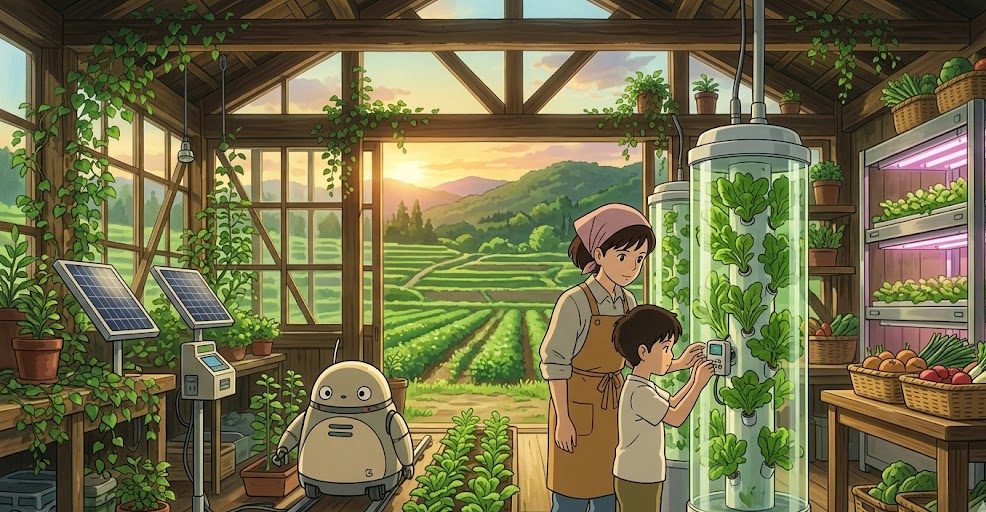
For indoor innovation hubs, soil-less farming is transforming productivity. Hydroponic vertical racks allow farmers to grow clean, pesticide-free leafy greens using 90% less water than traditional open-field farming. When paired with solar panels, these indoor hubs operate with near-zero carbon footprints.
4. Automation & Robotics: The Next-Gen Farm Labor
Finding reliable agricultural labor is becoming increasingly difficult worldwide. To maintain sustainable production, innovation hubs are integrating lightweight, autonomous field robots.
- Laser Weeding Robots: These AI-driven machines drive slowly down crop rows, using computer vision to differentiate between a weed and a cash crop. Once identified, a high-precision laser zaps the weed instantly, eliminating the need for toxic chemical herbicides or back-breaking manual weeding.
- Automated Harvesting Arms: Using delicate, pressure-sensitive robotic grippers and advanced AI vision, these machines can harvest fragile crops like strawberries, tomatoes, and apples at peak ripeness without bruising the produce.
5. Biological Innovation: Regenerative Inputs over Synthetics
Smart farming isn’t just about silicon microchips and metal robots; it is also about leveraging natural biology. For decades, synthetic chemical fertilizers have stripped the soil of its natural microbiome. The innovation hub prioritizes regenerative inputs.
Micro-Inoculants and Mycorrhizal Fungi
Instead of feeding the plant directly with chemical nitrogen, smart farmers inject the soil with beneficial microbes. These microbes form a symbiotic relationship with plant roots, unlocking tightly bound phosphorus and nitrogen already present in the soil, making them easily bio-available to the crop.
Biochar Integration
Biochar—porous charcoal created by heating agricultural waste in the absence of oxygen—acts as a permanent structural housing unit for soil microbes while sequestering carbon deep underground for centuries.
Sustainable Tools Matrix: Capital vs. Eco-Impact
To help modern growers prioritize their upgrades, here is a breakdown of how these smart tools stack up in terms of investment and environmental benefits:
| Smart Tool / Idea | Initial Setup Cost | Primary Sustainable Benefit | Resource Saved |
| IoT Soil Sensors | Low to Medium | Prevents over-irrigation and root rot | Fresh Water |
| Agricultural Drones | Medium to High | Enables precise spot-treatment of crops | Chemicals & Fuel |
| Laser Weeders | High | Eliminates chemical herbicide dependency | Topsoil Health |
| Subsurface Drip | Medium | Direct-to-root nutrition delivery | Water & Liquid Fertilizer |
| Micro-Inoculants | Low | Restores natural soil microbiome | Synthetic NPK Inputs |
Conclusion: The Future is Shared Innovation
The Farming Innovation Hub is not a futuristic dream—it is a practical, scalable reality that is unfolding right now. The ultimate goal of integrating smart tools into agriculture is to create a closed-loop system where productivity increases while environmental degradation drops to zero.
By embracing IoT data, precision water management, robotics, and soil biology, modern farmers are proofing their business against the volatility of climate change. Sustainable farming is no longer an alternative lifestyle choice; it is the most profitable, secure, and logical pathway for the future of global food security.