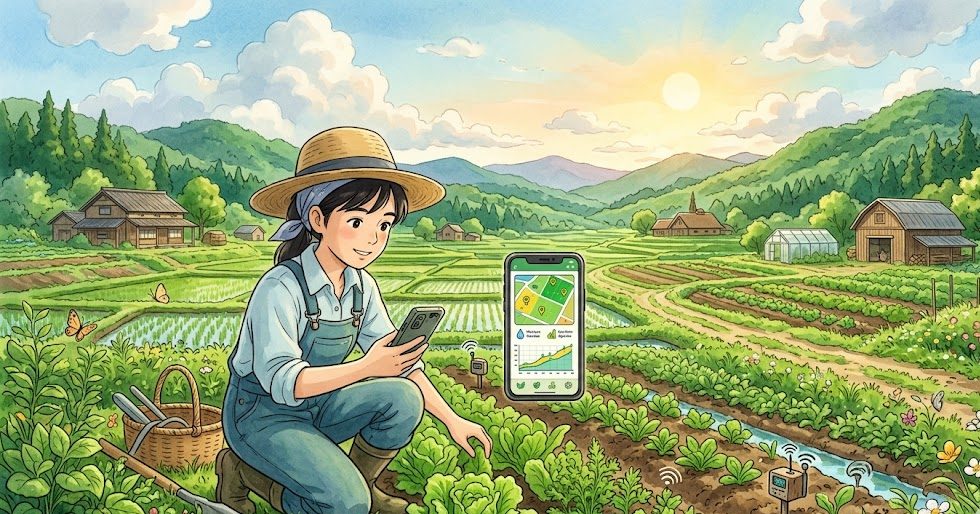
The modern farm is no longer defined solely by the quality of the soil or the strength of the farmer’s back; today, it is defined by the quality of data. We are living through an era of “Data-Driven Agriculture,” where a smartphone in a farmer’s pocket can do more for crop health than a tractor could achieve on its own a few decades ago.
By utilizing mobile applications integrated with satellite imagery, IoT sensors, and AI-driven analytics, farmers can now monitor their crops in real-time, detect diseases before they spread, and optimize resources with surgical precision. If you are ready to move beyond manual guesswork, here is how you can leverage mobile apps to monitor your crop health effectively.
The Digital Transformation of Crop Monitoring
Traditional farming often relied on periodic scouting—walking through rows of crops to visually inspect for pests or nutrient deficiencies. While essential, this method is labor-intensive and often reactive. By the time you notice yellowing leaves or wilting, the yield damage may already be irreversible.
Mobile apps act as a “remote control” for your fields. They aggregate data from various sources to provide a dashboard of your farm’s health. Whether it is tracking vegetative growth via satellite indices or receiving alerts from soil moisture sensors, these tools keep you connected to your land 24/7.
How Mobile Apps Track Crop Health
Modern agriculture apps are sophisticated hubs that process complex data into simple, actionable insights. Here is how they work:
1. Satellite-Based Vegetation Indices (NDVI)
One of the most powerful features of crop monitoring apps is the use of satellite imagery. By measuring the light reflected by plants, these apps calculate indices like NDVI (Normalized Difference Vegetation Index).
- What it tells you: A healthy plant reflects near-infrared light strongly. Apps convert this data into a “greenness map” of your fields.
- The Advantage: You can instantly spot “stress zones”—areas where the crops are struggling due to lack of water, nutrient deficiency, or pest pressure—without leaving your office. Happy Hydro
2. IoT Sensor Integration
Many apps sync directly with ground-based IoT sensors. These sensors can be placed at various depths in the soil to track:
- Soil Moisture: Helps you determine the exact moment your crops need water. WebMakers
- pH and Temperature: Alerts you if soil conditions are suboptimal for your specific crop variety. Folio3 AgTech
- Automated Alerts: If moisture levels drop below a critical threshold, the app sends a push notification to your phone, allowing you to trigger your irrigation system remotely. Folio3 AgTech
3. AI-Powered Pest and Disease Detection
With the help of Artificial Intelligence, your smartphone camera has become a diagnostic tool. By taking a clear photo of a damaged leaf or stem, many advanced apps use AI to identify the specific pathogen or pest.
- Immediate Identification: The app compares your photo against a vast database of agricultural diseases. AI Grants India
- Treatment Recommendations: Once identified, the app often suggests the most effective, least-harmful treatment, helping you avoid over-spraying chemicals. WebMakers
Key Benefits of Mobile-First Monitoring
Adopting a mobile-first approach to farming isn’t just about the “cool factor”—it’s about the bottom line.
- Real-Time Decision Making: You no longer need to wait for a weekly report. If a storm is approaching, you get hyper-local weather alerts on your phone, allowing you to adjust your harvesting or spraying schedule instantly. Happy Hydro+ 1
- Resource Efficiency: By knowing exactly which zones need water or fertilizer, you can implement Variable Rate Application (VRA), reducing input waste and lowering your annual costs. Google Play
- Improved Yields: Early detection of disease means you can isolate the problem before it wipes out an entire field. Saiwa.ai
- Enhanced Connectivity: Many apps allow for team management, where you can assign tasks to farmworkers and track their completion directly through the app, ensuring everyone is on the same page. Happy Hydro
Overcoming Common Challenges
While the benefits are clear, transitioning to a digital farming system comes with challenges. Many farmers worry about the complexity of new technology or the lack of internet connectivity in rural areas.
- System Complexity: Look for apps with user-friendly, intuitive dashboards. The best platforms highlight what needs your attention without overwhelming you with raw data.
- Offline Capabilities: High-quality apps are designed to work in the field. They can capture data offline and sync with the cloud automatically once you return to an area with connectivity. Happy Hydro
- Digital Literacy: Start small. You don’t need to overhaul your entire operation in one day. Begin by using one app for weather and another for mapping, and build your confidence from there.
Best Practices for Digital Crop Monitoring
To get the most out of your digital tools, follow these best practices:
- Standardize Your Records: Enter your planting dates, crop varieties, and input history consistently. The more data you provide the app, the more accurate its predictive analytics will be.
- Cross-Validate with Scouting: Digital tools are not a replacement for field presence. Use the satellite data to guide your scouting; if the app shows a “stress zone,” go to that exact location to verify what is happening on the ground. Alteia
- Use Historical Data: Over time, your app will build a library of your farm’s performance. Reviewing this data after the season helps you understand which varieties performed best in your specific soil conditions. EOS Data Analytics
- Prioritize Data Security: Only use reputable platforms that value data privacy and clearly explain how your farm information is stored and used.
Frequently Asked Questions (FAQs)
Q: Do I need expensive hardware to use these apps? A: Not necessarily. Most basic features, like weather tracking and field mapping, work with just your smartphone. Advanced features like sensor integration or high-resolution drone imagery are optional upgrades you can add as your operation grows.
Q: How accurate is satellite imagery for small farms? A: Satellite data has improved drastically, with some providers offering resolutions as high as 3 to 10 meters. While not as granular as a drone, it is highly effective for identifying health trends across most field sizes.
Q: What if I have bad internet coverage? A: Most professional farming apps include an “offline mode.” You can record your notes and field observations while in the field, and the app will upload the data to the cloud once you regain a signal.
Happy Hydro
Q: Can these apps help me with government compliance? A: Yes. Many apps keep a digital “Field Activity Log,” which acts as a historical record of all your farming operations. This can be invaluable when applying for government subsidies, insurance, or meeting safety compliance audits.
Google Play
Conclusion
Data-driven agriculture is not a luxury for the future—it is a necessity for the modern farmer. By integrating mobile apps into your daily routine, you move from a reactive posture to a proactive one. You gain the ability to “see” your crops with greater clarity, react to threats with greater speed, and manage your resources with greater efficiency.
Start by exploring one or two agricultural platforms, digitize your field records, and begin trusting the data. Your fields are telling you their story every day; it’s time you had the tools to listen.