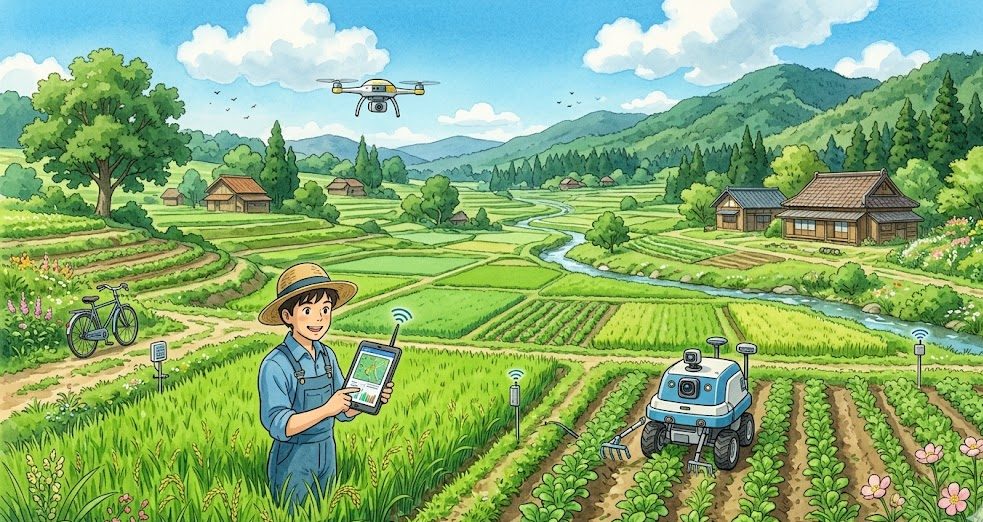
The global agricultural landscape is currently facing a dual-pressure system: a rapidly growing population that is expected to reach nearly 10 billion by 2050, and a shrinking pool of arable land compounded by climate instability. To meet this demand, farming can no longer rely on traditional “blanket” methods. Enter Precision Agriculture (PA)—a management strategy that uses digital technology to ensure that crops and soil receive exactly what they need for optimum health and productivity.
By shifting from “farming by the field” to “farming by the plant,” precision agriculture is redefining efficiency, sustainability, and profitability in the modern era.
1. The Core Philosophy of Precision Agriculture
At its heart, precision agriculture is about the “Right Four”: applying the right resource, at the right time, in the right place, and in the right amount.
In traditional farming, a farmer might apply the same amount of fertilizer across a 100-acre plot. However, soil quality is rarely uniform. Precision agriculture uses data to identify which specific square meters of that plot are nutrient-deficient and which are already saturated, preventing both waste and environmental runoff.
2. Key Technologies Driving the Revolution
The “smart” in smart farming comes from an ecosystem of integrated technologies:
Global Positioning System (GPS) and GNSS
GPS is the backbone of PA. It allows tractors and harvesters to navigate fields with centimeter-level accuracy. This precision reduces “overlaps” (spraying the same area twice) and “skips” (missing a spot), saving significantly on fuel and chemical costs.
IoT and Ground-Based Sensors
Internet of Things (IoT) sensors are the “nervous system” of the farm. These devices are placed in the soil or mounted on equipment to monitor:
- Soil Moisture: Triggering irrigation only when necessary.
- Nutrient Levels: Measuring nitrogen, phosphorus, and potassium (NPK) levels in real-time.
- Temperature and Humidity: Predicting pest outbreaks or frost risks.
Drones and Satellite Imagery
Remote sensing via satellites (like Sentinel or Landsat) and Unmanned Aerial Vehicles (UAVs) provides a “bird’s-eye view” of crop health. Using Normalized Difference Vegetation Index (NDVI) imaging, farmers can see photosynthetic activity. Areas appearing “stressed” on a map can be scouted immediately, often before the human eye can see the damage.
3. High-Yield Smart Techniques
Implementing technology is only half the battle; the real magic happens in how that data is used to change farming techniques.
Variable Rate Application (VRA)
VRA is the practice of varying the rate of seeds, fertilizers, and pesticides based on the needs of specific zones.
- Seeding: In fertile areas, seeds are planted more densely; in poorer soil, they are spread out to reduce competition for resources.
- Fertilization: Machines automatically adjust the flow of nutrients as they move across the field based on a pre-loaded “prescription map.”
Precision Irrigation
Water is becoming one of the most expensive and scarce resources in agriculture. Smart irrigation systems use soil moisture data and weather forecasts to automate watering. Techniques like Drip Irrigation, integrated with smart controllers, deliver water directly to the root zone, reducing evaporation by up to 40%.
Automated Guidance and Robotics
Self-steering tractors are now common, but the next frontier is fully autonomous robotics. Small robots can now move between rows to mechanically pull weeds, eliminating the need for chemical herbicides entirely in some organic setups.
4. The Benefits: Why the Shift Matters
The transition to precision agriculture isn’t just a “tech flex”—it offers tangible, multi-dimensional benefits.
| Benefit Category | Impact |
|---|---|
| Economic | Lower input costs (less seed/fertilizer) and higher yield per acre directly boost the bottom line. |
| Environmental | Targeted spraying prevents nitrogen runoff into local waterways and reduces the carbon footprint of heavy machinery. |
| Operational | Automation reduces the labor burden on farmers and allows for precise record-keeping for food safety compliance. |
| Resource Management | Drastic reduction in water waste through sensor-based scheduling. |
Export to Sheets
5. Challenges and Barriers to Adoption
Despite the clear advantages, the road to a “smart farm” isn’t without hurdles:
- High Initial Investment: The cost of drones, smart harvesters, and software subscriptions can be prohibitive for small-scale farmers.
- Data Overload: Farmers are often bombarded with more data than they can analyze. The industry needs better “Data-to-Action” software.
- Connectivity Issues: Many rural areas still lack the high-speed internet (5G or Starlink) required to transmit real-time data from field sensors to the cloud.
- Learning Curve: Shifting from manual labor to data science requires a new set of skills and technical training.
6. The Future: AI and Big Data
As we look toward the next decade, Artificial Intelligence (AI) will become the primary decision-maker. Machine learning algorithms will analyze decades of weather patterns, soil history, and genetic crop data to provide “predictive” rather than “reactive” advice.
We are moving toward Prescriptive Farming, where an AI might tell a farmer: “Based on the 80% chance of rain on Tuesday and your current soil nitrogen levels, apply exactly 12kg of urea to Zone B today for a 5% yield increase.”
Conclusion
Precision Agriculture is the bridge between the traditional wisdom of the farmer and the cutting-edge power of digital technology. It transforms the farm into a high-efficiency factory where every drop of water and every grain of seed is accounted for.
For the modern grower, adopting these smart techniques is no longer a luxury—it is a necessity for staying competitive in a global market and ensuring food security for a hungry planet. The future of farming isn’t just about working harder; it’s about farming smarter.