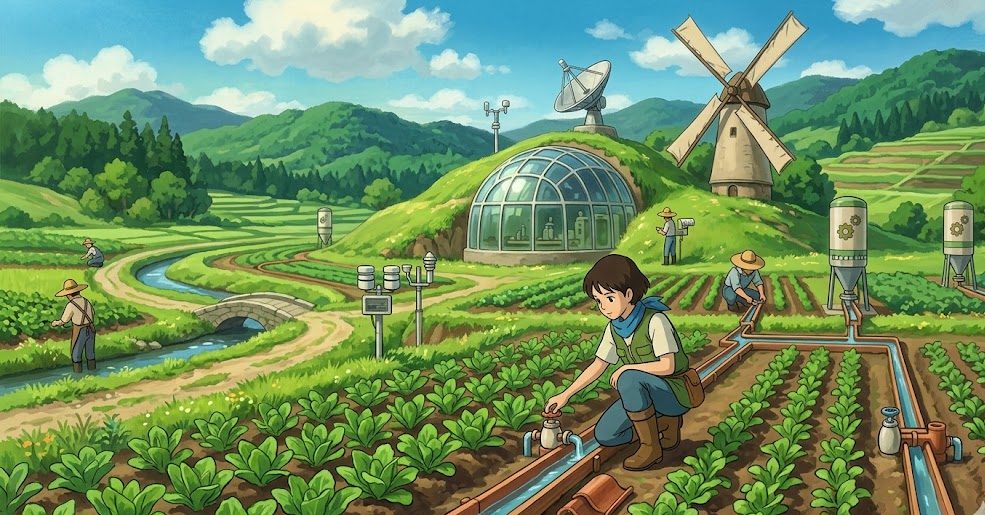
The modern agricultural sector is facing an unprecedented double bind. On one hand, global food demand is escalating; on the other, input costs for water and synthetic fertilizers are hitting record highs, alongside tightening environmental regulations. For professional growers and agribusinesses, traditional “blanket application” methods are no longer economically or ecologically viable.
The path forward lies in Smart Crop Farming—a data-driven, precision-engineered approach to resource management. By optimizing exactly how, when, and where water and nutrients are applied, commercial operations can drastically lower overhead costs, maximize crop yields, and significantly boost their net profit margins.
This guide provides a professional blueprint for optimizing your farm’s two most critical inputs: water and fertilizer.
1. The Core Philosophy of Smart Resource Optimization
In professional agronomy, resource optimization is governed by precision rather than volume. It relies heavily on the 4Rs of Nutrient Stewardship:
- Applying the Right Source (matching fertilizer type to crop needs).
- At the Right Rate (matching the amount to crop demand).
- At the Right Time (making nutrients available when crops need them most).
- In the Right Place (delivering nutrients directly to the root zone).
When you pair this framework with precision irrigation, you create a highly efficient closed-loop system where input waste drops to nearly zero.
2. Professional Water Optimization Strategies
Water optimization is not merely about using less water; it is about maximizing Water Use Efficiency (WUE). Professional growers achieve this by shifting away from visual guesswork and moving toward data-backed scheduling.
Automated Soil Moisture Monitoring
Relying on the look or feel of surface soil is highly inaccurate. Professional operations deploy continuous-logging soil moisture sensors (such as FDR or TDR probes) at multiple root depths. These sensors transmit real-time data to dashboard applications, mapping out exactly how much plant-available water is left in the root profile. This prevents both under-watering (crop stress) and over-watering (which leaches valuable fertilizers out of the root zone).
Evapotranspiration (ET) Scheduling
Smart irrigation networks utilize localized weather station data to calculate daily Evapotranspiration ($ET_c$) rates.
$$\text{Evapotranspiration} = \text{Evaporation from soil} + \text{Transpiration from plants}$$
By knowing the exact volume of water lost to the atmosphere daily based on wind, humidity, temperature, and crop growth stage, managers can replace only the precise amount of water that was lost, eliminating resource waste.
Precision Subsurface Drip Irrigation (SDI)
For high-value rows and orchard crops, Subsurface Drip Irrigation is the industry gold standard. By burying drip lines 6 to 18 inches below the surface, water is delivered straight to the root ecosystem. This completely eliminates surface evaporation losses, prevents weed growth between rows, and reduces water usage by up to 40% compared to traditional overhead pivots.
3. High-Efficiency Fertilizer Optimization
Fertilizer is often a farm’s highest variable cost. Optimizing it requires shifting from single, massive pre-plant applications to targeted, split-application schedules.
Grid Soil Sampling and Variable Rate Application (VRA)
Fields are rarely uniform. Treating an entire 100-acre field with the same rate of Nitrogen, Phosphorus, and Potassium (N-P-K) ensures that some parts are under-fertilized while others are over-fertilized.
Professional smart farming utilizes GPS-guided grid soil sampling to map out nutrient deficiencies across specific zones. This data is fed directly into a tractor’s computer, allowing Variable Rate Applicators to dynamically adjust fertilizer output in real-time as the machinery drives across the field.
Fertigation: The Ultimate Efficiency Convergence
Why apply water and fertilizer separately when you can combine them? Fertigation is the process of injecting water-soluble fertilizers directly into an automated irrigation system.
Instead of applying a massive dose of nitrogen that might wash away in the next heavy rain, fertigation allows managers to “spoon-feed” the crop with micro-doses of nutrients every time they irrigate. This keeps nutrient availability perfectly aligned with the plant’s immediate vegetative or reproductive growth stages.
Smart Input Optimization Framework
To see how traditional farming compares to professional smart farming practices, review the operational differences below:
| Resource Management Component | Traditional Approach | Professional Smart Farming Approach | Business Impact / ROI |
| Irrigation Scheduling | Calendar-based or visual check | Real-time soil probes & daily ET data | Saves 30-50% water; prevents root rot |
| Water Delivery | High-pressure overhead pivots | Subsurface drip or variable-rate pivots | Minimizes evaporation; lowers energy costs |
| Fertilizer Mapping | Uniform field-wide application | GPS grid sampling & zone mapping | Reduces fertilizer waste by 15-25% |
| Nutrient Delivery | Heavy dry-broadcast passes | Automated micro-dose fertigation | Maximizes nutrient uptake; boosts yield |
4. Integrating Ag-Tech and AI for Predictive Analytics
The pinnacle of professional smart farming involves linking field hardware to cloud-based predictive software.
Satellite and Drone Crop Phenotyping
Advanced operations utilize drone or satellite imagery equipped with Multispectral and NDVI (Normalized Difference Vegetation Index) sensors. These sensors read the light reflectance of the crop canopy. Because stressed or nutrient-deficient plants reflect light differently than healthy ones, NDVI maps act as an early-warning system, flagging specific field patches that require targeted nitrogen applications or localized irrigation adjustments long before human eyes can spot the issue.
Leaf Tissue Analysis
While soil tests show what is available in the ground, leaf tissue analysis reveals what the plant is actually absorbing. Taking regular tissue samples during critical growth windows allows agronomists to fine-tune fertigation formulas on the fly, rectifying micronutrient deficiencies (like Zinc, Iron, or Boron) before they negatively impact final harvest weights.
5. Economic Advantages of Smart Optimization
Transitioning to professional smart crop farming requires an upfront investment in sensors, software, and upgraded plumbing hardware. However, the return on investment (ROI) is incredibly rapid.
- Lower Utility Costs: Pumping less water directly translates to significantly lower electricity or diesel bills.
- Input Cost Mitigation: Using 20% less fertilizer while achieving higher yields shields the farm’s bottom line from volatile global fertilizer supply chains.
- Premium Crop Quality: Consistent, non-stressed crop growth results in more uniform produce sizes, higher sugar content (Brix levels), and better shelf-life, allowing you to command premium prices at market.
Final Thoughts: Data is the New Soil
Professional smart crop farming is no longer a futuristic concept reserved for tech laboratories; it is a baseline necessity for competitive agribusinesses. By treating water and fertilizer as high-precision instruments rather than bulk commodities, you protect the surrounding environment, maximize your land’s natural potential, and establish a highly resilient, highly profitable farming operation.
The equation is simple: Measure more, waste less, and grow precisely.