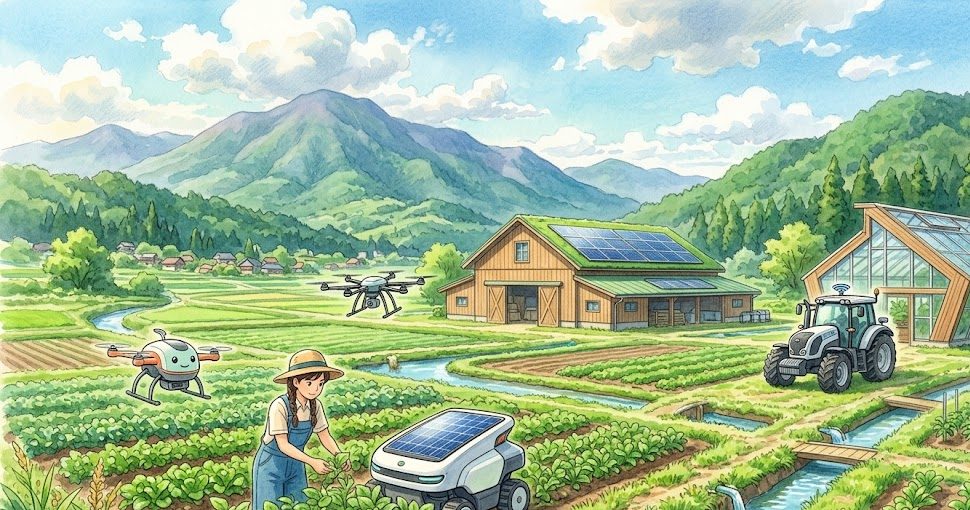
For thousands of years, farming was a profession anchored strictly in human muscle, animal labor, and unpredictable seasonal patterns. A sudden drought, an unseen pest infestation, or a minor calculation error could ruin an entire season’s harvest, leaving communities vulnerable.
Today, the picture looks radically different. Walk out onto a modern, tech-forward commercial farm, and you are just as likely to see an autonomous tractor navigating fields with sub-centimeter accuracy as you are to see a farmer checking a smartphone app.
We are living in the era of Next-Gen Farming. Driven by the urgent need to feed a growing global population under the pressure of climate volatility, labor shortages, and shrinking arable land, agriculture is undergoing its fastest technological evolution in history. This guide explores the cutting-edge tools and futuristic technologies that are fundamentally reshaping how we grow our food.
1. Artificial Intelligence: The Brain of the Modern Farm
Artificial Intelligence (AI) has officially moved from a tech industry buzzword to an essential, practical field asset. In next-gen agriculture, AI acts as a 24/7 digital agronomy consultant, transforming massive amounts of raw environmental data into strategic decisions.
Global Agriculture
Self-Planning Farm Systems and Predictive Analytics
Modern farm management platforms use AI to synthesize multiple data streams simultaneously—historical yield reports, hyper-local weather patterns, and real-time satellite imagery. Instead of a farmer manually scheduling when to plant, irrigate, or apply crop nutrition, these platforms generate highly accurate predictive models. They can forecast exactly when a specific crop will reach peak maturity or predict climate risks, such as a localized frost or flash flood, days before they occur, allowing growers to take protective action.
Ceres AI+ 1
Computer Vision for Crop Scouting
Equipped with advanced machine learning algorithms, high-resolution cameras mounted on tractors or field posts can visually inspect plants at a microscopic level.
- Early Stress Detection: AI can recognize the precise discoloration of a leaf that indicates a specific fungal infection long before the human eye can spot it. Growcycle
- Smart Weed Control: Computer vision allows smart equipment to distinguish between a healthy crop seedling and a rogue weed in milliseconds. Instead of blanket-spraying a whole field with herbicide, the machinery fires a highly targeted micro-dose directly onto the weed, cutting chemical usage by up to 80%. Mitra Agro Equipment
2. Robotics and Autonomous Machinery: Solving the Labor Crisis
Even with decades of heavy mechanization behind us, farming has historically remained intensely dependent on manual labor. However, seasonal labor shortages and rising operational costs have accelerated the rise of field robotics and machine autonomy.
ICL Group+ 1
Driverless Tractors and Harvesters
The concept of a driverless tractor is no longer science fiction; it is a major line item on modern procurement budgets. Using a sophisticated combination of GPS, LiDAR (Light Detection and Ranging), and onboard safety sensors, these autonomous giants can cultivate, seed, and plow fields entirely on their own. They can operate continuously day or night, through heavy dust or thick fog, following highly optimized routes that drastically reduce fuel consumption and prevent soil compaction.
Global Agriculture
Specialized Robotic Harvesters
Delicate, high-value crops like strawberries, grapes, and fresh tomatoes have traditionally resisted mechanical harvesting because machines would crush them. Next-gen robotic harvesters use gentle, soft-touch robotic arms paired with AI vision. The machine checks the fruit’s size and color to assess exact ripeness, clips it cleanly from the vine, and packs it into crates without causing a single bruise.
Global Agriculture+ 1
3. Agricultural Drones (UAVs): Precision in the Skies
Unmanned Aerial Vehicles (UAVs), or agricultural drones, have become one of the fastest-adopted precision tools in modern history. They provide an aerial edge that manual crop scouting simply cannot replicate.
Global Agriculture+ 1
Multispectral Imaging
As drones glide over hundreds of acres of crops, they capture data using multispectral cameras. These cameras read wavelengths of light—such as near-infrared light—that reveal the exact chlorophyll levels and internal water stress of plants. The resulting map shows a farmer exactly which specific zones of a field are thirsty, nutrient-starved, or under attack by pests.
Global Agriculture
Precision Spraying Drones
Heavy tractor-mounted sprayers often crush a percentage of the crops they drive over and can get stuck in wet, muddy fields. Precision-spray drones solve this entirely. Flying autonomously just meters above the crop canopy, they use ultra-low-volume nozzles to mist fertilizers or organic pest controls precisely where needed, completely eliminating chemical drift and drastically lowering water consumption.
4. Controlled-Environment Agriculture (CEA) and Vertical Farming
Next-gen farming isn’t just changing how we grow; it is changing where we grow. Controlled-Environment Agriculture completely decouples crop production from traditional geographic constraints.
Vertical Indoor Farming
By stacking crops in vertical layers inside highly controlled warehouses, urban vertical farms maximize spatial efficiency. These facilities completely bypass soil, utilizing hydroponic (water-based) or aeroponic (mist-based) systems to deliver nutrients directly to plant roots.
Spudnik+ 1
- Climate Independence: Because light, temperature, humidity, and CO2 levels are perfectly managed by automated systems, weather threats are eliminated. Strawberries can be grown in the middle of winter, and crisp lettuce can thrive in the heart of a desert.
- Extreme Resource Conservation: Because water is continuously recycled through a closed loop, vertical farming setups use up to 95% less water and 90% less land than traditional open-field farming. Global Agriculture
5. Agricultural Biotechnology: Editing the Code of Life
While hardware and software optimize the growing environment, biotechnology optimizes the seed itself. The modern frontier of crop genetics revolves around precision tools like CRISPR gene editing.
Global Agriculture
Unlike the controversial early generations of Genetically Modified Organisms (GMOs), which often introduced foreign DNA from entirely different species, modern gene editing works within a plant’s existing genetic code. Scientists can turn specific internal genes “on” or “off” to accelerate traits that would take decades to achieve through traditional cross-breeding.
Global Agriculture
- Drought and Heat Resilience: Developing wheat and corn varieties that require significantly less water and can survive intense heat waves. Global Agriculture
- Extended Shelf-Life: Editing produce to delay the natural decaying process, reducing post-harvest food waste throughout the global shipping chain. Global Agriculture
- Nutritional Biofortification: Enhancing staples like rice or cassava with higher concentrations of vitamins and essential minerals to combat malnutrition in developing regions. Global Agriculture
High-Tech vs. Traditional Agriculture
| Technological Layer | Traditional Approach | Next-Gen Farming Approach |
|---|---|---|
| Field Management | Whole-field uniform treatment. | Precision, variable-rate management per square meter. |
| Machinery Operation | Manually driven, labor-dependent tractors. | Autonomous, GPS-guided fleets operating 24/7. |
| Crop Scouting | Visual inspection by walking rows. | Multispectral drone scanning and satellite remote sensing. |
| Environmental Control | Highly vulnerable to weather and climate shifts. | Protected via micro-climate tracking or fully indoor CEA. |
| Resource Usage | Higher risk of over-fertilization and water waste. | Data-optimized inputs; highly conserved closed-loop water systems. |
Frequently Asked Questions (FAQs)
1. Are these next-gen technologies affordable for small-scale farmers?
Initially, advanced tools like autonomous tractors and commercial crop drones were limited to massive agricultural corporations due to their high upfront costs. However, technology prices are falling rapidly. Furthermore, tailored equipment financing models, data-sharing cooperatives, and payload-as-a-service providers are making precision tools increasingly accessible to smallholders worldwide.
DLL
2. Can smart farming technologies prevent food waste?
Yes, significantly. Sensors in grain silos, connected telematics in shipping containers, and temperature-controlled storage units track crop conditions from the exact moment of harvest until they arrive at the supermarket. If a cooling system fails during transit, the system immediately flags the issue, preventing tons of produce from spoiling.
3. Does the integration of AI mean human expertise is no longer needed?
Not at all. AI and modern software act as decision-support tools. They process data faster than a human can, but the final strategic decisions, local community adaptations, and overarching operational management still heavily rely on the experience, nuance, and intuition of the human farmer.
S M Sehgal Foundation
4. How do field sensors communicate across remote areas without internet?
Next-gen farms utilize low-power, wide-area networks like LoRaWAN. These networks are incredibly efficient; they can transmit small packets of sensor data (like soil moisture or temperature levels) over distances of up to 15 kilometers back to a central farm hub without requiring standard cellular data or high-power Wi-Fi.
5. How does next-gen farming contribute to environmental sustainability?
By applying inputs with surgical precision. Instead of treating entire regions with synthetic fertilizers, variable-rate technologies ensure that nitrogen is placed only where soil is deficient. This simple precision drastically cuts chemical runoff into local rivers, reduces carbon emissions from heavy machinery tracking, and protects natural water tables.
Mitra Agro Equipment
Conclusion
Global Agriculture
Next-gen farming is no longer a collection of pilot concepts or experimental theories—it is an active transformation of the global food supply chain. By seamlessly weaving together the analytical power of Artificial Intelligence, the tireless endurance of autonomous field robotics, the bird’s-eye perspective of agricultural drones, and the resilience of edited crop biology, modern agriculture is setting a brand-new standard.
The ultimate goal of this technological push is simple yet monumental: to grow cleaner, healthier, and more abundant food while leaving a significantly lighter footprint on our planet. As these modern tools become smarter, cheaper, and more deeply integrated with one another, they will turn the great challenge of global food security into an achievable reality. The future of farming has arrived, and it is beautifully high-tech.