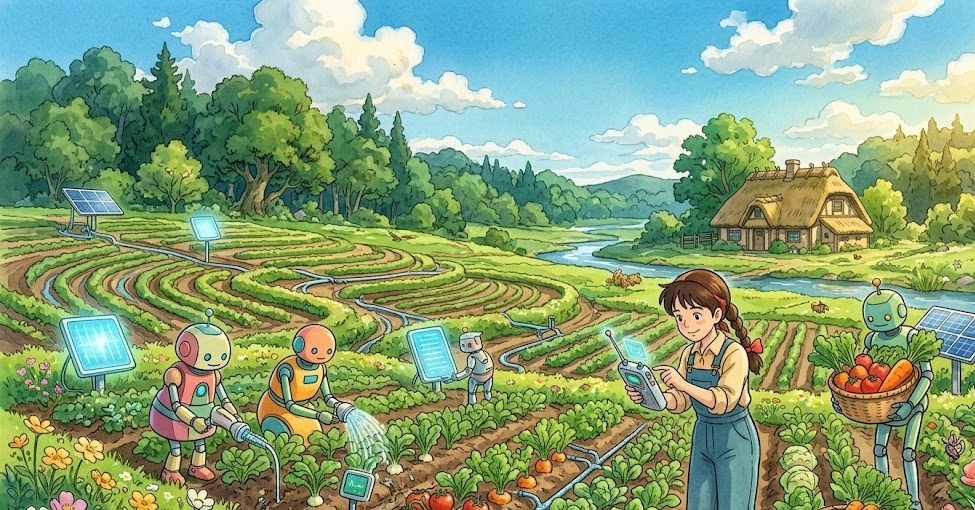
The global agricultural landscape is undergoing a massive transformation. For decades, farming relied on historical intuition, regional calendars, and uniform field management. A farmer would apply the same amount of fertilizer, water, and pesticide across an entire hundred-acre plot, treating every square meter of soil as if it were identical.
Today, that approach is no longer economically or environmentally viable. Rising input costs, erratic climate patterns, and depleted water tables are squeezing profit margins tighter than ever before. To survive and thrive, modern agribusiness must pivot toward a data-driven model: Smart Crop Farming.
Smart crop farming integration represents a shift from generalized farming to micro-managed precision cultivation. By combining real-time data collection, automated machinery, and advanced agronomic techniques, farmers can treat fields not as single units, but as a collection of unique zones with highly specific needs.
This comprehensive guide breaks down the advanced, actionable techniques you need to implement to optimize resource efficiency, safeguard your soil, and maximize your harvest yields.
1. Precision Agriculture and Micro-Zone Field Mapping
At the heart of smart farming is the concept of variability. Soil composition, moisture levels, and nutrient profiles can change drastically within just a few yards. Standard grid-based management ignores this, leading to the over-application of chemicals in fertile zones and the under-application of nutrients in poor zones.
Spatial Data Infrastructure
To implement true precision agriculture, you must establish an accurate digital baseline of your farm. This is achieved through a multi-layered mapping approach:
- Veris Soil EC Mapping: Pulling an electrical conductivity (EC) sensor sled through your fields maps out variations in soil texture, organic matter content, and water-holding capacity.
- Satellite and Drone Imagery (NDVI): Normalized Difference Vegetation Index (NDVI) data captures the spectral signatures of your crops. Healthy plants reflect near-infrared light differently than stressed ones, revealing hidden nutrient deficiencies, pest hotspots, or disease outbreaks days before they become visible to the naked eye.
[Soil EC Scans] + [Drone NDVI Imagery] ──► [GIS Software] ──► [Prescription Yield Maps]
By overlaying these data layers within a Geographic Information System (GIS), you can divide your acreage into distinct “management zones.” These zones dictate exactly how much seed, water, and fertilizer should be allocated to different parts of the field.
2. Deploying IoT and Real-Time Sensor Networks
Smart farming relies on continuous, real-time data collection. Internet of Things (IoT) sensors act as the central nervous system of a modern agricultural enterprise, feeding critical environmental metrics directly to your smartphone or farm management software.
In-Situ Soil Moisture Probes
Placing multi-depth capacitance probes throughout your fields eliminates the guesswork from irrigation. These probes measure volumetric water content at varying root depths (e.g., 10cm, 30cm, and 60cm). Knowing exactly how much water is available to the roots prevents both underwatering stress and overwatering, which leaches expensive nitrogen deep into the water table.
Micro-Climate Weather Stations
Regional weather forecasts are often too broad to rely on for precise fieldwork. On-farm weather stations monitor localized temperature, relative humidity, wind speed, and leaf wetness.
The Disease Prevention Matrix: High humidity paired with specific leaf-wetness duration windows creates the perfect environment for fungal spores to germinate. Real-time micro-climate tracking allows you to apply protective natural fungicides before a disease breaks out, dramatically reducing crop loss.
3. Variable Rate Technology (VRT) for Input Optimization
Once you have mapped your fields and deployed your sensors, the next step is taking targeted action. Variable Rate Technology (VRT) allows modern tractors, seeders, and sprayers to automatically adjust their application rates on the fly based on GPS location data.
Variable Rate Seeding (VRS)
Planting a uniform number of seeds per acre across an entire field often limits yield potential. In highly fertile zones with excellent water retention, you can safely increase planting density to maximize output. In poor, sandy, or rocky zones, reducing the planting density prevents overcrowded plants from competing for scarce resources, lowering your seed costs while protecting baseline yields.
Variable Rate Fertilization (VRF)
Instead of applying a standard blend of Nitrogen, Phosphorus, and Potassium (NPK) across the board, VRF equipment reads your digital prescription maps in real-time. As the tractor moves across the field, the fertilizer spreader alters its output instantly:
┌────────────────────────────────────────────────────────┐
│              Variable Rate Fertilizer Flow             │
├───────────────────────────┬────────────────────────────┤
│ High-Depletion Clay Zone  │ High Output (Boost Nutrients)│
├───────────────────────────┼────────────────────────────┤
│ Low-Yield Rocky Ridge     │ Minimal Output (Save Cost) │
└───────────────────────────┴────────────────────────────┘
This precise placement ensures that nutrients are delivered only where the crop can actively absorb them, preventing chemical runoff and maximizing your return on fertilizer investment.
4. Smart Irrigation and Automated Water Management
Water management is one of the most critical factors dictating final harvest weights. Smart irrigation moves past simple timers, utilizing automated, responsive closed-loop networks instead.
Evapotranspiration (ET) Modeling
Advanced irrigation software calculates daily crop water loss by combining local weather variables (solar radiation, wind, temperature) with the specific crop coefficient (its growth stage). This data indicates exactly how many millimeters of water evaporated from the soil and transpired through the plants over the previous 24 hours, allowing you to replace only what was lost.
Automated Drip Integration
By pairing automated solenoid valves with your soil moisture networks, irrigation systems can run autonomously within your predefined parameters. If soil moisture drops below a specific critical threshold, the drip lines activate automatically. Once the moisture reaches optimal root capacity, the system shuts off, saving water, reducing pumping energy costs, and maintaining an ideal air-to-water balance in the soil.
5. Controlled Environment Agriculture (CEA) and Vertical Integration
For high-value specialty crops, maximizing yields often means moving production away from unpredictable open-field environments entirely. Controlled Environment Agriculture (CEA)—ranging from automated greenhouses to closed vertical indoor farms—provides complete control over the plant’s entire life cycle.
Hydroponic and Aeroponic Systems
Growing plants without soil allows for maximum root efficiency. In aeroponic systems, plant roots hang suspended in the air and are misted with a highly concentrated nutrient solution at precise intervals. Because the roots enjoy unrestricted access to oxygen and perfectly balanced minerals, crop maturation speeds can increase by up to 30%, allowing for more harvest cycles per calendar year from the exact same footprint.
Strategic Implementation Framework for Smart Farming
Transitioning your operations to a smart farming model should be done in careful, structured phases to protect capital and ensure smooth adoption:
1
High-Resolution Base Mapping
Phase 1: Diagnosis
1.High-Resolution Base Mapping:Phase 1: Diagnosis.
Conduct intensive soil electrical conductivity (EC) testing and gather multi-season satellite NDVI data to map out the hidden biological variations across your acreage.
2
Telemetry and Sensor Deployment
Phase 2: Observation
2.Telemetry and Sensor Deployment:Phase 2: Observation.
Install real-time, multi-depth soil moisture probes and connected micro-climate weather stations in your key management zones to begin logging baseline environmental data.
3
Software Centralization
Phase 3: Integration
3.Software Centralization:Phase 3: Integration.
Connect all field telemetry, mapping layers, and weather inputs into a unified Farm Management Information System (FMIS) to track real-time resource efficiency.
4
Variable Rate Automation
Phase 4: Execution
4.Variable Rate Automation:Phase 4: Execution.
Equip your machinery with GPS-guided Variable Rate Controllers to automatically adjust seeding densities and fertilizer inputs as you work your fields.
Frequently Asked Questions (FAQs)
What is the primary difference between traditional farming and smart crop farming?
Traditional farming applies resources uniformly across an entire field based on schedules or general averages. Smart crop farming uses real-time data from sensors, satellites, and GPS systems to apply inputs like water, seed, and fertilizer precisely where and when they are needed, optimizing efficiency on a yard-by-yard basis.
Is smart farming technology profitable for small-scale farms?
Yes, smart farming is highly scalable. While large farms benefit from heavy automated machinery, smallholders can achieve excellent returns on investment by focusing on affordable entry-level tech, such as standalone handheld soil moisture meters, localized drip irrigation networks, and free open-source satellite NDVI data.
How does NDVI imagery help improve final harvest yields?
NDVI (Normalized Difference Vegetation Index) maps measure how much near-infrared light crop leaves reflect. Stressed or diseased plants display a distinct drop in reflection long before structural damage is visible to humans. Spotting these weak zones early allows you to address localized issues before they spread and harm your overall yields.
Can smart irrigation systems operate during periods of heavy rain?
Yes. Smart irrigation setups are integrated with automated rain gauges and real-time soil moisture probes. If the system detects sufficient rainfall or notices soil moisture levels are already at maximum holding capacity, it will automatically override its normal schedule and pause irrigation to prevent waterlogging.
Conclusion
Maximizing harvest yields in modern agriculture requires moving away from uniform, generalized field management. True profitability is found by adopting high-precision, data-driven techniques that treat every square yard of soil according to its individual biological needs.
By utilizing high-resolution soil mapping, deploying real-time IoT sensor networks, and implementing variable rate technologies, you can maximize resource efficiency and reduce unnecessary input costs. Smart crop farming isn’t simply about investing in high-tech gadgets; it is about combining advanced technology with sound agronomic principles to build a more resilient, productive, and profitable agricultural business.