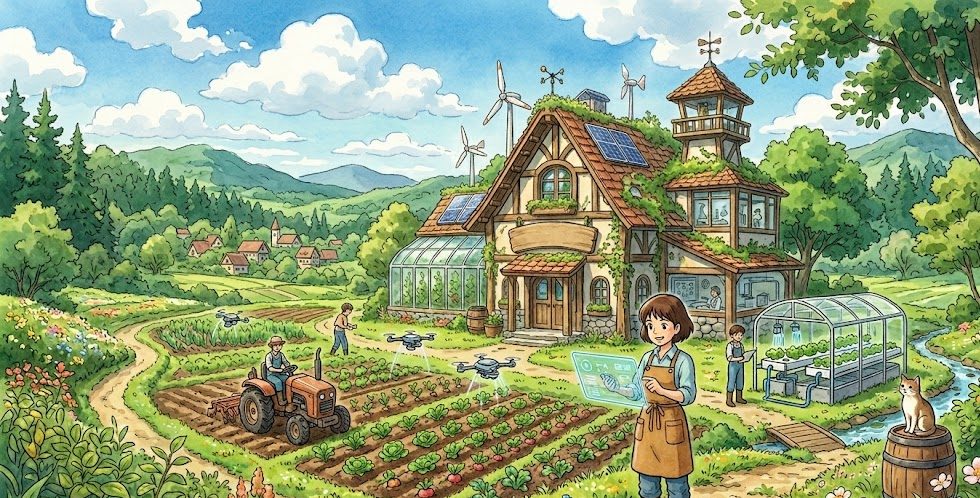
The global agricultural sector is undergoing a profound structural shift. For generations, farming relied heavily on historical averages, manual labor, and rigid seasonal routines. Today, volatile weather patterns, persistent labor shortages, and rising input costs have turned traditional practices into high-risk endeavors. To survive and thrive, the modern grower must look toward data-driven, automated solutions.
Enter the Farming Innovation Hub—a concept representing the convergence of digital ecosystems, advanced robotics, and physical artificial intelligence (AI). This central nucleus of agricultural technology (AgriTech) is changing the narrative of food production. Rather than deploying isolated, standalone gadgets, the modern innovation hub integrates cutting-edge technologies into a single, unified operating system. This comprehensive guide explores the pioneering tech redefining the fields and boosting farm profitability.
The Rise of the Farming Connected Intelligence Cloud
The greatest frustration for early adopters of AgriTech was “sensor fatigue”—managing dozens of disconnected mobile apps that measured only one metric, like soil moisture or a simple weather forecast. Today, innovation hubs have solved this bottleneck through unified, agricultural cloud platforms.
+-----------------------------------------------------------------+
|                    THE CONNECTED INTELLIGENCE HUBS             |
+-----------------------------------------------------------------+
| [Data Inputs: Satellites, IoT, Drones] -> [Unified Cloud Hub]   |
|                                                  |              |
|                                                  v              |
|                             [Agentic AI Decision-Grade Actions] |
+-----------------------------------------------------------------+
These advanced data hubs harmonize information from multiple sources—including low-earth-orbit satellites, IoT field sensors, autonomous tractors, and hyper-local weather stations. By feeding this collective data into machine learning models, the hub functions as the central nervous system of the farm.
Instead of generating generic, reactive alerts, these platforms deliver “decision-grade” predictive insights. Farmers can view a single dashboard to track whole-plot vegetation indexes, project exact crop yields, and manage resource constraints simultaneously.
Physical AI and Field Robotics
With agricultural labor pools shrinking globally, specialized automation is transitioning rapidly from an experimental luxury into an operational necessity. Physical AI—the integration of machine learning directly into mechanical hardware—is driving this field revolution.
Autonomous Implements and Smart Spraying
Instead of purchasing entirely new autonomous vehicle fleets, many growers are utilizing smart implements that attach directly to existing tractors. These implements utilize high-speed computer vision cameras trained on millions of plant images. As the tractor drives through rows, the implement distinguishes between crops and weeds in milliseconds, delivering a micro-dose of herbicide directly to the weed or using mechanical micro-blades to remove it. This targeted approach cuts chemical herbicide consumption by up to 50%, saving money while protecting soil biology.
Driverless Tractors and Retrofit Automation Kits
Full automation is taking root via driverless tractors guided by centimeter-level GPS and spatial telematics. These machines can operate safely around the clock, optimizing field routes to slash fuel consumption and significantly reduce soil compaction. By following identical, pre-programmed paths season after season, the tractor avoids crushing the delicate underground soil structure, preserving vital root pathways.
Agentic AI and Predictive Planning
Artificial intelligence in agriculture has moved far beyond simple spreadsheets and entry-level predictive models. The latest breakthrough inside innovation hubs is Agentic AI.
+------------------------+      +------------------------+      +------------------------+
|      Static Text       | ---> |    Agentic Planning    | ---> |  Optimized Operations  |
| "Fungal risk is rising |      | AI simulates scenarios |      | Recommends "next-best" |
|   due to high humidity"|      |  and checks logistics  |      | actions for procurement|
+------------------------+      +------------------------+      +------------------------+
Unlike traditional software that requires human prompts for every action, agentic systems act as autonomous intelligent agents. They understand natural language and continuously simulate complex risk scenarios as microclimates and market logistics shift in real time.
If an agentic system detects a sudden spike in moisture and humidity, it won’t just flag a disease risk; it will automatically check current bio-pesticide inventory, verify local weather windows, and recommend the absolute “next-best-action” for application. This shifts the farmer’s role from daily, reactive firefighting to high-level system oversight.
Instrumentation of Biology and Remote Sensing
Understanding crop health at a microscopic level without pulling up plants is now possible through advanced remote sensing technology and the instrumentation of biology.
- Satellite Remote Sensing & NDVI: Modern platforms utilize high-resolution multispectral satellite imagery to monitor Normalized Difference Vegetation Index (NDVI) levels. This allows operators to see subtle changes in crop health and chlorophyll levels long before structural damage is visible to the human eye. Farmonaut+ 1
- Precision Drones: Equipped with multispectral cameras, crop-scouting drones fly pre-programmed flight paths to map fields at a fraction of the cost of traditional manual scouting. Heavy-duty cargo drones are then deployed to execute spot-spraying or precise seeding over specific, high-stress zones.
Blockchain and Immutable Supply Chain Traceability
Consumer demand for food transparency has reached an all-time high. Buyers, processors, and international regulators want verifiable proof regarding how food was produced, where it was grown, and its overall carbon footprint.
Innovation hubs are addressing this challenge by embedding blockchain traceability directly into the harvest workflow.
When a crop is collected by an automated harvester, the load is immediately geotagged with its exact field coordinates and timestamped. As the batch moves through logistics channels, IoT temperature sensors log storage conditions onto an unchangeable, secure digital ledger. This end-to-end transparency dramatically lowers food safety contamination risks, simplifies international compliance, and allows farmers to command a premium price for verified sustainable practices.
Equipment-as-a-Service (EaaS) Lowers Financial Barriers
The advanced technologies pioneered within innovation hubs carry significant research and development costs. Historically, this meant high-tech precision agriculture was limited strictly to massive corporate conglomerates.
To bridge this digital divide, the AgriTech industry is actively shifting toward an Equipment-as-a-Service (EaaS) business model.
| Financing Model | Traditional Purchase | Equipment-as-a-Service (EaaS) |
|---|---|---|
| Upfront Capital | Extremely high; requires substantial loans or cash reserves. | Low entry barrier; predictable operational subscription fees. |
| Obsolescence Risk | High; the farmer owns hardware that may become outdated in years. | Zero; service providers update hardware and software versions. |
| Scalability | Rigid; difficult to expand or pivot technology quickly. | Highly flexible; scale technology up or down based on seasonal acreage. |
By treating advanced technology as an operational expense rather than a massive capital investment, small and mid-sized farming operations can access top-tier robotics, AI cloud systems, and sensor networks, keeping them highly competitive in a challenging global market.
Conclusion: Driving Predictable ROI at the Farm Edge
The modern Farming Innovation Hub proves that the future of agriculture relies on integration, not isolation. True efficiency isn’t achieved by simply buying a flashier tractor or adding another standalone app; it is realized when sensors, AI platforms, and robotics operate together as a cohesive ecosystem.
By adopting these integrated systems, modern agribusinesses can move from intuition-based choices to precise, insight-driven decisions. Investing in connected intelligence, physical AI, and smart financing models allows growers to mitigate climate risk, protect narrow profit margins, and deliver reliable food supply assurance to a changing world. AgriTech is no longer just an experiment—it is the foundational infrastructure for the future of global farming.