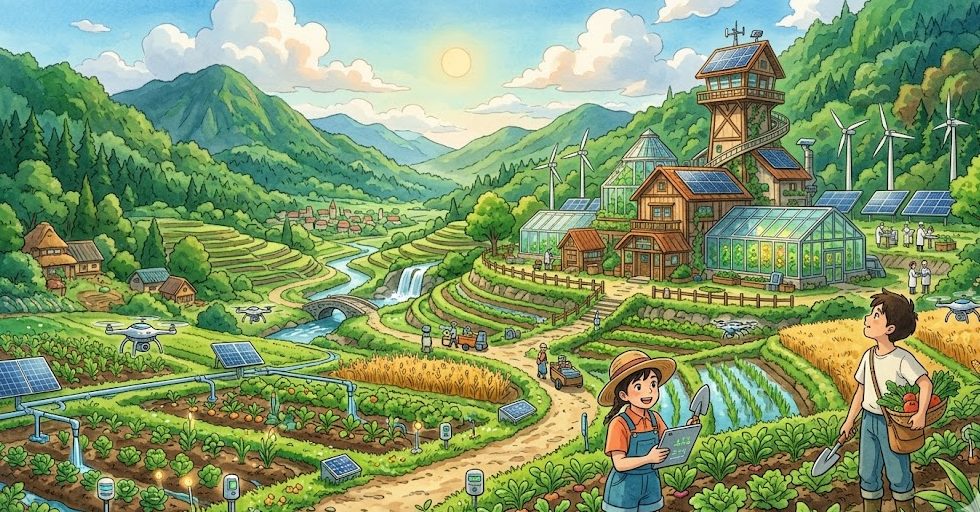
The agricultural landscape is undergoing a profound metamorphosis. As we navigate through 2026, the era of traditional, intuition-based farming is being eclipsed by “Next-Gen Farming”—a data-driven, hyper-efficient ecosystem. For farmers, investors, and agritech entrepreneurs, this shift is not just about adopting new tools; it is about building a future-proof business model that thrives on volatility and delivers consistent ROI.
In this guide, we explore the convergence of smart crops, strategic growth, and the innovation hubs that are defining the future of global food production.
1. The Core of Next-Gen Farming: Connectivity and AI
Next-gen farming is defined by the transition from “Big Data” to “Decision-Grade Intelligence.” In 2026, it is no longer enough to just collect data; the winners are those who can turn that data into immediate, actionable tasks.
The “Decision Support” Revolution
Modern operations are now leveraging Agentic Planning. Unlike older dashboards that simply displayed charts, today’s AI-powered platforms can simulate thousands of scenarios to recommend the “next-best-action” for planting, chemical application, and logistics.
- Real-Time Interoperability: Smart farms are now “connected ecosystems” where tractors, drones, and soil sensors communicate seamlessly. This eliminates data silos and reduces manual operational overhead by up to 80%.
2. Smart Crops: The Biotech Leap
The foundation of high-yield farming in 2026 lies in the genetic resilience of the crops themselves. Moving beyond traditional GMOs, the industry is witnessing a “Biotech Leap” centered on precision and speed.
- CRISPR and Gene Editing: Unlike older technologies, gene editing allows for precise modifications within a plant’s existing genome. This has accelerated the creation of drought-tolerant and heat-resistant varieties that thrive in the erratic climates of 2026.
- Physiological Hardening: Farmers are now using advanced biostimulants that “harden” crops, improving their natural tolerance to salinity and heat. This reduces the need for expensive chemical interventions and stabilizes yields against climate shocks.
3. Growth Strategies for the Modern Farmer
Moving from a traditional farm to a next-gen enterprise requires a shift in strategic thinking. The most successful operations today focus on Supply Assurance rather than just volume.
Pillars of High-Value Growth:
- Risk-Adjusted Sourcing: Top-tier firms are using AI to forecast the viability of new production zones. By analyzing decades of climate and logistical data, they minimize the risk of capital commitment.
- Modular Automation: Instead of expensive “all-in-one” systems, smart farmers are adopting modular robotics. By integrating task-specific bots for weeding or harvesting, they break the “ROI barrier” that previously made high-tech farming too expensive for mid-sized operations.
- Human-in-the-Loop: In 2026, the goal is not to replace the farmer, but to augment them. Machines handle repetitive, labor-intensive tasks, while the farmer focuses on high-level decision-making and strategic market engagement.
4. The Innovation Hub: Accelerating Adoption
Innovation Hubs—centers where technology providers, agronomists, and farmers collaborate—have become the engines of agricultural progress. These hubs serve as the bridge between theoretical research and field application.
- Field-Ready AI: Innovation hubs are shifting their focus from abstract research to “Field-Ready” AI. This means tools are designed to work in remote areas with limited connectivity, often using offline-first architectures.
- Standardization: A primary mission of these hubs is to standardize how agricultural data is shared. By creating universal protocols, they allow different technologies (like a drone from one company and a sprayer from another) to work together seamlessly.
The Economic Advantage of Next-Gen Farming
The transition to these technologies is driven by a focus on Resilience. In the current market, farming is an operational hazard; however, next-gen practices mitigate these risks through:
- Reduced Input Costs: Precision spraying and sensor-guided irrigation can reduce chemical use by up to 50% and water consumption significantly.
- Carbon Sequestration as an Asset: Regenerative practices, supported by smart sensors that track soil carbon, are turning healthy soil into a “bankable asset,” allowing farmers to tap into carbon credit markets.
- Traceability: With new global regulations (like the EUDR), digital traceability is no longer a luxury—it is a requirement to access premium export markets.
Frequently Asked Questions (FAQs)
Q: Is next-gen farming only for large corporations? A: No. In 2026, we are seeing a shift toward “Service Models” (Ag-as-a-Service) where small and mid-sized farmers can lease robotic equipment or access AI analytics platforms without the massive upfront capital investment.
Q: How do smart crops differ from traditional GMOs? A: Smart crops often use CRISPR gene editing, which is more precise and avoids the introduction of foreign DNA. This allows for faster regulatory approval and higher consumer acceptance.
Q: What is the most important first step for a farmer wanting to upgrade? A: Start with Connectivity. Before investing in robots or AI, ensure your farm has the infrastructure (IoT sensors and reliable connectivity) to capture high-quality, actionable data.
Conclusion
Next-gen farming is the pragmatic evolution of agriculture. By embracing smart crops, intelligent automation, and a data-first growth strategy, farmers can insulate their business from climate volatility and market instability. As we move forward, the competitive advantage will belong to those who can bridge the gap between biological potential and digital efficiency.