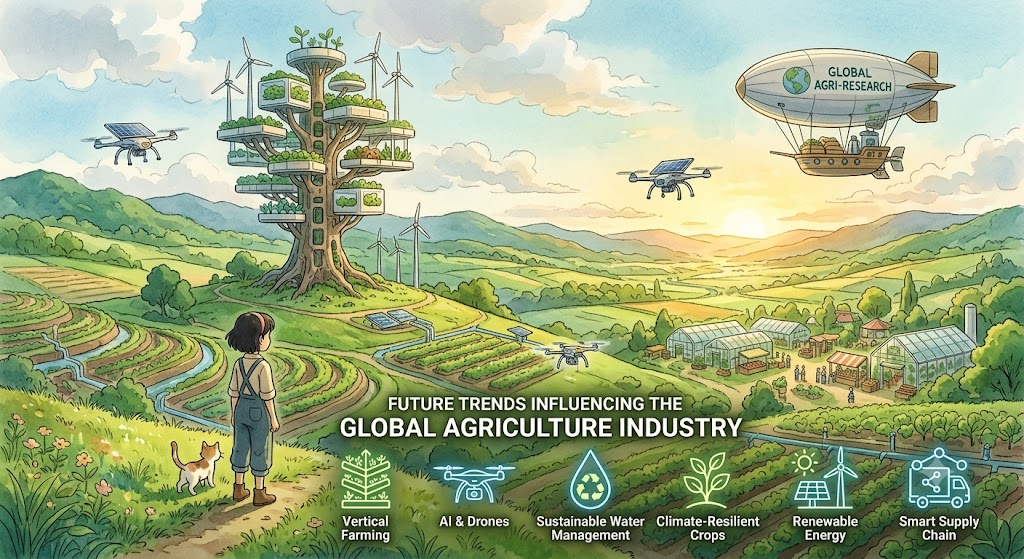
Agriculture is entering a new era of transformation. As the world’s population continues to grow and demand for food increases, farmers, researchers, governments, and agribusinesses are working to develop innovative solutions that improve productivity while protecting natural resources. At the same time, climate change, technological advancements, shifting consumer preferences, and sustainability concerns are reshaping how food is produced around the globe.
The future of agriculture will be driven by a combination of technology, environmental stewardship, resource efficiency, and data-driven decision-making. Understanding these emerging trends can help farmers, investors, and industry stakeholders prepare for the opportunities and challenges that lie ahead.
This article explores the key trends expected to influence the global agriculture industry in the coming years.
Growing Food Demand and Population Growth
One of the biggest forces shaping agriculture is the steady growth of the global population.
According to international projections, the world’s population is expected to continue increasing over the coming decades, creating greater demand for:
- Food crops
- Livestock products
- Fruits and vegetables
- Animal feed
- Agricultural raw materials
To meet this demand, farmers will need to increase productivity while using land, water, and other resources more efficiently.
Improving agricultural output without expanding farmland will remain a major priority.
Precision Agriculture and Smart Farming
Precision agriculture is becoming one of the most important developments in modern farming.
Advanced technologies now allow farmers to manage fields with greater accuracy using:
- GPS systems
- Drones
- Field sensors
- Satellite imagery
- Automated machinery
These tools provide detailed information about:
- Soil conditions
- Crop health
- Water requirements
- Nutrient levels
- Pest activity
Precision farming helps reduce waste, improve yields, and optimize resource use.
As technology becomes more affordable, adoption is expected to increase worldwide.
Artificial Intelligence in Agriculture
Artificial Intelligence (AI) is rapidly transforming agricultural management.
AI-powered systems can analyze large amounts of data to support decisions related to:
- Crop management
- Weather forecasting
- Pest detection
- Yield prediction
- Irrigation scheduling
Machine learning algorithms continue improving as they process more information, allowing farmers to make increasingly accurate and efficient decisions.
AI is expected to become a major component of future farming systems.
Automation and Agricultural Robotics
Labor shortages are becoming a significant challenge in many agricultural regions.
To address this issue, farms are increasingly adopting automation technologies.
Agricultural robots can perform tasks such as:
- Planting
- Harvesting
- Weeding
- Crop monitoring
- Sorting produce
Automated systems improve efficiency, reduce labor dependency, and increase operational consistency.
Future advancements are likely to make robotic solutions more accessible to farmers of all sizes.
Climate-Smart Agriculture
Climate change is affecting agricultural production through:
- Extreme weather events
- Changing rainfall patterns
- Rising temperatures
- Increased drought risks
Climate-smart agriculture focuses on helping farmers adapt to these challenges while reducing environmental impacts.
Key strategies include:
- Drought-resistant crop varieties
- Improved irrigation systems
- Soil conservation practices
- Agroforestry
- Efficient nutrient management
Climate resilience will become increasingly important for maintaining stable food production.
Sustainable Farming Practices
Consumers, governments, and agricultural organizations are placing greater emphasis on sustainability.
Future farming systems are expected to prioritize:
- Soil health improvement
- Water conservation
- Reduced chemical use
- Biodiversity protection
- Carbon reduction
Sustainable agriculture not only benefits the environment but can also improve long-term farm profitability.
Many markets are increasingly rewarding environmentally responsible production methods.
Advanced Crop Genetics
Crop breeding technologies continue to evolve rapidly.
Future crop varieties are expected to offer:
- Higher yields
- Better disease resistance
- Improved drought tolerance
- Enhanced nutritional value
- Greater climate adaptability
Advances in genetics will help farmers overcome production challenges while improving food security.
Improved crop varieties will play a major role in future agricultural growth.
Digital Agriculture and Data Analytics
Data is becoming one of agriculture’s most valuable resources.
Modern farming systems increasingly rely on:
- Farm management software
- Yield monitoring
- Remote sensing
- Predictive analytics
- Cloud-based platforms
Data-driven agriculture helps farmers:
- Improve decision-making
- Reduce production costs
- Increase efficiency
- Identify potential problems early
The use of agricultural data is expected to expand significantly in the coming years.
Water Management Innovations
Water scarcity is a growing concern in many farming regions.
Future agricultural systems will focus heavily on improving water efficiency through:
- Drip irrigation
- Smart irrigation controllers
- Soil moisture monitoring
- Rainwater harvesting
- Water recycling technologies
Efficient water use will become increasingly important for both productivity and sustainability.
Controlled Environment Agriculture
Controlled Environment Agriculture (CEA) allows crops to be grown under carefully managed conditions.
Examples include:
- Greenhouses
- Vertical farms
- Indoor growing facilities
- Hydroponic systems
Benefits include:
- Year-round production
- Reduced weather dependence
- Improved resource efficiency
- Increased productivity per square meter
As urban populations grow, controlled environment farming may become an important part of food production systems.
Vertical Farming Expansion
Vertical farming is gaining attention as a solution to limited land availability.
This method involves growing crops in stacked layers within controlled environments.
Advantages include:
- Reduced land requirements
- Lower water consumption
- Shorter supply chains
- Consistent production
While currently focused on high-value crops, vertical farming technology continues to improve and expand.
Renewable Energy Integration
Agricultural operations are increasingly adopting renewable energy solutions.
Examples include:
- Solar-powered irrigation systems
- Wind energy installations
- Bioenergy production
- Solar greenhouses
Renewable energy helps reduce operating costs while supporting environmental sustainability.
Energy-efficient farms are expected to become more common in the future.
Biological Pest Management
Future pest management strategies will increasingly emphasize biological solutions.
These include:
- Beneficial insects
- Biological pesticides
- Integrated Pest Management (IPM)
- Natural pest monitoring systems
Reducing dependence on chemical pesticides can improve environmental outcomes and support sustainable production.
Carbon Farming and Environmental Markets
Agriculture is beginning to play a larger role in carbon management.
Carbon farming practices may include:
- Cover cropping
- Reduced tillage
- Agroforestry
- Improved grazing systems
Some regions are developing carbon credit markets that reward farmers for environmentally beneficial practices.
This trend could create new income opportunities for agricultural producers.
Traceability and Food Transparency
Consumers increasingly want to know where their food comes from and how it was produced.
Future food systems may rely more heavily on:
- Digital tracking systems
- Blockchain technology
- Supply chain transparency tools
Improved traceability can increase consumer confidence and strengthen food safety standards.
Alternative Protein Production
Growing interest in alternative protein sources is influencing agricultural markets.
Examples include:
- Plant-based proteins
- Insect protein
- Cultivated food technologies
Although traditional agriculture will remain essential, alternative protein industries may create new opportunities and market dynamics.
Building a Future-Ready Agricultural Business
Farmers preparing for the future should focus on:
- Technology adoption
- Resource efficiency
- Soil health improvement
- Climate resilience
- Data-driven management
- Market diversification
- Sustainable production practices
Proactive planning can help agricultural businesses remain competitive in a rapidly changing industry.
Conclusion
The global agriculture industry is undergoing significant transformation driven by technological innovation, sustainability goals, climate adaptation, and changing consumer expectations. Trends such as precision agriculture, artificial intelligence, automation, advanced crop genetics, controlled environment farming, and renewable energy integration are reshaping how food is produced around the world.
Farmers and agricultural businesses that embrace innovation while maintaining sustainable practices will be better positioned to meet future challenges and opportunities. As agriculture continues to evolve, adaptability, efficiency, and responsible resource management will become key factors in achieving long-term success in the global food production system.