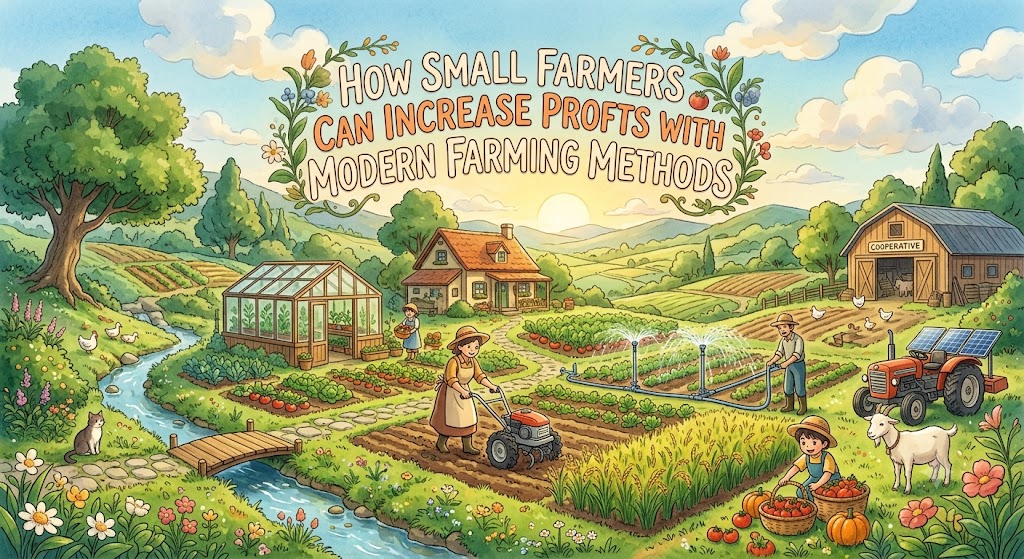
For many small farmers, increasing profits is not always about expanding the size of the farm. In many cases, the biggest improvements come from producing more efficiently, reducing unnecessary expenses, and making smarter business decisions. A small piece of land managed well can often generate better returns than a much larger farm managed poorly.
Agriculture has changed significantly over the past decade. Modern farming methods now allow farmers to grow healthier crops, conserve resources, reach better markets, and improve productivity without dramatically increasing production costs. These methods combine practical farming experience with improved technology, better planning, and sustainable management practices.
The good news is that modern farming is no longer limited to large commercial farms. Many affordable techniques can help small farmers improve yields, lower costs, and build a more profitable farming business.
Think Like a Farm Entrepreneur
Successful farmers today do more than grow crops—they manage their farms like businesses.
Before every planting season, ask yourself:
- Which crops are currently in high demand?
- What are the expected production costs?
- Where will the harvest be sold?
- Can value be added after harvesting?
- Which farming practices will reduce expenses?
Planning ahead reduces financial risk and helps farmers make better investment decisions.
Build Strong Profits From Healthy Soil
Healthy soil is one of the most valuable assets on any farm.
Rather than depending only on chemical fertilizers, modern farmers focus on improving soil naturally.
Effective practices include:
- Compost application
- Crop rotation
- Cover cropping
- Organic manure
- Mulching
- Reduced tillage
Healthy soil produces stronger crops while lowering long-term fertilizer requirements.
Grow Crops That Offer Better Returns
Not every crop delivers the same level of profit.
Many small farmers increase their income by replacing low-value crops with products that have stronger market demand.
Examples include:
- Medicinal herbs
- Garlic
- Ginger
- Turmeric
- Mushrooms
- Leafy vegetables
- Chili peppers
- Microgreens
- Strawberries
Choosing crops based on market demand often produces better financial results than simply growing traditional crops every year.
Reduce Water Waste
Water is becoming both expensive and increasingly limited.
Modern irrigation methods help farmers save money while improving crop growth.
Smart water management includes:
✔ Drip irrigation
✔ Mulching
✔ Rainwater harvesting
✔ Moisture monitoring
✔ Irrigating during cooler hours
Reducing water waste lowers production costs throughout the growing season.
Invest in Better Seeds Instead of More Fertilizer
Many farmers spend large amounts on fertilizers while planting poor-quality seeds.
Certified seeds usually provide:
- Better germination
- Higher yields
- Stronger disease resistance
- Improved crop quality
- More uniform growth
A good seed often produces a better return than excessive fertilizer applications.
Use Technology That Fits Your Budget
Modern farming technology doesn’t always require expensive machinery.
Affordable tools available today include:
- Mobile farming apps
- Weather forecast applications
- Soil testing kits
- Automatic irrigation timers
- GPS mapping tools
- Drone service providers
Even small technological improvements can make farm management more efficient.
Reduce Production Costs Without Reducing Quality
Improving profits is not only about increasing income.
Reducing unnecessary expenses is equally important.
Areas where farmers can save money include:
- Accurate fertilizer application
- Efficient irrigation
- Preventive pest management
- Fuel-efficient machinery
- Better crop planning
Small savings across multiple activities often create significant overall profit.
Sell Smarter, Not Just More
Growing an excellent crop means little if it is sold through poor marketing channels.
Modern farmers explore multiple selling options, including:
- Local markets
- Farmers’ markets
- Restaurants
- Grocery stores
- Food processors
- Online marketplaces
- Direct farm sales
Selling directly to customers often increases profit margins.
Add Value Before Selling
Raw agricultural products usually earn lower prices than processed products.
Value-added opportunities include:
| Raw Product | Value-Added Product |
|---|---|
| Tomatoes | Tomato sauce |
| Turmeric | Turmeric powder |
| Milk | Cheese or yogurt |
| Herbs | Dried herbal tea |
| Fruits | Jam or dried fruit |
| Honey | Branded packaged honey |
Processing and attractive packaging often increase product value significantly.
Keep Farm Records
Many profitable farmers know exactly where every dollar is spent.
Important records include:
- Seed purchases
- Fertilizer costs
- Irrigation expenses
- Labor costs
- Harvest quantities
- Selling prices
- Equipment maintenance
Good records help identify both profitable and unprofitable farming activities.
Protect Crops Before Problems Become Serious
Waiting until pests or diseases spread across the field usually results in higher costs.
Instead:
- Inspect fields regularly.
- Monitor weather conditions.
- Remove infected plants early.
- Use integrated pest management.
- Encourage beneficial insects.
- Apply treatments only when necessary.
Preventive management usually costs less than emergency control.
Diversify Farm Income
Relying on one crop increases financial risk.
Many successful small farmers combine several enterprises such as:
- Vegetable farming
- Poultry
- Beekeeping
- Mushroom production
- Fish farming
- Fruit orchards
- Medicinal plants
Multiple income sources improve financial stability throughout the year.
Learn Continuously
Agriculture changes every season.
Farmers who continue learning often outperform those who rely only on traditional methods.
Useful learning sources include:
- Agricultural workshops
- Farmer training programs
- Demonstration farms
- Research institutions
- Online farming courses
- Agricultural extension services
Knowledge remains one of the most valuable farming investments.
Modern Farming Practices Worth Adopting
| Traditional Approach | Modern Alternative |
|---|---|
| Fixed irrigation schedules | Soil moisture-based irrigation |
| Uniform fertilizer application | Soil testing and precision nutrition |
| Manual farm records | Digital record keeping |
| Selling only to wholesalers | Multiple marketing channels |
| Growing one crop | Diversified farming systems |
These changes help improve efficiency while reducing unnecessary costs.
Common Profit-Reducing Mistakes
Many farms lose money because of avoidable errors.
Avoid these common mistakes:
- Growing crops without market research
- Ignoring soil testing
- Using poor-quality seeds
- Overusing fertilizers
- Delaying pest management
- Keeping no financial records
- Selling immediately after harvest without comparing prices
Correcting these issues can significantly improve farm income.
Final Thoughts
Small farmers have enormous potential to increase profits without dramatically expanding their land. By improving soil health, choosing high-value crops, adopting efficient irrigation, using quality seeds, reducing unnecessary expenses, and exploring better marketing opportunities, farms can become both more productive and more profitable.
Modern farming is not about replacing traditional knowledge—it is about strengthening it with better planning, practical technology, and smarter business decisions. Farmers who embrace continuous improvement and sustainable practices will be better prepared to succeed in an increasingly competitive agricultural industry.
Frequently Asked Questions
1. How can small farmers increase profits without buying more land?
They can improve soil health, grow higher-value crops, reduce production costs, diversify income sources, and adopt efficient farming techniques.
2. Which modern farming method saves the most money?
Efficient irrigation, precision fertilizer application, quality seeds, and good crop planning often produce the greatest savings.
3. Is modern farming expensive for beginners?
No. Many modern practices, such as composting, soil testing, crop rotation, and mobile farming apps, are affordable and suitable for small farms.
4. Why is record keeping important in farming?
Farm records help farmers monitor expenses, compare profits, identify weak areas, and make better financial decisions.
5. Can diversification improve farm income?
Yes. Combining crops with activities such as beekeeping, mushroom cultivation, poultry, or fruit production reduces financial risk and creates multiple sources of income.