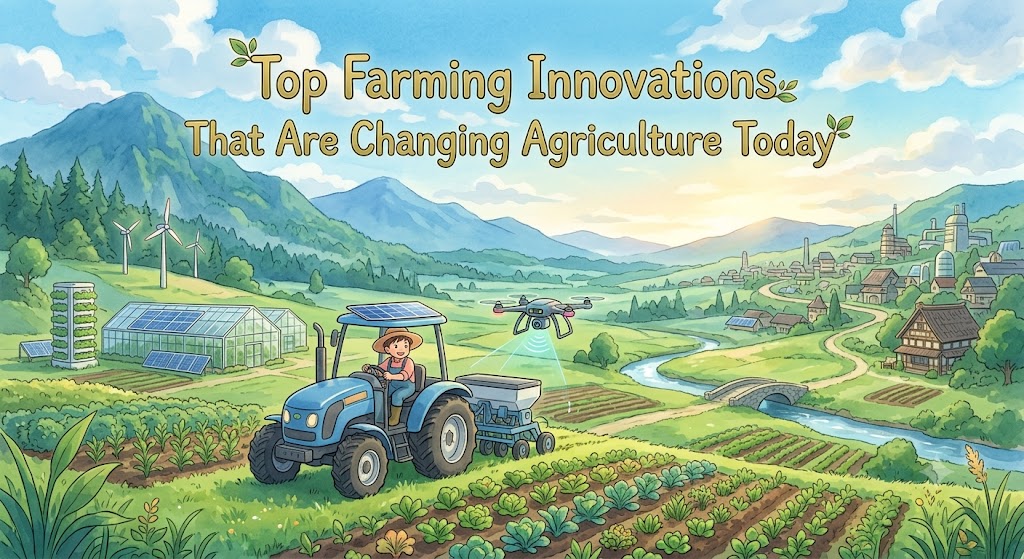
Agriculture has entered a new era where technology, sustainability, and data-driven decision-making are transforming the way food is produced. Modern farming is no longer limited to tractors, irrigation systems, and traditional cultivation methods. Today, farmers are using advanced tools such as artificial intelligence, drones, smart sensors, precision equipment, robotics, and digital farm management systems to improve productivity while reducing costs and protecting natural resources.
As the global population continues to grow and climate conditions become more unpredictable, the demand for efficient and sustainable farming practices has never been greater. Agricultural innovations are helping farmers produce more food with fewer resources while minimizing environmental impact.
This guide explores some of the most important farming innovations that are reshaping agriculture today and explains how they are improving crop production, resource management, and long-term farm profitability.
Why Innovation Is Essential in Modern Agriculture
Farmers face many challenges, including:
- Climate change
- Rising production costs
- Water shortages
- Soil degradation
- Labor shortages
- Pest and disease outbreaks
- Increasing food demand
Modern agricultural innovations provide practical solutions that help farmers overcome these challenges while improving efficiency and sustainability.
Precision Farming
Precision farming uses technology to manage crops according to the specific needs of different areas within a field rather than treating the entire farm the same way.
This approach allows farmers to:
- Apply fertilizers more accurately
- Optimize irrigation
- Reduce chemical use
- Improve crop health
- Increase productivity
By making field management more precise, farmers reduce waste while improving crop performance.
Smart Sensors for Soil and Crops
Modern sensors continuously monitor important field conditions.
They can measure:
- Soil moisture
- Soil temperature
- Nutrient availability
- Humidity
- Weather conditions
Real-time information allows farmers to make better irrigation and fertilization decisions instead of relying on guesswork.
This improves both efficiency and crop quality.
Agricultural Drones
Drones have become valuable tools for crop monitoring.
They help farmers:
- Survey large fields quickly
- Detect stressed plants
- Monitor crop growth
- Identify pest outbreaks
- Assess irrigation performance
- Create detailed field maps
Regular aerial monitoring enables early intervention before problems become widespread.
Artificial Intelligence in Farming
Artificial intelligence is changing agriculture by analyzing large amounts of farm data and supporting better decision-making.
AI systems assist with:
- Yield prediction
- Disease identification
- Pest detection
- Weather forecasting
- Irrigation scheduling
- Fertilizer recommendations
By processing information rapidly, AI helps farmers improve productivity while reducing unnecessary input costs.
Internet of Things (IoT)
The Internet of Things connects farm equipment and sensors through digital networks.
Connected devices can automatically monitor:
- Water usage
- Greenhouse conditions
- Soil moisture
- Equipment performance
- Livestock health
This continuous monitoring allows farmers to respond quickly when conditions change.
Automated Irrigation Systems
Water conservation has become one of agriculture’s highest priorities.
Modern irrigation systems automatically deliver water based on soil moisture and crop requirements.
Advantages include:
- Reduced water waste
- Lower pumping costs
- Better crop growth
- Improved water-use efficiency
- Consistent irrigation schedules
Smart irrigation supports both profitability and environmental sustainability.
Agricultural Robotics
Robots are increasingly performing repetitive farming tasks that once required large labor forces.
Examples include:
- Automated planting
- Mechanical weeding
- Fruit harvesting
- Greenhouse management
- Crop monitoring
Automation improves efficiency while addressing labor shortages affecting many agricultural regions.
Satellite Technology
Satellite imagery provides valuable information about field conditions over large areas.
Farmers can monitor:
- Crop health
- Vegetation growth
- Moisture stress
- Field variability
- Land use changes
Satellite data supports better planning and more accurate farm management decisions.
Climate-Smart Agriculture
Climate-smart farming combines productivity with environmental responsibility.
Important practices include:
- Efficient irrigation
- Drought-resistant varieties
- Crop diversification
- Conservation tillage
- Agroforestry
- Improved nutrient management
These methods help farms remain productive despite changing weather conditions.
Vertical Farming
Vertical farming produces crops in stacked growing systems, often inside controlled environments.
Benefits include:
- Year-round production
- Reduced land requirements
- Lower water consumption
- Minimal pesticide use
- Consistent crop quality
This innovation is particularly useful near urban areas where farmland is limited.
Hydroponic Farming
Hydroponics allows plants to grow without traditional soil.
Instead, roots receive carefully balanced nutrient solutions.
Advantages include:
- Faster growth
- Efficient water use
- Reduced weed pressure
- Controlled growing conditions
- High-quality produce
Hydroponics has become increasingly popular for vegetables and herbs.
Improved Seed Technology
Plant breeders continue developing improved crop varieties capable of tolerating difficult growing conditions.
Modern varieties often provide:
- Higher yields
- Better disease resistance
- Drought tolerance
- Heat tolerance
- Improved grain quality
Selecting suitable varieties remains one of the simplest ways to improve farm productivity.
Digital Farm Management Software
Many farmers now use software to organize daily operations.
Digital platforms help manage:
- Planting schedules
- Fertilizer records
- Irrigation planning
- Machinery maintenance
- Financial records
- Harvest planning
Accurate digital records support better long-term business decisions.
Renewable Energy on Farms
Agriculture increasingly benefits from renewable energy technologies.
Common examples include:
- Solar-powered irrigation
- Wind energy
- Biogas production
- Solar-powered fencing
- Battery-powered farm equipment
Renewable energy reduces operating costs while lowering environmental impact.
Biological Pest Management
Modern farming is moving toward environmentally friendly pest control methods.
Biological approaches include:
- Beneficial insects
- Biological pesticides
- Natural predators
- Pheromone traps
- Crop rotation
These methods reduce dependence on synthetic chemicals while protecting biodiversity.
Sustainable Soil Management Innovations
Healthy soil remains essential for long-term productivity.
Modern soil conservation practices include:
- Cover crops
- Compost application
- Precision nutrient management
- Reduced tillage
- Soil testing
- Organic matter improvement
Healthy soils improve water retention, nutrient availability, and crop resilience.
Benefits of Modern Farming Innovations
Farmers adopting modern technologies often experience:
- Higher yields
- Better crop quality
- Lower production costs
- Improved water efficiency
- Reduced environmental impact
- More accurate decision-making
- Better resource management
- Increased long-term profitability
Technology works best when combined with strong farming knowledge and good management practices.
Challenges of Adopting New Technologies
Although innovation offers many benefits, farmers may also face challenges such as:
- Initial investment costs
- Technical training requirements
- Equipment maintenance
- Internet connectivity limitations
- Data management
Despite these challenges, many technologies quickly recover their costs through improved efficiency and productivity.
The Future of Agriculture
Agriculture will continue becoming more data-driven, automated, and environmentally responsible.
Future innovations are expected to include:
- More advanced AI systems
- Autonomous farm machinery
- Improved robotics
- Smarter irrigation
- Climate-resilient crops
- Greater renewable energy integration
- Enhanced digital decision-support tools
Farmers who embrace innovation while maintaining sustainable practices will be better prepared for future agricultural challenges.
Conclusion
Modern farming innovations are transforming agriculture by making food production more efficient, productive, and environmentally sustainable. Technologies such as precision farming, artificial intelligence, drones, smart sensors, automated irrigation, robotics, satellite monitoring, and digital farm management are helping farmers make informed decisions while reducing waste and improving crop performance.
At the same time, sustainable practices such as climate-smart agriculture, biological pest management, renewable energy, and improved soil conservation ensure that innovation supports both profitability and environmental protection. Farmers who combine traditional knowledge with modern technology are better equipped to meet growing food demand, adapt to climate change, and build resilient farming businesses for the future.
Frequently Asked Questions
1. What is the most important innovation in modern agriculture?
Precision farming is considered one of the most significant innovations because it helps farmers use water, fertilizers, and other resources more efficiently while increasing crop yields.
2. How do drones help farmers?
Drones monitor crop health, detect pest and disease problems, assess irrigation performance, and create accurate field maps that improve farm management.
3. Can artificial intelligence improve farming?
Yes. AI analyzes farm data to support decisions related to irrigation, fertilization, pest management, weather forecasting, and yield prediction.
4. Why is smart irrigation becoming popular?
Smart irrigation reduces water waste, lowers operating costs, improves crop health, and helps farmers respond more effectively to changing weather conditions.
5. Are farming innovations only useful for large farms?
No. Many technologies, including soil sensors, mobile farm management apps, drip irrigation systems, and improved seed varieties, are also highly beneficial for small and medium-sized farms.