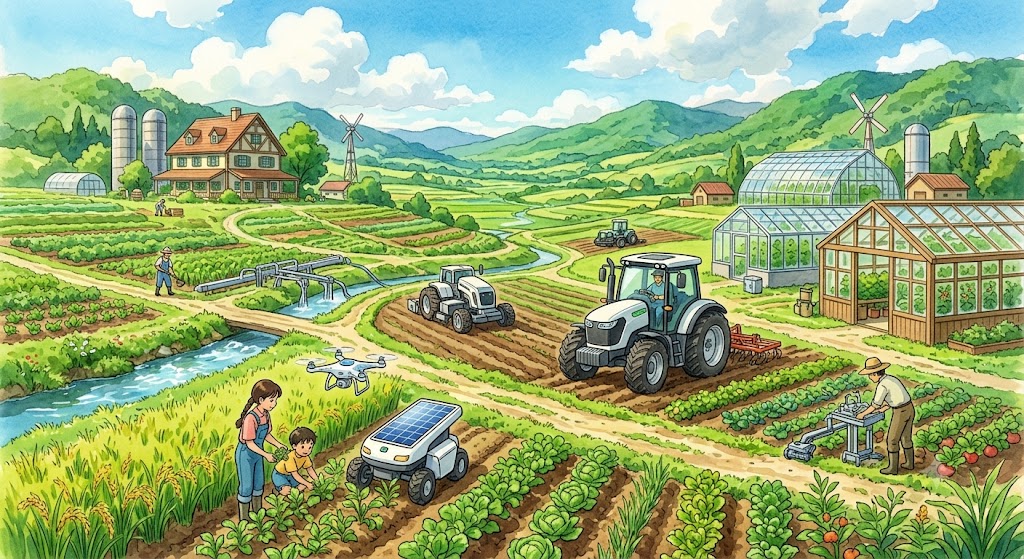
Agriculture has undergone remarkable transformations over the past few decades. As the global population continues to grow and the demand for food increases, farmers face mounting pressure to produce more crops using fewer resources. At the same time, challenges such as climate change, labor shortages, water scarcity, soil degradation, and rising production costs are reshaping the agricultural landscape.
To address these challenges, modern agriculture is embracing innovative technologies and farming practices that improve efficiency, sustainability, and productivity. From precision farming systems and smart irrigation to advanced crop genetics and artificial intelligence, agricultural innovation is helping farmers optimize production while protecting natural resources.
These advancements are not only increasing yields but also transforming how crops are grown, monitored, managed, and harvested.
The Growing Need for Agricultural Innovation
Global agriculture must meet several critical challenges:
- Increasing food demand
- Limited arable land
- Climate variability
- Water shortages
- Rising input costs
- Environmental concerns
- Labor constraints
Traditional farming methods alone may not be sufficient to address these issues.
Agricultural innovations provide farmers with new tools and strategies to improve productivity while maintaining long-term sustainability.
Precision Agriculture: Farming with Data
Precision agriculture is one of the most significant developments in modern crop production.
This approach uses technology to collect and analyze data that supports better decision-making.
Key tools include:
- GPS technology
- Geographic Information Systems (GIS)
- Field sensors
- Yield monitors
- Variable-rate application systems
Benefits include:
- More efficient fertilizer use
- Improved irrigation management
- Reduced input waste
- Increased crop yields
- Better resource allocation
By applying resources only where needed, farmers can reduce costs while improving productivity.
Smart Irrigation Systems
Water management is becoming increasingly important as water resources become more limited.
Smart irrigation technologies help farmers optimize water use.
Examples include:
- Drip irrigation
- Soil moisture sensors
- Automated irrigation controllers
- Weather-based irrigation scheduling
Benefits include:
- Reduced water waste
- Improved crop growth
- Lower energy costs
- Better drought resilience
Efficient irrigation systems contribute significantly to sustainable crop production.
Drones in Agriculture
Agricultural drones are rapidly becoming valuable tools for modern farmers.
Drones can perform tasks such as:
- Crop monitoring
- Field mapping
- Plant health assessment
- Pest detection
- Irrigation analysis
High-resolution aerial imagery allows farmers to identify problems early and take corrective action before significant losses occur.
Drone technology improves efficiency while reducing labor requirements.
Artificial Intelligence and Machine Learning
Artificial Intelligence (AI) is transforming agriculture through advanced data analysis and predictive capabilities.
AI-powered systems can help farmers:
- Predict pest outbreaks
- Forecast weather impacts
- Optimize planting schedules
- Analyze crop health
- Improve yield predictions
Machine learning algorithms continuously improve as they process larger datasets, allowing for increasingly accurate recommendations.
AI supports smarter and more efficient farm management decisions.
Advanced Crop Breeding Technologies
Crop breeding has advanced significantly in recent years.
Modern breeding techniques focus on developing varieties that offer:
- Higher yields
- Disease resistance
- Drought tolerance
- Improved nutritional value
- Better climate adaptability
Advanced genetics allow farmers to grow crops that perform more reliably under challenging environmental conditions.
Improved crop varieties contribute directly to increased agricultural productivity.
Controlled Environment Agriculture
Controlled Environment Agriculture (CEA) allows farmers to manage growing conditions with greater precision.
Examples include:
- Greenhouses
- Vertical farms
- Indoor growing facilities
- Hydroponic systems
Benefits include:
- Year-round production
- Reduced weather dependence
- Improved resource efficiency
- Higher productivity per unit area
Controlled environments are particularly valuable in urban areas and regions with challenging climates.
Hydroponics and Soilless Farming
Hydroponic systems allow crops to grow without traditional soil.
Plants receive nutrients through carefully managed water solutions.
Advantages include:
- Reduced water usage
- Faster plant growth
- Efficient nutrient management
- Reduced land requirements
- Lower weed pressure
Hydroponic farming is becoming increasingly popular for high-value crops and urban agriculture.
Agricultural Robotics
Robotic technologies are helping farmers address labor shortages while improving efficiency.
Agricultural robots can assist with:
- Planting
- Weeding
- Harvesting
- Crop monitoring
- Sorting produce
Automation reduces labor demands and improves operational consistency.
As technology advances, robotic systems are expected to play an even greater role in agriculture.
Internet of Things (IoT) in Farming
The Internet of Things (IoT) connects farm equipment, sensors, and management systems through digital networks.
IoT devices can monitor:
- Soil moisture
- Temperature
- Humidity
- Nutrient levels
- Equipment performance
Real-time data helps farmers make informed decisions and respond quickly to changing conditions.
Connected farming systems improve efficiency and productivity across agricultural operations.
Sustainable Pest Management Innovations
Modern pest management is increasingly focused on environmentally responsible solutions.
Innovative approaches include:
- Biological controls
- Precision pesticide application
- Smart pest monitoring systems
- Beneficial insect conservation
These methods reduce chemical use while maintaining effective pest control.
Sustainable pest management supports both crop health and environmental protection.
Climate-Smart Agriculture
Climate-smart agriculture focuses on helping farmers adapt to changing environmental conditions.
Key practices include:
- Drought-resistant crops
- Improved water management
- Soil conservation techniques
- Agroforestry systems
- Weather forecasting tools
These innovations improve farm resilience while supporting long-term sustainability.
Climate-smart agriculture is becoming increasingly important in regions experiencing climate-related challenges.
Big Data and Farm Analytics
Agriculture now generates vast amounts of data.
Modern analytics platforms help farmers interpret information from:
- Weather stations
- Satellite imagery
- Soil sensors
- Machinery
- Crop monitoring systems
Benefits include:
- Improved decision-making
- Better yield forecasting
- Reduced production risks
- Enhanced profitability
Data-driven agriculture allows farmers to optimize nearly every aspect of crop production.
Renewable Energy Integration
Many farms are adopting renewable energy technologies to reduce operating costs and improve sustainability.
Examples include:
- Solar-powered irrigation systems
- Wind energy installations
- Bioenergy production
- Solar greenhouses
Renewable energy solutions reduce dependence on fossil fuels while lowering long-term expenses.
Digital Farm Management Platforms
Modern software platforms help farmers manage complex agricultural operations.
These systems can track:
- Planting schedules
- Input applications
- Crop performance
- Financial records
- Equipment maintenance
Digital management tools improve efficiency and support more informed decision-making.
Benefits of Agricultural Innovation
Agricultural innovations provide numerous advantages:
- Higher productivity
- Improved resource efficiency
- Reduced environmental impact
- Better risk management
- Enhanced profitability
- Increased sustainability
- Greater climate resilience
These benefits help farmers remain competitive while addressing modern agricultural challenges.
The Future of Crop Production
Future agricultural innovations are expected to focus on:
- Greater automation
- Improved artificial intelligence systems
- Advanced biotechnology
- Enhanced sustainability
- Climate adaptation solutions
- Resource-efficient production systems
As technology continues to evolve, crop production will become increasingly precise, efficient, and environmentally responsible.
Conclusion
Agricultural innovations are fundamentally reshaping modern crop production by providing farmers with powerful tools to increase productivity, improve sustainability, and manage resources more effectively. Technologies such as precision agriculture, smart irrigation, drones, artificial intelligence, advanced breeding techniques, and digital farm management systems are transforming how crops are grown and managed.
Farmers who embrace innovation are better positioned to overcome modern agricultural challenges while achieving stronger yields, lower production costs, and long-term profitability. As global food demand continues to rise, agricultural innovation will remain a driving force behind the future of sustainable crop production.