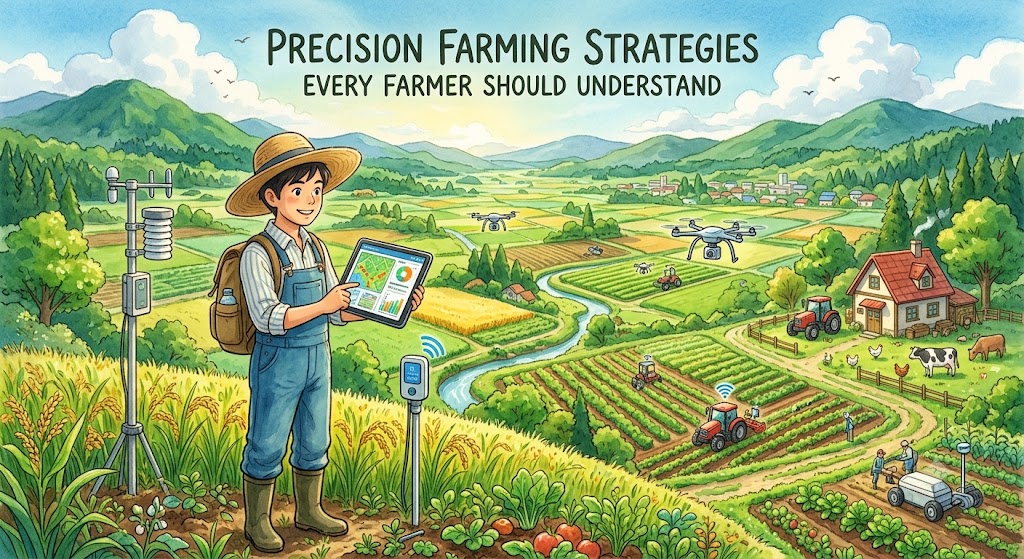
Agriculture has always been about making the best possible use of available resources. However, today’s farming environment is far more challenging than it was a decade ago. Rising production costs, climate uncertainty, limited water supplies, labor shortages, and increasing food demand have forced farmers to rethink traditional farming methods.
This is where precision farming has become one of the most valuable approaches in modern agriculture.
Precision farming focuses on managing every part of a field according to its specific needs rather than treating an entire farm the same way. Since no two sections of land are identical, applying equal amounts of water, fertilizers, or pesticides across an entire field often leads to unnecessary waste and lower efficiency.
By using accurate information, modern equipment, and better management practices, farmers can increase productivity while reducing operating costs and protecting natural resources.
What Makes Precision Farming Different?
Traditional farming often follows a uniform management system where every part of a field receives the same treatment.
Precision farming takes a completely different approach.
Instead of asking, “What does the whole farm need?”, it asks:
- Which area needs more water?
- Which section lacks nutrients?
- Where are pests beginning to spread?
- Which plants are growing slower?
- Where can input costs be reduced?
Answering these questions allows farmers to make smarter decisions based on actual field conditions.
Strategy 1: Know Your Soil Before Planting
Healthy crops always begin with healthy soil.
One of the first principles of precision farming is understanding soil variability across the field.
Regular soil testing helps identify:
- Soil pH
- Organic matter content
- Nutrient availability
- Moisture-holding capacity
- Soil texture
Instead of applying fertilizer uniformly, farmers can match nutrients to each area’s actual requirements.
This improves efficiency while reducing unnecessary expenses.
Strategy 2: Divide Fields Into Management Zones
Large fields rarely perform equally.
Some areas produce excellent yields while others consistently underperform.
Creating management zones allows farmers to divide land based on characteristics such as:
- Soil type
- Drainage
- Elevation
- Crop history
- Moisture levels
Each zone can then receive customized management rather than identical treatment.
Strategy 3: Use Accurate Crop Monitoring
Successful farming depends on identifying problems early.
Modern crop monitoring combines field inspections with digital technologies such as:
- Satellite imagery
- Drone photography
- GPS mapping
- Mobile farming applications
- Remote sensing
Early detection allows farmers to respond before small problems become expensive losses.
Strategy 4: Apply Water Precisely
Water is becoming one of agriculture’s most valuable resources.
Precision irrigation focuses on applying the right amount of water at the right time.
Common methods include:
- Drip irrigation
- Soil moisture monitoring
- Automated irrigation scheduling
- Weather-based irrigation planning
Efficient irrigation improves crop health while reducing water consumption and energy costs.
Strategy 5: Optimize Fertilizer Application
Excess fertilizer increases production costs and may damage the environment.
Precision nutrient management recommends applying fertilizers according to:
- Soil analysis
- Crop growth stage
- Nutrient demand
- Field variability
Many modern spreaders automatically adjust fertilizer rates as they move across different areas of a field.
Strategy 6: Monitor Pests Before They Spread
Waiting until pests become visible often results in greater crop damage.
Precision farming encourages continuous field monitoring.
Farmers should observe:
- Leaf damage
- Insect activity
- Disease symptoms
- Weather conditions
- Humidity levels
Early intervention usually requires fewer pesticides while providing better crop protection.
Strategy 7: Keep Digital Farm Records
Accurate records help farmers improve every growing season.
Important information to record includes:
- Planting dates
- Fertilizer applications
- Irrigation schedules
- Pest control activities
- Weather events
- Harvest yields
- Production expenses
Digital records make future planning much easier and support better business decisions.
Strategy 8: Reduce Input Waste
Every unnecessary application increases production costs.
Precision farming helps reduce waste by improving the efficiency of:
✔ Seeds
✔ Water
✔ Fertilizers
✔ Fuel
✔ Labor
✔ Crop protection products
Using fewer resources while maintaining strong yields increases profitability.
Strategy 9: Combine Technology With Farmer Experience
Technology provides valuable information, but experience remains equally important.
The best farming decisions combine:
- Local knowledge
- Field observations
- Historical production records
- Weather forecasts
- Digital monitoring systems
Technology should support farmers—not replace them.
Strategy 10: Continuously Evaluate Results
Precision farming is an ongoing improvement process.
After every harvest, farmers should evaluate:
- Yield performance
- Input efficiency
- Water use
- Fertilizer response
- Profitability
- Areas needing improvement
Continuous evaluation helps farms become more productive year after year.
Essential Tools Supporting Precision Farming
Modern precision farming uses a combination of technologies that improve management accuracy.
These include:
| Technology | Main Purpose |
|---|---|
| GPS Systems | Accurate field navigation |
| Drones | Crop monitoring |
| Soil Sensors | Moisture and nutrient measurement |
| Satellite Images | Large-scale field observation |
| Mobile Apps | Farm management |
| Smart Irrigation | Efficient water application |
| Yield Monitors | Harvest performance analysis |
Farmers do not need every tool immediately. Many begin with one or two technologies and expand gradually.
Benefits That Farmers Notice
Precision farming improves both productivity and resource management.
Many farms experience:
- Higher crop yields
- Better product quality
- Reduced fertilizer expenses
- Improved irrigation efficiency
- Lower fuel consumption
- Faster decision-making
- Better environmental protection
- Increased profitability
These improvements often become more significant over multiple growing seasons.
Common Misconceptions About Precision Farming
Some farmers hesitate to adopt precision farming because of common myths.
“It’s Only for Large Farms”
Many precision farming practices, such as soil testing, moisture monitoring, and digital record keeping, are affordable for farms of every size.
“Technology Is Too Complicated”
Modern farming tools are becoming easier to use, with smartphone apps and user-friendly software simplifying daily operations.
“Traditional Experience Is No Longer Needed”
Farmer knowledge remains essential. Precision farming enhances experience by providing more accurate information.
Practical Tips for Getting Started
If you’re interested in precision farming, begin with manageable improvements.
Consider these steps:
- Test your soil before each planting season.
- Monitor soil moisture regularly.
- Record field activities digitally.
- Improve irrigation efficiency.
- Observe crops consistently.
- Use GPS mapping if available.
- Review harvest performance every season.
Small changes often produce significant long-term benefits.
Final Thoughts
Precision farming is transforming agriculture by helping farmers make smarter decisions based on accurate information rather than assumptions. By understanding soil conditions, monitoring crops closely, managing water efficiently, optimizing fertilizer use, and reducing unnecessary waste, farmers can increase productivity while lowering production costs.
As agricultural technology continues to advance, precision farming will become an even more important part of sustainable food production. Farmers who begin adopting these strategies today will be better prepared to meet future challenges, improve profitability, and protect the natural resources that agriculture depends on.
Frequently Asked Questions
1. What is precision farming?
Precision farming is a management approach that uses data, technology, and careful planning to apply resources only where and when they are needed.
2. Does precision farming increase crop yields?
Yes. Better management of water, nutrients, and crop health often leads to higher yields and improved product quality.
3. Is precision farming expensive?
Some technologies require investment, but many practices such as soil testing, crop monitoring, and record keeping are affordable and provide long-term savings.
4. Can small farmers use precision farming techniques?
Absolutely. Small farms can gradually adopt precision farming practices without purchasing expensive equipment all at once.
5. Why is precision farming important for sustainable agriculture?
Precision farming reduces waste, conserves natural resources, lowers production costs, and helps farmers produce more food while minimizing environmental impact.