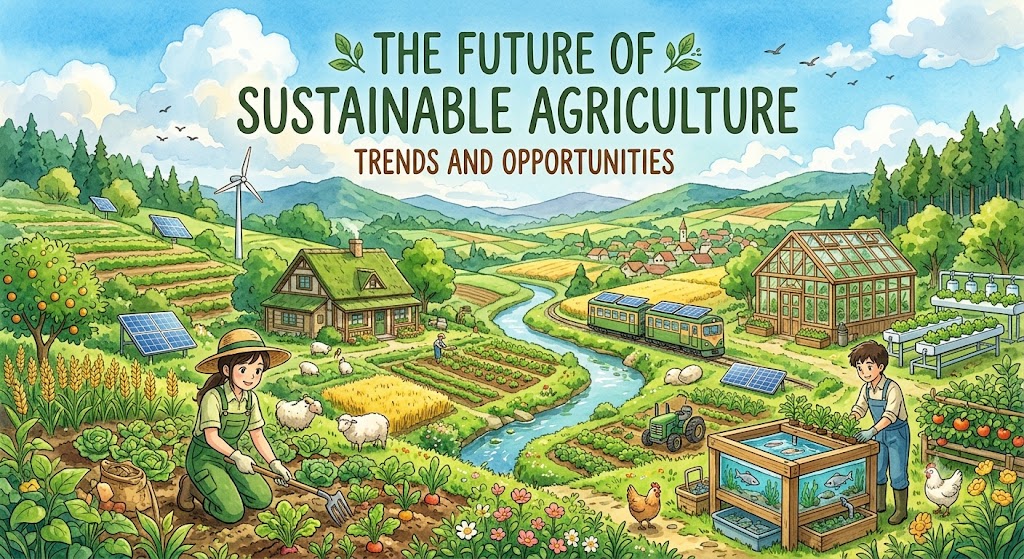
The future of agriculture will not be defined only by how much food farmers produce—it will be measured by how responsibly that food is grown. Across the world, agriculture is entering a new phase where productivity, environmental protection, and economic sustainability must work together instead of competing with one another.
Farmers today face a very different reality than previous generations. Climate change is affecting rainfall patterns, fertile land is becoming more limited, water resources are under increasing pressure, and production costs continue to rise. At the same time, consumers are demanding healthier food, governments are encouraging environmentally friendly farming, and global markets are placing greater importance on sustainable production.
These changes are creating both challenges and opportunities. Farmers who understand the future direction of agriculture will be better prepared to improve productivity, reduce costs, and build stronger farming businesses.
Sustainable agriculture is no longer simply an environmental concept—it has become one of the smartest long-term business strategies for modern farming.
A New Generation of Farming Is Emerging
For many years, agricultural success was measured mainly by total production. Today, success also depends on how efficiently resources are used and how well farms can continue producing healthy crops without damaging the environment.
Modern farming is gradually shifting toward systems that focus on:
- Improving soil health
- Conserving water
- Protecting biodiversity
- Reducing chemical dependency
- Increasing resource efficiency
- Lowering carbon emissions
This transformation is changing the way farms are managed across every continent.
Technology Will Continue Driving Sustainable Growth
One of the biggest forces shaping future agriculture is technological innovation.
Digital tools are helping farmers make decisions based on accurate information instead of assumptions. Sensors, satellite imagery, artificial intelligence, farm management software, drones, and automated equipment are making farming more precise than ever before.
Rather than increasing production by using more resources, technology allows farmers to achieve better results with smarter management.
Some of the fastest-growing technologies include:
- Artificial Intelligence
- Precision farming systems
- Smart irrigation
- Agricultural drones
- Internet of Things (IoT) sensors
- Autonomous machinery
- Satellite crop monitoring
As these technologies become more affordable, they will become accessible to farms of all sizes.
Soil Health Will Become the Top Priority
Healthy soil is the foundation of sustainable agriculture.
Instead of relying heavily on synthetic fertilizers, future farming will place greater emphasis on rebuilding soil naturally through practices that improve long-term fertility.
Farmers are increasingly adopting:
- Compost application
- Cover cropping
- Crop rotation
- Reduced tillage
- Organic matter management
- Green manure
These practices not only improve crop performance but also strengthen the soil’s ability to store water and nutrients.
Water Management Will Define Farm Success
Water availability is becoming one of agriculture’s greatest concerns.
Future farming systems will focus on using every drop as efficiently as possible.
Important developments include:
✔ Smart irrigation systems
✔ Soil moisture monitoring
✔ Rainwater harvesting
✔ Drip irrigation technology
✔ Weather-based irrigation scheduling
Efficient water management reduces production costs while helping farms remain productive during periods of drought.
Climate-Resilient Farming Will Expand
Changing weather patterns require crops and farming systems that can adapt to environmental uncertainty.
Farmers are increasingly investing in:
- Drought-tolerant crop varieties
- Flood-resistant farming methods
- Heat-resistant crops
- Diversified cropping systems
- Agroforestry
- Conservation agriculture
These strategies improve resilience while reducing financial risk.
Consumers Are Influencing Agricultural Change
Modern consumers care about more than price.
Many buyers now consider:
- Food safety
- Environmental impact
- Organic production
- Animal welfare
- Sustainable packaging
- Product traceability
This shift is encouraging farmers to adopt practices that improve both product quality and environmental responsibility.
Sustainability has become a valuable market advantage.
Diversification Creates New Opportunities
Depending on a single crop increases financial risk.
Future farms are expected to become more diversified by combining multiple agricultural enterprises.
Examples include:
- Crop farming
- Livestock production
- Beekeeping
- Mushroom cultivation
- Aquaculture
- Medicinal plants
- Agro-tourism
Diversification creates multiple income streams while improving overall farm resilience.
Carbon Farming Is Becoming an Income Opportunity
Agriculture is beginning to play an important role in reducing greenhouse gas emissions.
Many governments and organizations are encouraging farming practices that capture carbon within the soil.
Examples include:
- Planting cover crops
- Increasing organic matter
- Reduced tillage
- Tree planting
- Improved pasture management
In some regions, farmers may even earn additional income through carbon credit programs while improving soil quality.
Digital Agriculture Will Improve Farm Management
Managing a farm is becoming increasingly data-driven.
Modern software platforms help farmers organize:
- Crop planning
- Equipment maintenance
- Irrigation schedules
- Fertilizer applications
- Production costs
- Harvest records
Better information leads to better financial decisions and improved long-term profitability.
Challenges That Must Still Be Addressed
Although sustainable agriculture offers tremendous opportunities, several obstacles remain.
Some of the biggest challenges include:
| Challenge | Possible Solution |
|---|---|
| High technology costs | Gradual adoption and government support |
| Limited technical knowledge | Farmer education and training |
| Climate uncertainty | Climate-smart farming practices |
| Water shortages | Efficient irrigation systems |
| Soil degradation | Regenerative farming methods |
| Market access | Better supply chains and digital marketing |
Overcoming these challenges requires cooperation between farmers, researchers, governments, and agricultural organizations.
Why Young Farmers Have a Unique Opportunity
The next generation of farmers is entering agriculture during one of the most innovative periods in history.
Young farmers often adapt quickly to:
- Digital technologies
- Precision farming
- Sustainable production
- Online marketing
- Data-driven management
Their willingness to adopt new ideas will play an important role in shaping the future of global agriculture.
Building a Farm for the Next Decade
Preparing for the future does not require making expensive investments immediately.
Farmers can begin with practical improvements such as:
- Protecting soil health.
- Conserving water.
- Diversifying crop production.
- Keeping accurate farm records.
- Reducing unnecessary chemical use.
- Exploring affordable technology.
- Continuing agricultural education.
Small improvements made consistently often produce the greatest long-term results.
Final Thoughts
The future of sustainable agriculture is filled with opportunity for farmers who are willing to adapt and innovate. Advances in technology, better soil management, efficient water use, climate-resilient farming, and diversified agricultural systems are creating a more productive and environmentally responsible future.
Sustainable agriculture is not about producing less—it is about producing smarter. Farms that invest in healthy soil, efficient resource management, modern technology, and continuous learning will be better positioned to meet growing food demand while protecting the natural resources that future generations depend upon.
As agriculture continues to evolve, sustainability will become not just an environmental responsibility but one of the strongest foundations for long-term farming success.
Frequently Asked Questions
1. What is sustainable agriculture?
Sustainable agriculture is a farming approach that meets current food needs while protecting soil, water, biodiversity, and natural resources for future generations.
2. Why is sustainable farming becoming more important?
It helps farmers improve productivity, reduce environmental impact, conserve resources, and adapt to climate change.
3. What technologies support sustainable agriculture?
Artificial Intelligence, IoT sensors, drones, smart irrigation systems, GPS technology, and farm management software all contribute to sustainable farming.
4. Can sustainable farming increase farm income?
Yes. Better resource efficiency, healthier soils, reduced production costs, diversified income sources, and access to premium markets can improve long-term profitability.
5. What is the biggest opportunity in the future of agriculture?
Combining sustainable farming practices with modern technology offers one of the greatest opportunities to increase food production while protecting the environment and ensuring long-term farm success.