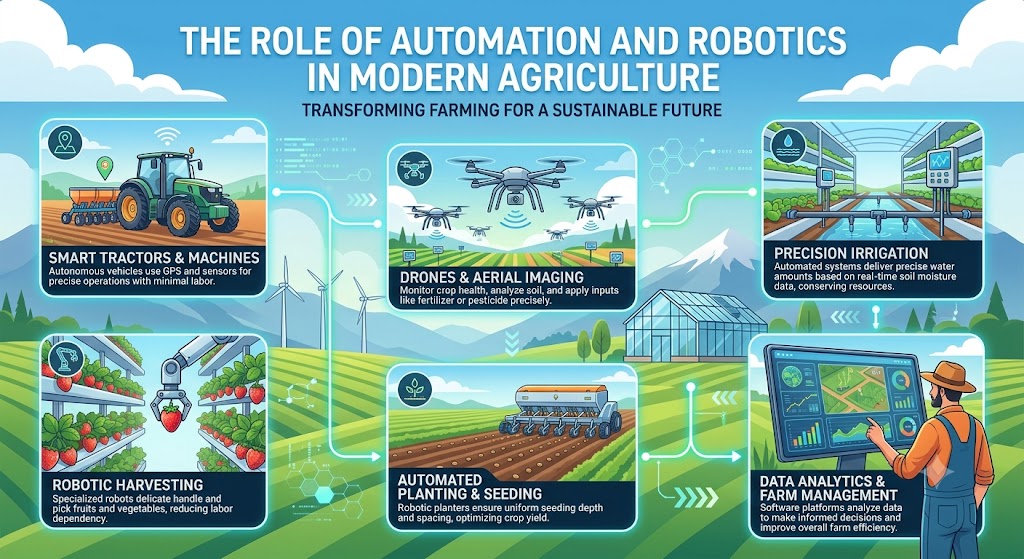
Imagine a farm where tractors drive themselves, robots carefully harvest ripe strawberries without damaging the fruit, drones inspect hundreds of acres in just a few minutes, and irrigation systems automatically provide the exact amount of water crops need. Just a decade ago, this sounded like science fiction. Today, it is becoming a reality on farms across the world.
Modern agriculture is evolving at an incredible pace. Farmers are expected to produce more food than ever before while facing rising labor costs, unpredictable weather, shrinking farmland, and increasing pressure to use resources responsibly. Meeting these challenges with traditional farming methods alone is becoming more difficult every year.
This is where automation and robotics are transforming agriculture. These technologies are helping farmers complete repetitive tasks with greater speed, accuracy, and efficiency while reducing waste and improving overall productivity. Instead of replacing farmers, automation acts as a powerful partner that supports better decision-making and more sustainable farming practices.
Why Agriculture Needs Automation
Agriculture has always depended heavily on manual labor. Planting seeds, watering crops, spraying fields, harvesting produce, and monitoring plant health require significant time and effort. As labor shortages continue to affect many agricultural regions, completing these tasks efficiently has become increasingly challenging.
Automation addresses these issues by allowing machines and smart systems to perform routine work with minimal human intervention.
Some of the biggest challenges farmers face today include:
- Rising labor costs
- Difficulty finding skilled workers
- Increasing production expenses
- Climate uncertainty
- Pressure to produce higher yields
- Limited availability of water and other natural resources
Modern automation helps farmers respond to these challenges more effectively.
What Is Agricultural Automation?
Agricultural automation refers to the use of advanced machines, digital systems, sensors, software, and robotics to perform farming activities automatically or with very little human supervision.
Instead of depending entirely on manual labor, farmers can use technology to improve accuracy, reduce workload, and make better management decisions.
Automation is now being used in almost every stage of crop production, from land preparation to post-harvest management.
How Robotics Is Changing Modern Farming
Robotics has become one of the most exciting developments in agriculture. Unlike traditional machines that perform only one task, agricultural robots are designed to recognize plants, analyze field conditions, and complete highly precise operations.
Many robots use cameras, artificial intelligence, GPS technology, and sensors to make real-time decisions while working in the field.
This combination allows them to perform tasks with remarkable consistency and efficiency.
Autonomous Tractors Are Increasing Productivity
Modern tractors no longer require continuous human steering.
Using GPS guidance systems and onboard computers, autonomous tractors can:
- Prepare fields
- Plant seeds
- Apply fertilizers
- Spray crops
- Perform tillage operations
These machines follow highly accurate routes, reducing overlaps and minimizing wasted fuel, seed, and fertilizer.
Farmers can also monitor operations remotely, making field management much more efficient.
Robotic Harvesting Systems
Harvesting fruits and vegetables often requires large numbers of seasonal workers.
Today, robotic harvesters are helping solve this challenge.
Equipped with cameras and intelligent sensors, these machines can identify ripe produce and harvest it carefully without damaging nearby plants.
Robotic harvesting is increasingly used for crops such as:
- Tomatoes
- Strawberries
- Apples
- Lettuce
- Cucumbers
- Bell peppers
As robotic technology continues improving, harvesting efficiency is expected to increase even further.
Smart Weed Control
Traditional weed management often involves applying herbicides across entire fields.
Robotic weed control offers a far more precise approach.
Modern systems can distinguish crops from weeds using computer vision and artificial intelligence.
Once identified, weeds can be:
- Removed mechanically
- Destroyed using lasers
- Sprayed individually
- Eliminated through precision cultivation
This reduces chemical use while protecting surrounding crops.
Automated Irrigation Systems
Water management is becoming one of agriculture’s greatest challenges.
Automated irrigation systems combine soil moisture sensors, weather forecasts, and programmable controllers to deliver water only when crops actually need it.
Benefits include:
✔ Lower water consumption
✔ Healthier plant growth
✔ Reduced energy costs
✔ Better drought management
✔ Improved irrigation efficiency
These systems help farmers conserve one of their most valuable natural resources.
Drones Working Alongside Robots
Although drones are not ground robots, they play an important role in agricultural automation.
They quickly collect valuable information by capturing detailed aerial images of fields.
Farmers use drones to:
- Monitor crop health
- Detect pest infestations
- Identify nutrient deficiencies
- Assess irrigation performance
- Measure plant growth
- Create digital field maps
The information gathered allows robotic equipment to perform field operations more accurately.
Artificial Intelligence Makes Robots Smarter
Modern agricultural robots rely heavily on Artificial Intelligence (AI).
AI enables machines to learn from collected data and improve their performance over time.
Examples include:
- Recognizing ripe fruit
- Identifying plant diseases
- Detecting weeds
- Predicting crop stress
- Optimizing machinery routes
Instead of following fixed instructions, AI-powered machines adapt to changing field conditions.
Advantages of Automation and Robotics
Farmers adopting automated systems often experience improvements across many areas of their operations.
Key Benefits
- Higher labor efficiency
- Reduced operating costs
- Greater planting accuracy
- Better crop monitoring
- Lower chemical usage
- Improved water management
- Faster harvesting
- Increased productivity
- Better product quality
- More consistent farm operations
These benefits become even more valuable as farms expand.
Challenges That Still Exist
Despite rapid progress, agricultural automation is not without limitations.
Some challenges include:
| Challenge | Possible Solution |
|---|---|
| High equipment costs | Gradual investment or equipment sharing |
| Technical knowledge | Farmer training programs |
| Internet connectivity | Offline-compatible systems |
| Equipment maintenance | Regular servicing and software updates |
| Initial learning curve | Professional guidance and demonstrations |
As technology becomes more affordable, many of these barriers are expected to decrease.
Small Farms Can Benefit Too
Automation is no longer limited to large commercial farms.
Many affordable technologies are now available for small and medium-sized farms, including:
- Automatic drip irrigation timers
- Portable weather stations
- Smartphone farm management apps
- Small robotic weeders
- Drone service providers
- GPS guidance systems
Farmers can gradually introduce automation based on their budget and production needs.
What the Future Looks Like
Agricultural automation is expected to advance rapidly over the next decade.
Future developments may include:
- Fully autonomous farm machinery
- Swarms of cooperative field robots
- AI-powered harvest planning
- Self-monitoring irrigation systems
- Autonomous greenhouses
- Robots capable of planting, maintaining, and harvesting entire crops
These innovations will allow farmers to produce more food while using fewer natural resources and reducing environmental impact.
Final Thoughts
Automation and robotics are reshaping modern agriculture by making farming more efficient, productive, and sustainable. From autonomous tractors and robotic harvesters to AI-powered monitoring systems and automated irrigation, these technologies are helping farmers overcome labor shortages, reduce costs, and improve crop quality.
While traditional farming knowledge remains invaluable, combining it with modern automation creates stronger and more resilient agricultural systems. As technology continues to become more accessible and affordable, farms of all sizes will have the opportunity to benefit from smarter, more precise, and environmentally responsible farming practices.
Frequently Asked Questions
1. What is agricultural automation?
Agricultural automation is the use of machines, software, sensors, and robotics to perform farming tasks with little or no human intervention.
2. How do robots help farmers?
Robots assist with planting, harvesting, weed control, spraying, monitoring crops, and other repetitive tasks while improving accuracy and efficiency.
3. Are robotic farming systems only suitable for large farms?
No. Many automation tools, such as smart irrigation systems, GPS guidance, and drone services, are affordable for small and medium-sized farms.
4. Does automation replace farm workers?
Automation mainly reduces repetitive and labor-intensive work while allowing farmers to focus on management, planning, and decision-making.
5. Why is automation important for the future of agriculture?
Automation improves productivity, conserves resources, addresses labor shortages, reduces waste, and supports sustainable food production for a growing global population.