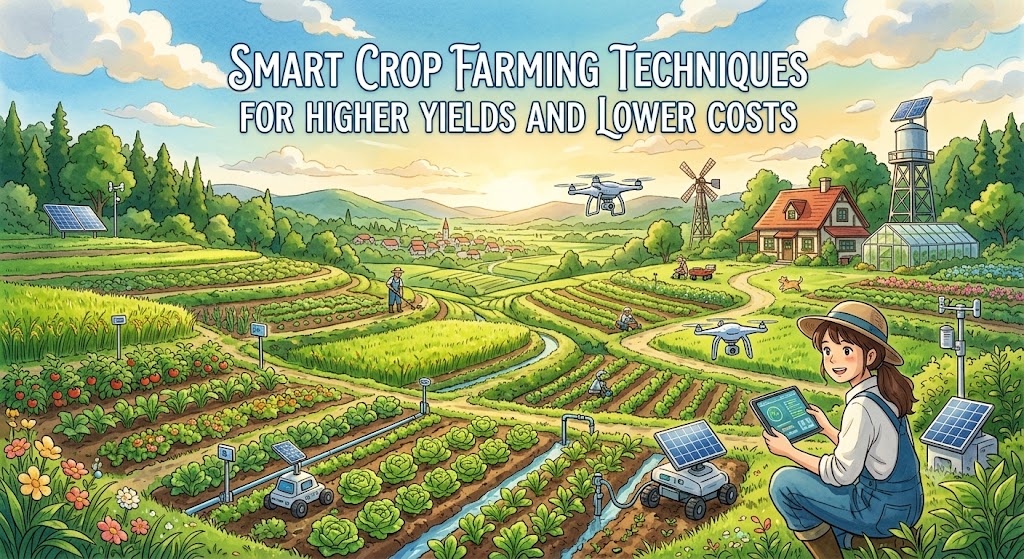
Farming has always been about balancing two important goals: producing higher yields and keeping production costs under control. In recent years, achieving both has become more challenging due to rising input prices, unpredictable weather, labor shortages, and increasing pressure to farm sustainably. Fortunately, modern farming practices are helping growers overcome these challenges through smarter crop management.
Smart crop farming is not limited to expensive technology or large commercial farms. It is a practical approach that combines better planning, efficient resource management, improved cultivation methods, and modern tools to maximize productivity while minimizing unnecessary expenses.
Whether growing cereals, vegetables, fruits, or cash crops, adopting smart farming techniques can improve crop performance, increase profitability, and protect natural resources for future generations.
The Foundation of Smart Farming
Every successful harvest begins long before seeds are planted. Smart farming focuses on making informed decisions at every stage of crop production instead of relying on routine practices.
This approach emphasizes:
- Careful planning
- Efficient resource use
- Continuous field monitoring
- Timely interventions
- Sustainable production methods
When these principles are applied consistently, farms become more productive and resilient.
Start With Healthy Soil
Healthy crops cannot grow without healthy soil.
Before investing in seeds or fertilizers, farmers should understand the condition of their soil through regular testing.
Soil analysis helps determine:
- Nutrient availability
- Soil pH
- Organic matter levels
- Moisture-holding capacity
- Potential deficiencies
Knowing these details prevents unnecessary fertilizer use and supports stronger plant growth.
Choose High-Quality Seeds
Seed quality directly affects crop performance.
Certified, disease-resistant, and climate-adapted varieties usually produce better germination, healthier plants, and higher yields.
When selecting seeds, consider:
✔ Local climate
✔ Disease resistance
✔ Yield potential
✔ Market demand
✔ Growing season
Quality planting material often provides one of the highest returns on investment.
Apply Water More Efficiently
Water is becoming one of agriculture’s most valuable resources.
Instead of watering fields on a fixed schedule, smart farming recommends irrigating according to crop needs and soil moisture conditions.
Efficient irrigation methods include:
- Drip irrigation
- Sprinkler systems
- Soil moisture sensors
- Rainwater harvesting
- Scheduled watering based on weather forecasts
Efficient water use reduces both operating costs and environmental impact.
Feed Crops According to Their Needs
Applying excessive fertilizer does not always increase yields.
Smart nutrient management focuses on supplying crops with the right nutrients at the right time and in the right quantity.
Effective practices include:
- Soil testing before application
- Split fertilizer applications
- Compost incorporation
- Organic nutrient sources
- Balanced fertilization
This improves nutrient efficiency while lowering input costs.
Monitor Crops Regularly
Frequent field inspections help identify problems before they become serious.
Farmers should routinely check for:
- Pest activity
- Disease symptoms
- Nutrient deficiencies
- Weed growth
- Water stress
Early detection usually requires less expensive solutions than treating advanced problems.
Use Precision Farming Techniques
Modern precision farming allows farmers to manage different parts of a field individually instead of treating the entire farm the same way.
Common precision farming tools include:
- GPS guidance
- Field mapping
- Variable-rate fertilizer application
- Drone monitoring
- Digital crop records
These technologies reduce waste while improving productivity.
Practice Crop Rotation
Growing the same crop repeatedly depletes soil nutrients and encourages pest populations.
Rotating crops offers several advantages:
- Improved soil fertility
- Reduced disease pressure
- Better nutrient utilization
- Increased biodiversity
- Lower pesticide requirements
A well-planned crop rotation supports healthier fields over the long term.
Protect Soil With Mulch
Mulching is a simple but highly effective farming practice.
Organic mulch materials include:
- Straw
- Dry leaves
- Grass clippings
- Crop residues
Mulching helps:
✔ Reduce evaporation
✔ Control weeds
✔ Improve soil temperature
✔ Increase organic matter
✔ Prevent erosion
Healthy soil creates stronger crops.
Integrated Pest Management Saves Money
Rather than depending solely on chemical pesticides, integrated pest management combines several methods to control pests efficiently.
These methods include:
- Field monitoring
- Biological control
- Resistant crop varieties
- Crop rotation
- Targeted pesticide application
This balanced approach protects crops while reducing chemical expenses.
Mechanization Improves Efficiency
Appropriate farm machinery helps complete tasks faster and more accurately.
Useful equipment includes:
- Seed drills
- Mechanical weeders
- Fertilizer spreaders
- Precision sprayers
- Harvesting equipment
Even small farms can benefit from shared machinery or custom hiring services.
Keep Accurate Farm Records
Successful farmers treat agriculture as both a science and a business.
Maintaining detailed records allows farmers to evaluate performance and identify opportunities for improvement.
Important records include:
- Planting dates
- Fertilizer applications
- Irrigation schedules
- Pest control activities
- Production costs
- Harvest yields
Reliable data supports better planning every season.
Compare Traditional and Smart Farming
| Traditional Practice | Smart Farming Approach |
|---|---|
| Uniform fertilizer application | Nutrient application based on soil testing |
| Fixed irrigation schedules | Irrigation based on crop demand |
| Reactive pest control | Continuous monitoring and early action |
| Manual record keeping | Digital farm management |
| General field management | Precision field management |
Small improvements across multiple activities often produce significant overall gains.
Common Mistakes That Increase Costs
Many unnecessary farming expenses result from avoidable management mistakes.
Watch out for:
- Over-irrigation
- Excess fertilizer use
- Poor-quality seeds
- Delayed pest control
- Lack of soil testing
- Ignoring weather forecasts
- Inadequate crop planning
Correcting these issues can improve profitability without increasing production.
Building a Smarter Farm Over Time
Farm modernization does not happen overnight.
Farmers can gradually improve their operations by:
- Testing soil regularly.
- Improving irrigation efficiency.
- Using better-quality seeds.
- Introducing crop rotation.
- Keeping accurate farm records.
- Exploring precision farming tools.
- Investing in appropriate machinery when practical.
Continuous improvement usually produces better long-term results than making sudden large investments.
Final Thoughts
Smart crop farming is about making better decisions throughout every stage of crop production. By combining healthy soil management, efficient irrigation, balanced nutrition, precision farming, integrated pest management, and careful planning, farmers can increase yields while reducing production costs.
The future of successful agriculture depends not only on working harder but on working smarter. Farms that adopt practical innovations and sustainable farming practices are better prepared to meet growing food demand while protecting natural resources and maintaining long-term profitability.
Frequently Asked Questions
1. What is smart crop farming?
Smart crop farming uses improved management practices, modern technology, and data-based decisions to increase productivity while reducing costs and resource waste.
2. Can small farmers use smart farming techniques?
Yes. Many smart farming methods, such as soil testing, crop rotation, efficient irrigation, and proper record keeping, are affordable for farms of all sizes.
3. How does precision farming improve yields?
Precision farming helps farmers apply water, fertilizers, and pesticides only where needed, improving crop performance and reducing waste.
4. Which farming practice reduces production costs the most?
Efficient irrigation, balanced fertilizer use, quality seeds, and early pest management are among the most effective ways to reduce farming costs.
5. Is smart farming environmentally friendly?
Yes. Smart farming conserves water, reduces chemical use, improves soil health, lowers pollution, and supports sustainable agricultural production.