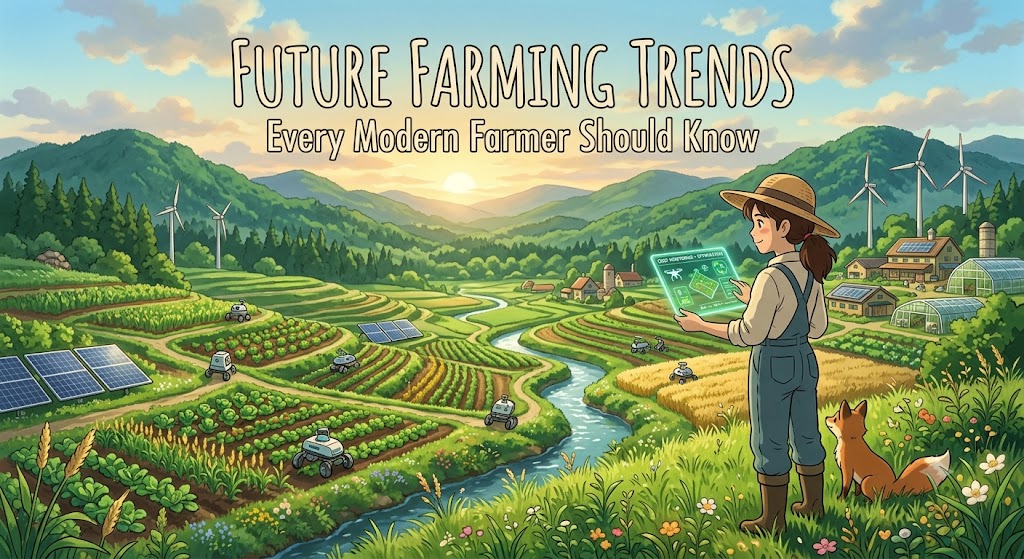
Agriculture is entering one of the most exciting periods in its history. Rapid technological advancements, changing consumer preferences, climate challenges, and the growing demand for food are transforming how farms operate around the world. Today’s farmers are no longer relying only on traditional methods. Instead, they are embracing innovative tools, sustainable practices, and data-driven decisions to increase productivity while protecting natural resources.
The future of farming is not just about producing more food—it is about producing it more efficiently, responsibly, and profitably. Farmers who understand emerging trends and adapt to new technologies will be better prepared to face market competition, climate uncertainty, and rising production costs.
This guide explores the major farming trends shaping the future of agriculture and explains how modern farmers can benefit from these changes.
Why Future Farming Is Changing So Quickly
Several global factors are driving agricultural innovation.
Some of the biggest challenges include:
- Population growth
- Climate change
- Water scarcity
- Labor shortages
- Rising input costs
- Declining soil fertility
- Increasing consumer demand for quality food
These challenges encourage the development of smarter, more efficient farming systems that maximize production while conserving resources.
Precision Agriculture Will Become Standard Practice
Precision agriculture is changing the way farms are managed by using accurate field data instead of applying the same treatment everywhere.
Farmers use precision farming to:
- Apply fertilizers only where needed
- Optimize irrigation
- Monitor crop growth
- Reduce production costs
- Improve yields
As technology becomes more affordable, precision farming will become common on farms of every size.
Artificial Intelligence Will Support Better Decisions
Artificial intelligence is expected to play a much larger role in agriculture over the coming years.
AI-powered systems can analyze:
- Weather forecasts
- Soil conditions
- Crop health
- Pest outbreaks
- Irrigation needs
- Yield predictions
Instead of replacing farmers, AI helps them make faster and more informed management decisions.
Smart Irrigation Will Save Water
Water shortages are becoming one of agriculture’s biggest concerns.
Future irrigation systems will increasingly rely on:
- Soil moisture sensors
- Weather data
- Automated irrigation scheduling
- Drip irrigation
- Mobile monitoring applications
These technologies reduce water waste while ensuring crops receive the right amount of moisture at the right time.
Drones Will Become Everyday Farming Tools
Agricultural drones are already helping farmers inspect crops quickly and accurately.
In the future, drones will perform even more tasks, including:
- Crop monitoring
- Disease detection
- Nutrient assessment
- Precision spraying
- Field mapping
- Plant counting
Regular aerial surveys help farmers detect problems before they reduce productivity.
Robotics Will Reduce Labor Challenges
Labor shortages continue to affect agriculture worldwide.
Modern agricultural robots are being developed to perform:
- Planting
- Harvesting
- Weeding
- Fruit picking
- Greenhouse management
- Crop monitoring
Automation improves efficiency while reducing dependence on seasonal labor.
Climate-Smart Farming Will Expand
Changing weather conditions require farming systems that are more resilient.
Climate-smart agriculture focuses on:
- Drought-resistant crop varieties
- Water conservation
- Soil protection
- Crop diversification
- Carbon-efficient farming
- Improved nutrient management
These practices help farms remain productive despite environmental uncertainty.
Soil Health Will Become a Top Priority
Future farming places increasing importance on healthy living soil rather than relying solely on chemical fertilizers.
Farmers are adopting practices such as:
- Compost application
- Cover cropping
- Crop rotation
- Reduced tillage
- Organic matter improvement
Healthy soil improves water retention, nutrient availability, and long-term productivity.
Digital Farm Management Will Continue Growing
Farm management software is becoming an essential business tool.
Modern digital platforms help farmers manage:
- Crop planning
- Financial records
- Irrigation schedules
- Machinery maintenance
- Input inventory
- Harvest planning
Organized records improve efficiency and simplify decision-making.
Renewable Energy Will Power More Farms
Rising fuel prices encourage greater use of renewable energy.
Future farms are expected to use:
- Solar-powered irrigation
- Wind energy
- Biogas systems
- Solar lighting
- Battery-powered equipment
Renewable energy lowers long-term operating costs while reducing environmental impact.
Controlled Environment Agriculture Will Expand
Growing crops inside controlled environments provides greater consistency.
Examples include:
- Greenhouses
- Hydroponic farms
- Vertical farms
- Indoor vegetable production
Advantages include:
- Year-round production
- Reduced weather risks
- Efficient water use
- Higher-quality produce
Controlled farming systems are expected to become increasingly important in urban areas.
Biological Crop Protection Will Increase
Future agriculture is moving toward environmentally friendly pest management.
Farmers are increasingly using:
- Beneficial insects
- Biological pesticides
- Natural predators
- Microbial products
- Integrated pest management
These methods reduce dependence on synthetic chemicals while protecting biodiversity.
Data-Driven Farming Will Improve Efficiency
Modern agriculture generates large amounts of valuable information.
Farmers now use data from:
- Weather stations
- Soil sensors
- Satellite imagery
- Drones
- Machinery
- Farm software
Analyzing this information helps improve planning and resource management.
Consumer Demand Will Influence Crop Choices
Modern consumers increasingly value:
- Organic food
- Sustainably produced crops
- Traceable food products
- Fresh local produce
- Chemical-free farming
Farmers who understand changing market preferences may discover new opportunities for premium products.
Diversification Will Become More Important
Future farming will rely less on single-crop systems.
Many successful farms will combine:
- Food crops
- High-value vegetables
- Fruit production
- Livestock
- Beekeeping
- Medicinal plants
- Agroforestry
Diversification reduces financial risk while improving ecosystem health.
Carbon-Friendly Agriculture Will Grow
Agriculture is expected to play a greater role in environmental conservation.
Farmers are adopting practices that store carbon naturally, including:
- Cover crops
- Conservation tillage
- Agroforestry
- Compost application
- Permanent ground cover
These practices improve soil health while contributing to climate resilience.
Continuous Learning Will Become Essential
Technology continues evolving rapidly.
Future farmers will benefit from:
- Agricultural training
- Online learning platforms
- Demonstration farms
- Research updates
- Digital advisory services
Successful farming increasingly depends on continuous education alongside practical experience.
Challenges Farmers Should Prepare For
While innovation creates opportunities, future farming also presents new challenges.
Farmers may need to address:
- Higher technology investments
- Equipment maintenance
- Digital skills
- Climate uncertainty
- Market competition
- Water management
Planning ahead helps farms remain competitive in changing conditions.
Building a Future-Ready Farm
Preparing for the future does not require adopting every new technology immediately.
Farmers can begin by:
- Improving soil health
- Conserving water
- Using quality seeds
- Monitoring crops regularly
- Keeping accurate records
- Testing new technologies gradually
- Diversifying production
Small improvements made consistently often produce the greatest long-term results.
Conclusion
The future of agriculture will be shaped by innovation, sustainability, and smarter resource management. Technologies such as precision farming, artificial intelligence, drones, robotics, digital farm management, and renewable energy are transforming the way food is produced. At the same time, practices that improve soil health, conserve water, encourage biodiversity, and reduce environmental impact are becoming essential for long-term success.
Modern farmers who remain open to learning, adopt practical innovations, and focus on sustainable production will be better positioned to meet future challenges and growing market demands. By combining traditional farming knowledge with emerging technologies, they can build resilient, productive, and profitable farming businesses for generations to come.
Frequently Asked Questions
1. What is the biggest future trend in agriculture?
Precision agriculture, supported by artificial intelligence and data-driven decision-making, is expected to become one of the most important trends in modern farming.
2. How will technology improve farming?
Technology helps farmers monitor crops more accurately, reduce waste, conserve water, optimize fertilizer use, improve pest management, and increase productivity.
3. Why is soil health becoming more important?
Healthy soil improves water retention, nutrient availability, biological activity, and long-term crop productivity while reducing dependence on synthetic inputs.
4. Can small farmers benefit from future farming technologies?
Yes. Affordable tools such as mobile farming apps, drip irrigation, improved seed varieties, soil testing, and weather forecasting services can significantly benefit small and medium-sized farms.
5. How can farmers prepare for the future?
Farmers should focus on improving soil health, conserving water, diversifying crops, learning new farming techniques, adopting suitable technologies, and staying informed about changing market trends.